This is a Pew Research Center report from the Pew-Knight Initiative, a research program funded jointly by The Pew Charitable Trusts and the John S. and James L. Knight Foundation. Find related reports online at https://www.pewresearch.org/pew-knight/.
National Cross-Sectional Surveys
Most of this report focuses on how often U.S. adults say they go to religious services, how often they pray, how important they say religion is in their lives, and whether they identify with a religion. The analysis is based on Pew Research Center’s National Public Opinion Reference Surveys (NPORS) (conducted annually from 2020 through 2026), the Center’s 2025 Cross-Sectional Engagement Survey, and the Center’s three Religious Landscape Studies (RLS) (conducted in 2007, 2014 and 2023-24).
All of the NPORS, the 2025 Cross-Sectional Engagement Survey and the 2023-24 RLS were conducted with similar methodologies, using address-based sampling and a multimode protocol. The sample for each survey was a national, stratified random sample drawn from the U.S. Postal Service Computerized Delivery Sequence File. Participants were first mailed an invitation to complete an online survey. A paper survey was later mailed to those who did not respond. Beginning in 2024, NPORS participants were also given the option of calling a toll-free number to take the survey over the phone with a live interviewer. The 2025 Cross-Sectional Engagement Survey and the 2023-24 RLS also offered respondents the option of participating by phone. Most respondents choose to participate online or on paper even when a telephone option is offered.
All of these surveys were conducted over several months, featured multiple mailings to invite and remind respondents to participate, and offered monetary incentives for participation. None of them required participants to join a survey panel to participate. They feature much higher response rates than those obtained in most polls today. For example, the 2026 NPORS has a 30% response rate, and the 2025 Cross-Sectional Engagement Survey has a 28% response rate.
The 2014 and 2007 Religious Landscape Studies were conducted by telephone using a random-digit-dialing (RDD) approach.
For an analysis of the impact of switching from telephone surveys (in the 2007 and 2014 studies) to surveys conducted mainly online and on paper, refer to Appendix A of the 2023-24 RLS report, “Comparing results across Religious Landscape Studies.”
All of the surveys were conducted in English and Spanish.
Complete details about how each of these surveys were conducted are available at the links below.
2026 NPORS (conducted Jan. 30-June 18, 2026)
- Methodology
- Questionnaire (paper, online/telephone)
2025 Pew-Knight Initiative’s Cross-Sectional Engagement Survey (conducted July 9-Dec. 5, 2025)
2025 NPORS (conducted Feb. 5-June 18, 2025)
- Methodology
- Questionnaire (paper, online/telephone)
2024 NPORS (conducted Feb. 1-June 10, 2024)
- Methodology
- Questionnaire (paper, online/telephone)
2023-24 RLS (conducted July 17, 2023-March 4, 2024)
- Methodology
- Questionnaire (paper, online/telephone)
2023 NPORS (conducted May 19-Sept. 5, 2023)
- Methodology
- Questionnaire (paper, online)
2022 NPORS (conducted May 23-Sept. 6, 2022)
- Methodology
- Questionnaire (paper, online)
2021 NPORS (conducted May 29-Aug. 25, 2021)
- Methodology
- Questionnaire (paper, online)
2020 NPORS (conducted June 1-Aug. 11, 2020)
- Methodology
- Questionnaire (paper, online)
2014 RLS (conducted June 4-Sept. 30, 2014)
2007 RLS (conducted May 8-Aug. 13, 2007)
- Methodology (begins on page 174)
- Topline (with questions)
Sample sizes and margins of error
The following tables show the unweighted sample sizes and the error attributable to sampling that would be expected at the 95% level of confidence for different groups in the cross-sectional surveys.
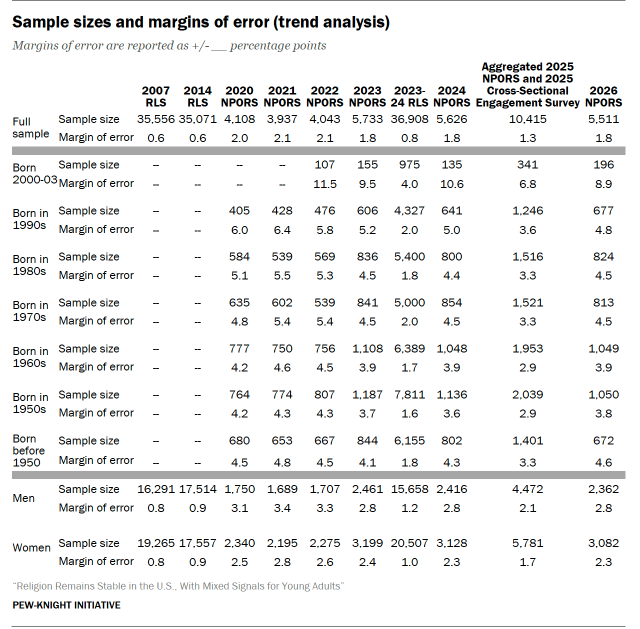
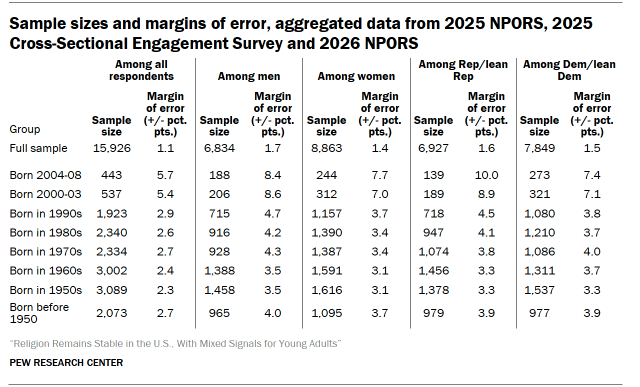
Sample sizes and sampling errors for other subgroups are available upon request. In addition to sampling error, one should bear in mind that question wording and practical difficulties in conducting surveys can introduce error or bias into the findings of opinion polls.
American Trends Panel
In addition to the cross-sectional surveys described above, this report also uses surveys conducted among respondents in Pew Research Center’s American Trends Panel (ATP). The ATP surveys analyzed here ask respondents whether they attended religious services during the prior month and (separately) whether they watched religious services online or on TV during the prior month. These are “yes/no” questions, and respondents can answer “yes” to both of them, one of them, or neither of them.
The most recent ATP survey that asked these questions was Wave 194, conducted May 26-June 1, 2026. Complete details about how the survey was conducted and what it found are available at the links below:
Methodological details about previous ATP surveys that included these questions are available at the links below.
Sample sizes and margins of error
The following table shows the unweighted sample sizes and the error attributable to sampling that would be expected at the 95% level of confidence for different groups in the ATP surveys.
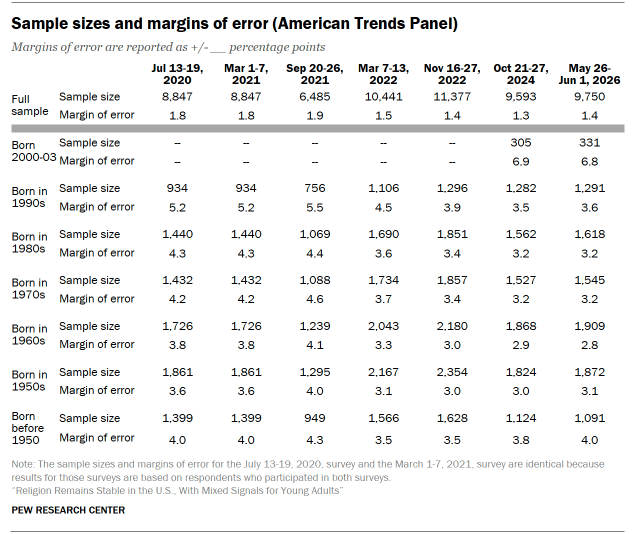
Sample sizes and sampling errors for other subgroups are available upon request. In addition to sampling error, one should bear in mind that question wording and practical difficulties in conducting surveys can introduce error or bias into the findings of opinion polls.