Ahead of what the White House is calling a “large-scale revival” meeting on the National Mall devoted to “rededicating our country as One Nation under God,” a new Pew Research Center survey shows that a growing minority of U.S. adults say religion is gaining influence in American life. And more than half say religion plays a positive role in society.
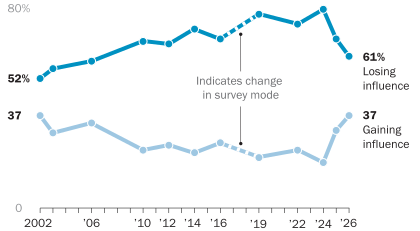
Source: Survey of U.S. adults conducted April 6-12, 2026.
| Losing influence | Gaining influence | |
|---|---|---|
| Mar 2002 | 52% | 37% |
| July 2003 | 56% | 30% |
| Jul 2006 | 59% | 34% |
| Jul-Aug 2010 | 67% | 23% |
| Jun-Jul 2012 | 66% | 25% |
| Sep 2014 | 72% | 22% |
| Jan 2016 | 68% | 26% |
| Mar-Apr 2019 | 78% | 20% |
| Sep 2022 | 74% | 23% |
| Feb 2024 | 80% | 18% |
| Feb 2025 | 68% | 31% |
| Apr 2026 | 61% | 37% |
Source: Survey of U.S. adults conducted April 6-12, 2026.
At the same time, most people want churches and other houses of worship to stay out of day-to-day politics and not endorse candidates.
The new survey also finds growing familiarity with the term “Christian nationalism.” Most Americans surveyed now say they have heard at least a little about it.
Support for ideas that are sometimes associated with Christian nationalism is mostly unchanged in recent years. For example, there has been no growth in the shares of Americans who want the government to stop enforcing separation of church and state or who believe that God favors the United States over all countries.
There has, however, been a small uptick in the share of U.S. adults who say the federal government should declare Christianity the nation’s official religion: 17% now say this, up from 13% in 2024.
On many of these issues, there are sharp partisan divides. For example, Republicans are considerably more likely than Democrats to say religion has a positive influence on American life and to support religion having a prominent role in government and lawmaking.
Views on religion’s influence in society
Today, 61% of U.S. adults say religion is losing influence in American life, while 37% say it is gaining influence. The share saying religion is gaining influence has risen 19 percentage points in the last two years and is now as high as it has been in Center surveys going back to 2002.
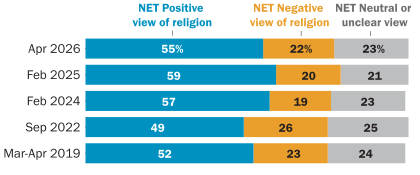
“How Americans Feel About Religion’s Influence in Government and Public Life”
| NET Positive view of religion | NET Negative view of religion | NET Neutral or unclear view | |
|---|---|---|---|
| Apr-26 | 55% | 22% | 23% |
| Feb-25 | 59% | 20% | 21% |
| Feb-24 | 57% | 19% | 23% |
| Sep-22 | 49% | 26% | 25% |
| Mar-Apr 2019 | 52% | 23% | 24% |
“How Americans Feel About Religion’s Influence in Government and Public Life”
Most people who think religion’s influence is growing see this as a good thing. Overall, 55% of U.S. adults express a positive view of religion’s role in American life – saying either that religion’s influence is growing and this is a good thing (21%) or that its influence is declining and this is a bad thing (34%).
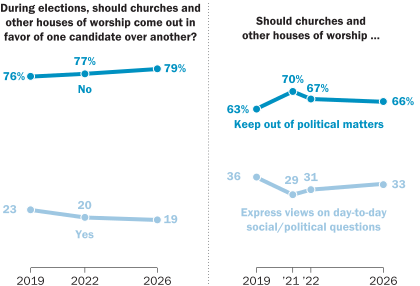
“How Americans Feel About Religion’s Influence in Government and Public Life”
| Question | Response | 2019 | 2021 | 2022 | 2026 |
|---|---|---|---|---|---|
| During elections, should churches and other houses of worship come out in favor of one candidate over another? | Yes | 23% | 20% | 19% | |
| During elections, should churches and other houses of worship come out in favor of one candidate over another? | No | 76% | 77% | 79% | |
| Should churches and other houses of worship … | Express views on day-to-day social/political questions | 36% | 29% | 31% | 33% |
| Should churches and other houses of worship … | Keep out of political matters | 63% | 70% | 67% | 66% |
“How Americans Feel About Religion’s Influence in Government and Public Life”
Although views of religion’s influence lean positive, most Americans are uneasy with the idea of churches getting directly involved with politics. The vast majority (79%) say churches and other houses of worship should not support candidates in elections. And two-thirds say churches and other houses of worship should keep out of political matters rather than expressing views on day-to-day social and political questions. The public’s views on these questions have not changed very much in recent years.
Familiarity with ‘Christian nationalism’
The new survey also finds that the public’s familiarity with the term “Christian nationalism” is growing. Since we last asked about it roughly two years ago, there has been a 14 percentage point increase in the share of U.S. adults who say they have heard or read at least a little about Christian nationalism, from 45% to 59%.

“How Americans Feel About Religion’s Influence in Government and Public Life”
| NET At least a little | A great deal | Quite a bit | Some | A little | Nothing at all | No answer | |
|---|---|---|---|---|---|---|---|
| Apr-26 | 59% | 9% | 12% | 23% | 15% | 40% | <1% |
| Feb-24 | 45% | 6% | 9% | 16% | 14% | 54% | 1% |
| Sep-22 | 45% | 5% | 9% | 17% | 14% | 54% | 1% |
“How Americans Feel About Religion’s Influence in Government and Public Life”
As familiarity with the term has grown, so have both positive and negative views of Christian nationalism.
On balance, sentiment toward Christian nationalism remains more negative than positive. Today, 31% of U.S. adults say they have an unfavorable view of Christian nationalism (up 6 percentage points since 2024), while 10% view it favorably (up 5 points).
But the majority of Americans (59%) still say they’ve never heard of Christian nationalism (40%), don’t know enough to express an opinion (11%), or have neither a favorable nor an unfavorable view (8%).
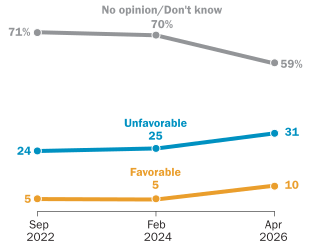
“How Americans Feel About Religion’s Influence in Government and Public Life”
| No opinion/Unclear | Unfavorable | Favorable | |
|---|---|---|---|
| 2022 | 71% | 24% | 5% |
| 2024 | 70% | 25% | 5% |
| 2026 | 59% | 31% | 10% |
“How Americans Feel About Religion’s Influence in Government and Public Life”
Views on church-state issues
The survey also finds a small increase in the percentage of Americans who say they want the government to declare Christianity the nation’s official religion. Overall, 17% of U.S. adults now express this view, up from 13% in 2024. Among Republicans and independents who lean toward the GOP, 27% now favor making Christianity the official religion of the U.S., up 6 points in roughly two years.
government …
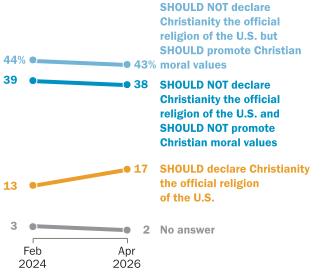
“How Americans Feel About Religion’s Influence in Government and Public Life”
government …
| SHOULD declare Christianity the official religion of the U.S. | SHOULD NOT declare Christianity the official religion of the U.S. but SHOULD promote Christian moral values | SHOULD NOT declare Christianity the official religion of the U.S. and SHOULD NOT promote Christian moral values | No answer | |
|---|---|---|---|---|
| Feb-24 | 13% | 44% | 39% | 3% |
| Apr-26 | 17% | 43% | 38% | 2% |
“How Americans Feel About Religion’s Influence in Government and Public Life”
Yet most Americans continue to reject the idea that Christianity should be the nation’s official religion. Instead, they say either that the government should promote Christian moral values without making Christianity the official religion (43%) or that the government should neither establish an official religion nor promote Christian values (38%).
On other questions about ideas sometimes associated with Christian nationalism, we see minimal movement in public opinion.
The share of Americans who say they want the Bible to influence U.S. laws and that the Bible should take priority over the will of the people is the same now as when we first asked about this in 2020.
Similarly, the share who say God favors the U.S. over all other countries has not changed since 2021.
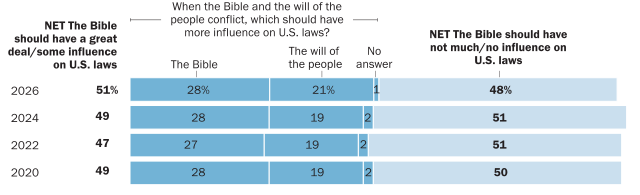
“How Americans Feel About Religion’s Influence in Government and Public Life”
| When the bible and the will of the people conflict, which should have more influence on U.S. laws? | NET The Bible should have a great deal/some influence on U.S. laws | The Bible | The will of the people | No answer | NET The Bible should have not much/no influence on U.S. laws |
|---|---|---|---|---|---|
| 2026 | 51% | 28% | 21% | 1% | 48% |
| 2024 | 49% | 28% | 19% | 2% | 51% |
| 2022 | 47% | 27% | 19% | 2% | 51% |
| 2020 | 49% | 28% | 19% | 2% | 50% |
“How Americans Feel About Religion’s Influence in Government and Public Life”
There has been a decline (from 19% in 2021 to 13% in 2026) in the share of Americans who want the government to stop enforcing separation of church and state, with a corresponding rise in the share expressing a neutral view or no opinion on this question. But the percentage of Americans who say the government should enforce separation of church and state has remained essentially flat and now stands at 54%.
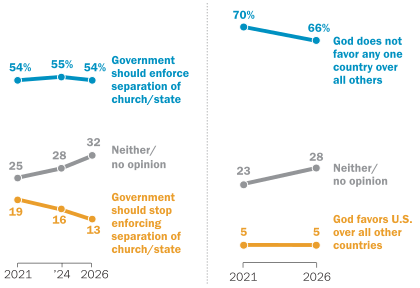
“How Americans Feel About Religion’s Influence in Government and Public Life”
| Government should stop enforcing separation of church/state | Government should enforce separation of church and state | Neither/no opinion | |
|---|---|---|---|
| 2021 | 19% | 54% | 25% |
| 2024 | 16% | 55% | 28% |
| 2026 | 13% | 54% | 32% |
| God favors U.S. over all other countries | God does not favor any one country over all others | Neither/no opinion | |
| 2021 | 5% | 70% | 23% |
| 2026 | 5% | 66% | 28% |
“How Americans Feel About Religion’s Influence in Government and Public Life”
The new survey finds that 52% of U.S. adults think “conservative Christians have gone too far in trying to push their religious values in the government and public schools.”
In response to a separate question, 48% say “liberals who are not religious have gone too far in trying to keep religious values out of the government and public schools.” Nearly one-in-five Americans (18%) agree with both assertions, saying that both conservative Christians and secular liberals have gone too far pushing their respective points of view.
These are among the key findings on views of religion in public life from a nationally representative Pew Research Center survey conducted April 6-12, 2026, among 3,592 U.S. adults. The survey is part of a long line of Center analyses exploring the intersection of religion, politics and society. Additional details about how religious groups answered the questions we asked and estimates for the full set of response categories are in the detailed tables.
How Republicans and Democrats view religion’s influence
Rising shares of both Republicans and Democrats think religion is gaining influence in American life: 43% of Republicans now say this (up 28 percentage points since 2024) along with 34% of Democrats (up 14 points).
But the survey also reveals deep partisan gaps about whether religion’s growing influence is a good or bad thing and about how far religion should extend into government and politics.
Views on whether religion’s role is positive or negative
When we combine responses about whether religion is gaining or losing influence and whether that’s a good or bad thing, we see that 75% of Republicans and independents who lean toward the GOP express a positive view of religion’s influence in American life. This is nearly double the share of Democrats and Democratic leaners who do so (38%). Today, Democrats are about as likely to express a negative view of religion’s role in society (37%) as to express a positive view (38%).
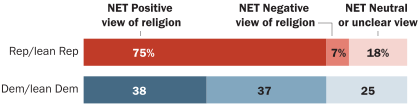
“How Americans Feel About Religion’s Influence in Government and Public Life”
| NET Positive | NET Negative | NET Neutral or unclear view | |
|---|---|---|---|
| Rep/lean Rep | 75% | 7% | 18% |
| Dem/lean Dem | 38% | 37% | 25% |
“How Americans Feel About Religion’s Influence in Government and Public Life”
Views on Christianity in government and national politics
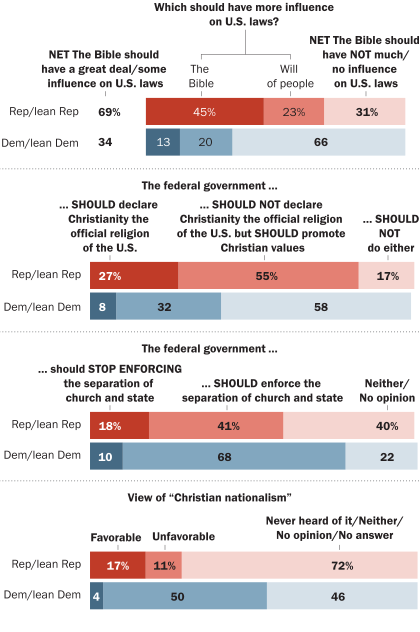
Republicans and Democrats also differ over how much the government should embrace Christianity. For example, most Republicans say the Bible should have at least some influence on U.S. laws, including 45% who say that when the Bible conflicts with the will of the people, the Bible should have more influence. By contrast, two-thirds of Democrats say the Bible should have little or no influence on U.S. laws.
“How Americans Feel About Religion’s Influence in Government and Public Life”
| Question | Party | NET The Bible should have a great deal/some influence on U.S. laws | The Bible | Will of people | No answer | NET The Bible should have not much/ no influence on U.S. laws |
|---|---|---|---|---|---|---|
| When Bible and will of people conflict, which should have more influence on U.S. laws? | Rep/lean Rep | 69% | 45% | 23% | 1% | 31% |
| When Bible and will of people conflict, which should have more influence on U.S. laws? | Dem/lean Dem | 34% | 13% | 20% | 1% | 66% |
| Question | Party | … SHOULD declare Christianity the official religion of the U.S. | … SHOULD NOT declare Christianity the official religion of the U.S. but SHOULD promote Christian values | … SHOULD NOT do either | No answer | |
| The federal government … | Rep/lean Rep | 27% | 55% | 17% | 1% | |
| The federal government … | Dem/lean Dem | 8% | 32% | 58% | 1% | |
| Question | Party | … should STOP ENFORCING the separation of church and state | … SHOULD enforce the separation of church and state | Neither/No opinion | ||
| The federal government … | Rep/lean Rep | 18% | 41% | 40% | ||
| The federal government … | Dem/lean Dem | 10% | 68% | 22% | ||
| Question | Party | Favorable | Unfavorable | Never heard of it / neither / no opinion | ||
| View of “Christian nationalism” | Rep/lean Rep | 17% | 11% | 72% | ||
| View of “Christian nationalism” | Dem/lean Dem | 4% | 50% |
“How Americans Feel About Religion’s Influence in Government and Public Life”
Republicans are also more likely than Democrats to say that Christianity should be the nation’s official religion, or that the government should not declare Christianity the official religion but should promote Christian moral values. Most Democrats say the government shouldn’t do either of these things.
Additionally, most Democrats (68%) say the federal government should enforce the separation of church and state. Republicans aren’t so sure: 41% say the government should enforce the separation of church and state, but 18% say the government should stop enforcing the separation of church and state and 40% express no opinion or choose neither option.
Democrats are also far more likely than Republicans to express an unfavorable view of Christian nationalism. Republicans, by contrast, are more likely than Democrats to say they view Christian nationalism favorably and far more likely to say they have never heard of it or to express no opinion.
Views on how churches and other houses of worship engage with politics
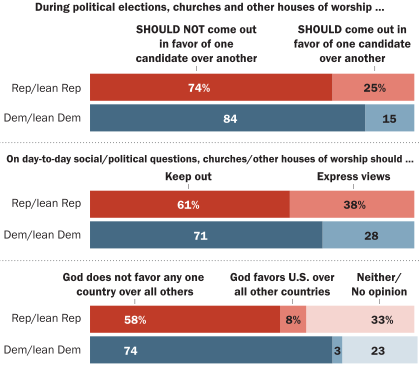
Despite these partisan differences in views about religion’s role in public life, there is substantial agreement in both parties about how churches and other houses of worship should engage – or not engage – with politics.
“How Americans Feel About Religion’s Influence in Government and Public Life”
| During political elections, churches and other houses of worship … | ||||
|---|---|---|---|---|
| … SHOULD NOT come out in favor of one candidate over another | … SHOULD come out in favor of one candidate over another | No answer | ||
| Rep/lean Rep | 74% | 25% | 1% | |
| Dem/lean Dem | 84% | 15% | 1% | |
| On day-to-day social/political questions, churches/other houses of worship should … | ||||
| … Keep out | … Express views | No answer | ||
| Rep/lean Rep | 61% | 38% | 1% | |
| Dem/lean Dem | 71% | 28% | <1% | |
| God does not favor any one country over all others | God favors U.S. over all other countries | Neither/no opinion | No answer | |
| Rep/lean Rep | 58% | 8% | 33% | 1% |
| Dem/lean Dem | 74% | 3% | 23% | 1% |
“How Americans Feel About Religion’s Influence in Government and Public Life”
Large majorities of both Republicans and Democrats say churches and other houses of worship should not endorse candidates in elections. And most people in both parties say churches and other houses of worship should keep out of political matters in general.
Meanwhile, relatively few Republicans (8%) and Democrats (3%) think God favors the U.S. over all other countries. Majorities in both parties say God does not favor any one country over all others.
How religious groups think about religion’s influence
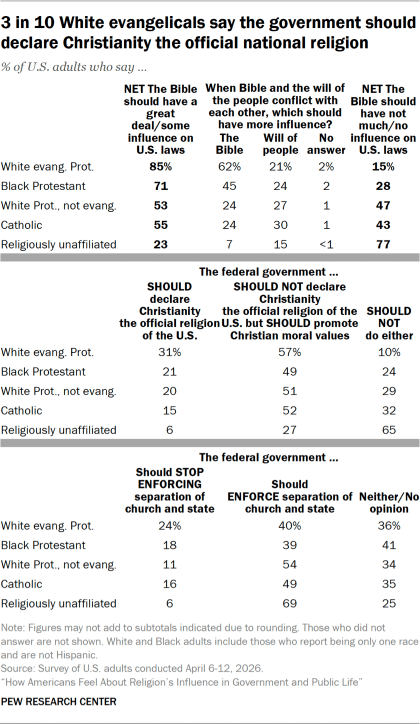
On many of the survey’s questions, White evangelical Protestants stand out as the religious group most likely to express positive views of religion’s role in society; to say the Bible should play a prominent role in U.S. lawmaking; to support declaring Christianity the nation’s official religion; and to express a favorable view of Christian nationalism.
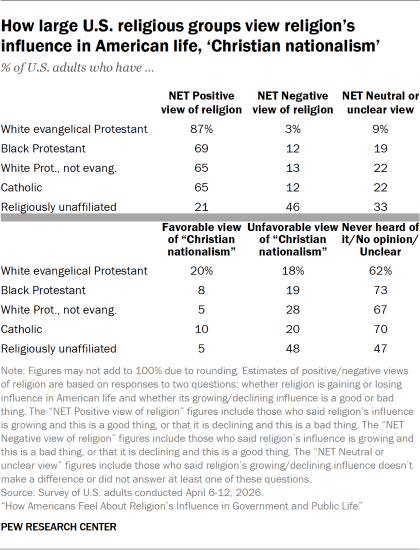
But White evangelicals aren’t alone in taking a positive view of religion’s role in society. Most Catholics, White nonevangelical Protestants and Black Protestants say the same.
The survey also shows that nearly half of Black Protestants and a quarter of Catholics and White nonevangelical Protestants say the Bible should take precedence if it conflicts with the will of the people. And roughly half or more in all the Christian categories we can analyze say the government should at least promote Christian moral values, even if they do not think the government should declare the U.S. a Christian nation.
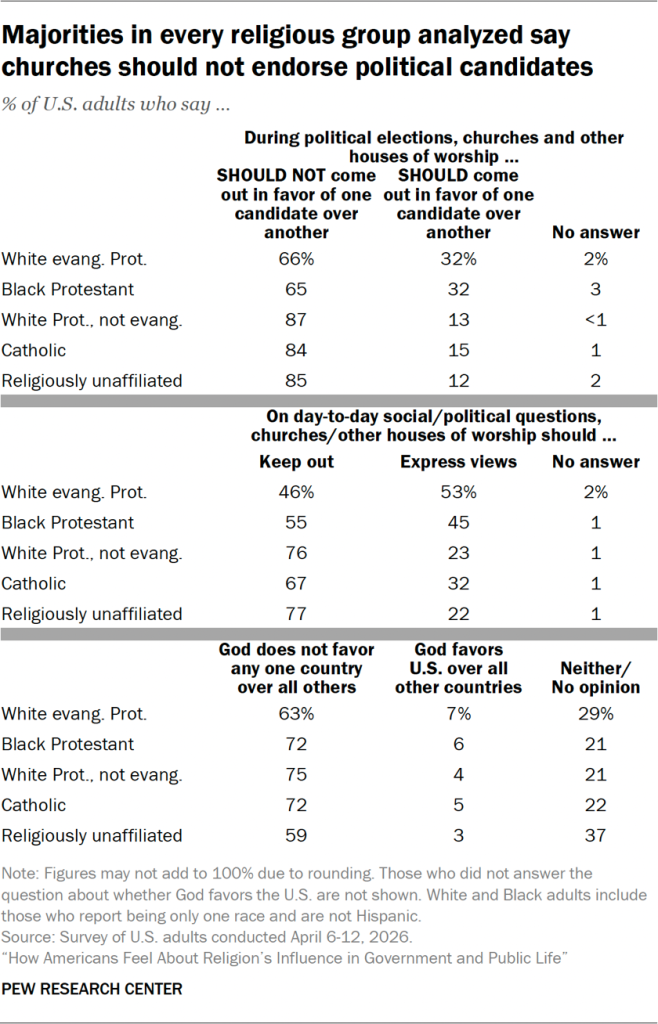
Majorities of people in every religious category we can analyze say churches and other houses of worship should refrain from endorsing candidates.
More broadly, most people who are religiously unaffiliated – atheists, agnostics or people saying their religion is “nothing in particular” – as well as most Catholics and White nonevangelical Protestants also say churches and other houses of worship should keep out of day-to-day social and political issues. By comparison, White evangelicals and Black Protestants are more divided, with substantial shares in each group saying churches and other houses of worship should express their views on social and political matters.
The survey included respondents of many other religious backgrounds, including Jews, Muslims, members of the Church of Jesus Christ of Latter-day Saints (widely known as Mormons), Hindus and Buddhists. But there are not enough respondents from these smaller groups to report on their answers separately.
Detailed tables
Views on whether religion is gaining or losing influence in American life
% who say religion is __ in American life
| Gaining influence | Losing influence | No answer | |
|---|---|---|---|
| All U.S. adults | 37% | 61% | 2% |
| Religion | |||
| Protestant | 39% | 59% | 1% |
| White evangelical | 45% | 53% | 2% |
| White nonevangelical | 36% | 63% | 1% |
| Black Protestant | 35% | 64% | 1% |
| Catholic | 38% | 61% | 2% |
| White Catholic | 42% | 57% | 1% |
| Hispanic Catholic | 31% | 67% | 2% |
| Religiously unaffiliated | 35% | 64% | 1% |
| Atheist | 39% | 60% | 1% |
| Agnostic | 41% | 59% | 1% |
| Nothing in particular | 32% | 67% | 1% |
| Party | |||
| Rep/lean Rep | 43% | 56% | 1% |
| Dem/lean Dem | 34% | 65% | 1% |
Note: Figures may not add to 100% due to rounding. White and Black adults include those who report being only one race and are not Hispanic. Hispanics are of any race.
Source: Survey of U.S. adults conducted April 6-12, 2026.
“How Americans Feel About Religion’s Influence in Government and Public Life”
PEW RESEARCH CENTER
Views of whether religion’s influence is a positive or negative thing
U.S. adults’ views toward religion, based on combined responses to two questions about whether religion’s influence is growing or declining and whether this is a good or bad thing
| NET Positive view of religion | Religion’s influence is growing, this is good | Religion’s influence is declining, this is bad | NET Negative view of religion | Religion’s influence is growing, this is bad | Religion’s influence is declining, this is good | NET Neither positive nor negative | Religion’s influence is growing, this doesn’t make a difference | Religion’s influence is declining, this doesn’t make a difference | Did not answer | |
|---|---|---|---|---|---|---|---|---|---|---|
| All U.S. adults | 55% | 21% | 34% | 22% | 11% | 11% | 23% | 5% | 16% | 2% |
| Religion | ||||||||||
| Protestant | 75% | 30% | 45% | 9% | 6% | 3% | 16% | 4% | 11% | 2% |
| White evangelical | 87% | 42% | 46% | 3% | 2% | 1% | 9% | 2% | 6% | 2% |
| White nonevangelical | 65% | 24% | 41% | 13% | 8% | 5% | 22% | 4% | 16% | 2% |
| Black Protestant | 69% | 21% | 48% | 12% | 8% | 4% | 19% | 6% | 12% | 1% |
| Catholic | 65% | 27% | 39% | 12% | 6% | 6% | 22% | 4% | 16% | 2% |
| White Catholic | 73% | 32% | 41% | 11% | 7% | 4% | 16% | 3% | 12% | 2% |
| Hispanic Catholic | 56% | 19% | 37% | 13% | 5% | 8% | 30% | 6% | 21% | 3% |
| Religiously unaffiliated | 21% | 7% | 14% | 46% | 22% | 24% | 33% | 6% | 25% | 2% |
| Atheist | 9% | 3% | 6% | 81% | 33% | 48% | 10% | 2% | 6% | 1% |
| Agnostic | 10% | 3% | 7% | 62% | 33% | 29% | 28% | 5% | 22% | 1% |
| Nothing in particular | 29% | 10% | 19% | 30% | 14% | 16% | 41% | 8% | 31% | 2% |
| Party | ||||||||||
| Rep/lean Rep | 75% | 36% | 39% | 7% | 3% | 5% | 18% | 4% | 12% | 1% |
| Dem/lean Dem | 38% | 9% | 29% | 37% | 20% | 17% | 25% | 5% | 19% | 1% |
Note: Figures may not add to 100% or subtotals indicated due to rounding. White and Black adults include those who report being only one race and are not Hispanic. Hispanics are of any race.
Source: Survey of U.S. adults conducted April 6-12, 2026.
“How Americans Feel About Religion’s Influence in Government and Public Life”
PEW RESEARCH CENTER
Views on whether churches and other houses of worship should engage in political matters
% who say each of the following
| During political elections, churches and other houses of worship … | Churches and other houses of worship should … | |||||
|---|---|---|---|---|---|---|
| Should come out in favor of one candidate over another | Should not do this | No answer | Express their views on day-to-day social and political questions | Keep out of political matters | No answer | |
| All U.S. adults | 19% | 79% | 2% | 33% | 66% | 1% |
| Religion | ||||||
| Protestant | 27% | 72% | 2% | 41% | 58% | 1% |
| White evangelical | 32% | 66% | 2% | 53% | 46% | 2% |
| White nonevangelical | 13% | 87% | <1% | 23% | 76% | 1% |
| Black Protestant | 32% | 65% | 3% | 45% | 55% | 1% |
| Catholic | 15% | 84% | 1% | 32% | 67% | 1% |
| White Catholic | 16% | 83% | 1% | 36% | 64% | 0% |
| Hispanic Catholic | 12% | 86% | 2% | 28% | 70% | 2% |
| Religiously unaffiliated | 12% | 85% | 2% | 22% | 77% | 1% |
| Atheist | 11% | 87% | 2% | 14% | 84% | 1% |
| Agnostic | 14% | 84% | 2% | 19% | 81% | 1% |
| Nothing in particular | 12% | 86% | 2% | 25% | 74% | 1% |
| Party | ||||||
| Rep/lean Rep | 25% | 74% | 1% | 38% | 61% | 1% |
| Dem/lean Dem | 15% | 84% | 1% | 28% | 71% | <1% |
Note: Figures may not add to 100% due to rounding. White and Black adults include those who report being only one race and are not Hispanic. Hispanics are of any race.
Source: Survey of U.S. adults conducted April 6-12, 2026.
“How Americans Feel About Religion’s Influence in Government and Public Life”
PEW RESEARCH CENTER
Familiarity with the term ‘Christian nationalism’
% who they have heard or read __ about ‘Christian nationalism’
| NET At least a little | A great deal | Quite a bit | Some | A little | Nothing at all | No answer | |
|---|---|---|---|---|---|---|---|
| All U.S. adults | 59% | 9% | 12% | 23% | 15% | 40% | <1% |
| Religion | |||||||
| Protestant | 58% | 9% | 10% | 22% | 16% | 42% | <1% |
| White evangelical | 62% | 11% | 11% | 25% | 15% | 38% | 0% |
| White nonevangelical | 54% | 9% | 9% | 19% | 16% | 46% | 0% |
| Black Protestant | 51% | 7% | 11% | 17% | 17% | 47% | 2% |
| Catholic | 49% | 5% | 10% | 17% | 17% | 51% | <1% |
| White Catholic | 49% | 4% | 10% | 19% | 16% | 50% | <1% |
| Hispanic Catholic | 47% | 5% | 8% | 17% | 17% | 53% | 0% |
| Religiously unaffiliated | 66% | 12% | 16% | 26% | 13% | 33% | 1% |
| Atheist | 84% | 26% | 22% | 28% | 8% | 15% | 1% |
| Agnostic | 81% | 17% | 20% | 29% | 15% | 19% | 0% |
| Nothing in particular | 56% | 6% | 12% | 24% | 14% | 43% | 1% |
| Party | |||||||
| Rep/lean Rep | 54% | 5% | 9% | 23% | 17% | 46% | <1% |
| Dem/lean Dem | 67% | 13% | 16% | 23% | 15% | 32% | <1% |
Note: Figures may not add to 100% or subtotals indicated due to rounding. White and Black adults include those who report being only one race and are not Hispanic. Hispanics are of any race.
Source: Survey of U.S. adults conducted April 6-12, 2026.
“How Americans Feel About Religion’s Influence in Government and Public Life”
PEW RESEARCH CENTER
Views about ‘Christian nationalism’
All in all, do you have a favorable or unfavorable view of ‘Christian nationalism’?
| Very favorable/ Somewhat favorable | Neither favorable nor unfavorable | Very unfavorable/ Somewhat unfavorable | Don’t know enough to say/No answer | Haven’t heard of Christian nationalism | No answer on question about familiarity with Christian nationalism | |
|---|---|---|---|---|---|---|
| All U.S. adults | 10% | 8% | 31% | 11% | 40% | <1% |
| Religion | ||||||
| Protestant | 13% | 10% | 21% | 14% | 42% | <1% |
| White evangelical | 20% | 8% | 18% | 16% | 38% | 0% |
| White nonevangelical | 5% | 7% | 28% | 14% | 46% | 0% |
| Black Protestant | 8% | 10% | 19% | 14% | 47% | 2% |
| Catholic | 10% | 8% | 20% | 11% | 51% | <1% |
| White Catholic | 9% | 7% | 23% | 10% | 50% | <1% |
| Hispanic Catholic | 12% | 9% | 15% | 12% | 53% | 0% |
| Religiously unaffiliated | 5% | 5% | 48% | 8% | 33% | 1% |
| Atheist | 2% | 1% | 80% | 1% | 15% | 1% |
| Agnostic | 4% | 4% | 69% | 4% | 19% | 0% |
| Nothing in particular | 6% | 7% | 32% | 11% | 43% | 1% |
| Party | ||||||
| Rep/lean Rep | 17% | 11% | 11% | 15% | 46% | <1% |
| Dem/lean Dem | 4% | 6% | 50% | 7% | 32% | <1% |
Note: Figures may not add to 100% or subtotals indicated due to rounding. White and Black adults include those who report being only one race and are not Hispanic. Hispanics are of any race.
Source: Survey of U.S. adults conducted April 6-12, 2026.
“How Americans Feel About Religion’s Influence in Government and Public Life”
PEW RESEARCH CENTER
Views about whether the government should declare a Christian nation, promote Christian values or neither
% who say the federal government …
| SHOULD declare Christianity the official religion of the U.S. | SHOULD NOT declare Christianity the official religion of the U.S. but SHOULD promote Christian values | SHOULD NOT declare Christianity the official religion of the U.S. and SHOULD NOT promote Christian moral values | No answer | |
|---|---|---|---|---|
| All U.S. adults | 17% | 43% | 38% | 2% |
| Religion | ||||
| Protestant | 26% | 52% | 19% | 2% |
| White evangelical | 31% | 57% | 10% | 2% |
| White nonevangelical | 20% | 51% | 29% | 1% |
| Black Protestant | 21% | 49% | 24% | 6% |
| Catholic | 15% | 52% | 32% | 2% |
| White Catholic | 20% | 55% | 26% | <1% |
| Hispanic Catholic | 9% | 46% | 41% | 4% |
| Religiously unaffiliated | 6% | 27% | 65% | 1% |
| Atheist | 3% | 13% | 83% | 1% |
| Agnostic | 2% | 18% | 79% | 0% |
| Nothing in particular | 9% | 35% | 55% | 1% |
| Party | ||||
| Rep/lean Rep | 27% | 55% | 17% | 1% |
| Dem/lean Dem | 8% | 32% | 58% | 1% |
Note: Figures may not add to 100% due to rounding. White and Black adults include those who report being only one race and are not Hispanic. Hispanics are of any race.
Source: Survey of U.S. adults conducted April 6-12, 2026.
“How Americans Feel About Religion’s Influence in Government and Public Life”
PEW RESEARCH CENTER
Views about how much influence the Bible should have on U.S. laws
How much influence should the Bible have on the laws of the United States?
| NET A great deal/Some | A great deal | Some | NET Not much/None at all | Not much | None at all | No answer | |
|---|---|---|---|---|---|---|---|
| All U.S. adults | 51% | 25% | 26% | 48% | 17% | 31% | 1% |
| Religion | |||||||
| Protestant | 71% | 41% | 30% | 28% | 13% | 15% | 1% |
| White evangelical | 85% | 57% | 28% | 15% | 8% | 6% | <1% |
| White nonevangelical | 53% | 17% | 35% | 47% | 17% | 29% | <1% |
| Black Protestant | 71% | 43% | 28% | 28% | 12% | 16% | 1% |
| Catholic | 55% | 20% | 35% | 43% | 22% | 21% | 2% |
| White Catholic | 51% | 17% | 35% | 49% | 26% | 23% | 0% |
| Hispanic Catholic | 59% | 25% | 34% | 37% | 18% | 19% | 4% |
| Religiously unaffiliated | 23% | 7% | 16% | 77% | 17% | 60% | 1% |
| Atheist | 7% | 1% | 6% | 92% | 8% | 83% | 1% |
| Agnostic | 12% | 2% | 11% | 88% | 14% | 73% | 0% |
| Nothing in particular | 31% | 10% | 21% | 68% | 20% | 48% | 1% |
| Party | |||||||
| Rep/lean Rep | 69% | 37% | 32% | 31% | 16% | 15% | <1% |
| Dem/lean Dem | 34% | 13% | 21% | 66% | 18% | 47% | <1% |
Note: Figures may not add to 100% or subtotals indicated due to rounding. White and Black adults include those who report being only one race and are not Hispanic. Hispanics are of any race.
Source: Survey of U.S. adults conducted April 6-12, 2026.
“How Americans Feel About Religion’s Influence in Government and Public Life”
PEW RESEARCH CENTER
Views on whether the Bible or the will of the people should have more influence on U.S. laws if the two conflict
% who say …
| When Bible and will of people conflict, which should have more influence on U.S. laws? | ||||||
|---|---|---|---|---|---|---|
| NET Bible should have a great deal/some influence on U.S. laws | The Bible | Will of people | No answer | NET Bible should have not much/ no influence on U.S. laws | Did not answer the question about how much influence the Bible should have on U.S. laws | |
| All U.S. adults | 51% | 28% | 21% | 1% | 48% | 1% |
| Religion | ||||||
| Protestant | 71% | 47% | 22% | 2% | 28% | 1% |
| White evangelical | 85% | 62% | 21% | 2% | 15% | <1% |
| White nonevangelical | 53% | 24% | 27% | 1% | 47% | <1% |
| Black Protestant | 71% | 45% | 24% | 2% | 28% | 1% |
| Catholic | 55% | 24% | 30% | 1% | 43% | 2% |
| White Catholic | 51% | 23% | 27% | 1% | 49% | 0% |
| Hispanic Catholic | 59% | 26% | 32% | 1% | 37% | 4% |
| Religiously unaffiliated | 23% | 7% | 15% | <1% | 77% | 1% |
| Atheist | 7% | 3% | 4% | 0% | 92% | 1% |
| Agnostic | 12% | 1% | 11% | 0% | 88% | 0% |
| Nothing in particular | 31% | 11% | 19% | 1% | 68% | 1% |
| Party | ||||||
| Rep/lean Rep | 69% | 45% | 23% | 1% | 31% | <1% |
| Dem/lean Dem | 34% | 13% | 20% | 1% | 66% | <1% |
Note: Figures may not add to 100% or subtotals indicated due to rounding. White and Black adults include those who report being only one race and are not Hispanic. Hispanics are of any race.
Source: Survey of U.S. adults conducted April 6-12, 2026.
“How Americans Feel About Religion’s Influence in Government and Public Life”
PEW RESEARCH CENTER
Views on whether the government should enforce church-state separation
% who say the federal government should __ the separation of church and state
| Enforce | Stop enforcing | Neither/no opinion | No answer | |
|---|---|---|---|---|
| All U.S. adults | 54% | 13% | 32% | 1% |
| Religion | ||||
| Protestant | 43% | 18% | 38% | 1% |
| White evangelical | 40% | 24% | 36% | 1% |
| White nonevangelical | 54% | 11% | 34% | <1 |
| Black Protestant | 39% | 18% | 41% | 2% |
| Catholic | 49% | 16% | 35% | <1% |
| White Catholic | 53% | 16% | 30% | 1% |
| Hispanic Catholic | 40% | 16% | 44% | 0% |
| Religiously unaffiliated | 69% | 6% | 25% | <1% |
| Atheist | 91% | 1% | 8% | 1% |
| Agnostic | 89% | 2% | 9% | 0% |
| Nothing in particular | 56% | 8% | 35% | 1% |
| Party | ||||
| Rep/lean Rep | 41% | 18% | 40% | <1% |
| Dem/lean Dem | 68% | 10% | 22% | <1% |
Note: Figures may not add to 100% due to rounding. White and Black adults include those who report being only one race and are not Hispanic. Hispanics are of any race.
Source: Survey of U.S. adults conducted April 6-12, 2026.
“How Americans Feel About Religion’s Influence in Government and Public Life”
PEW RESEARCH CENTER
Views on whether God favors the U.S. or does not favor any country over others
% who say …
| God favors the U.S. over all other countries | God does not favor any one country over all others | Neither/no opinion | No answer | |
|---|---|---|---|---|
| All U.S. adults | 5% | 66% | 28% | 1% |
| Religion | ||||
| Protestant | 7% | 68% | 24% | 1% |
| White evangelical | 7% | 63% | 29% | 1% |
| White nonevangelical | 4% | 75% | 21% | <1% |
| Black Protestant | 6% | 72% | 21% | 2% |
| Catholic | 5% | 72% | 22% | 2% |
| White Catholic | 2% | 73% | 24% | 2% |
| Hispanic Catholic | 8% | 70% | 21% | 2% |
| Religiously unaffiliated | 3% | 59% | 37% | 1% |
| Atheist | 2% | 52% | 44% | 3% |
| Agnostic | 1% | 69% | 30% | 0% |
| Nothing in particular | 4% | 57% | 38% | 1% |
| Party | ||||
| Rep/lean Rep | 8% | 58% | 33% | 1% |
| Dem/lean Dem | 3% | 74% | 23% | 1% |
Note: Figures may not add to 100% due to rounding. White and Black adults include those who report being only one race and are not Hispanic. Hispanics are of any race.
Source: Survey of U.S. adults conducted April 6-12, 2026.
“How Americans Feel About Religion’s Influence in Government and Public Life”
PEW RESEARCH CENTER
Views on whether some Americans have gone too far trying to control religion’s role in government and schools
% who say each of the following
| Do you think conservative Christians have gone too far in trying to push their religious values in the government and public schools? | Do you think liberals who are not religious have gone too far in trying to keep religious values out of the government and public schools? | |||||
|---|---|---|---|---|---|---|
| Yes | No | No answer | Yes | No | No answer | |
| All U.S. adults | 52% | 46% | 2% | 48% | 50% | 2% |
| Religion | ||||||
| Protestant | 39% | 59% | 2% | 65% | 32% | 2% |
| White evangelical | 23% | 75% | 2% | 83% | 15% | 2% |
| White nonevangelical | 52% | 46% | 2% | 57% | 42% | 1% |
| Black Protestant | 49% | 48% | 3% | 48% | 48% | 5% |
| Catholic | 48% | 50% | 2% | 49% | 48% | 3% |
| White Catholic | 44% | 56% | <1% | 62% | 37% | 2% |
| Hispanic Catholic | 53% | 43% | 4% | 34% | 61% | 5% |
| Religiously unaffiliated | 71% | 28% | 2% | 23% | 75% | 2% |
| Atheist | 92% | 8% | 0% | 12% | 87% | 1% |
| Agnostic | 86% | 14% | 0% | 14% | 86% | 0% |
| Nothing in particular | 59% | 38% | 3% | 30% | 68% | 3% |
| Party | ||||||
| Rep/lean Rep | 28% | 71% | 1% | 75% | 24% | 1% |
| Dem/lean Dem | 76% | 23% | 1% | 23% | 75% | 1% |
Note: Figures may not add to 100% due to rounding. White and Black adults include those who report being only one race and are not Hispanic. Hispanics are of any race.
Source: Survey of U.S. adults conducted April 6-12, 2026.
“How Americans Feel About Religion’s Influence in Government and Public Life”
PEW RESEARCH CENTER