Seven-in-ten Americans say President Donald Trump is not too or not at all religious, according to a new Pew Research Center survey. That’s up 8 percentage points since we last asked this question in fall 2024.

| Very religious | Somewhat religious | Not too/Not at all religious | |
|---|---|---|---|
| 02-2020 | 7 | 28 | 63 |
| 03-2021 | 6 | 26 | 67 |
| 02-2024 | 4 | 25 | 68 |
| 10-2024 | 6 | 31 | 62 |
| 04-2026 | 5 | 24 | 70 |
At the same time, many Republicans and White evangelical Protestants say Trump stands up for people with religious beliefs like theirs.
Overall, 70% of U.S. adults now say Trump is not too or not at all religious, while 24% say he is somewhat religious and 5% say he is very religious. The survey was conducted April 6-12, 2026, just before Trump criticized Pope Leo XIV and posted an image on social media depicting himself as a Jesus-like figure. Trump later deleted the image and said he intended to show himself as a doctor.
Democrats and Democratic-leaning independents are much more likely than Republicans and Republican leaners to say Trump is not too or not at all religious (89% vs. 49%).

| Very religious | Somewhat religious | Not too/Not at all religious | Group | |
|---|---|---|---|---|
| U.S. adults | 5 | 24 | 70 | 1 |
| Protestant | 5 | 31 | 64 | 2 |
| > White evangelical | 5 | 44 | 51 | 2 |
| > White, not evangelical | 4 | 30 | 66 | 2 |
| > Black Protestant | 3 | 10 | 86 | 2 |
| Catholic | 5 | 24 | 71 | 2 |
| > White Catholic | 6 | 32 | 62 | 2 |
| > Hispanic Catholic | 3 | 15 | 80 | 2 |
| Religiously unaffiliated | 5 | 16 | 78 | 2 |
| > Atheist | 2 | 10 | 87 | 2 |
| > Agnostic | 5 | 8 | 86 | 2 |
| > Nothing in particular | 5 | 20 | 73 | 2 |
| Rep/lean Rep | 8 | 42 | 49 | 3 |
| Dem/lean Dem | 2 | 8 | 89 | 3 |
Conversely, Republicans are much more likely than Democrats to say he is somewhat religious (42% vs. 8%). White evangelical Protestants – a mostly Republican-leaning group – are also more inclined than people in other religious groups to view Trump as at least somewhat religious.
But even among Trump’s strongest supporters, relatively few people say they think he is very religious. Just 8% of Republicans and 5% of White evangelicals say this is the case.
People in both political parties have become more likely to say Trump is not too or not at all religious, compared with when we last asked this question in fall 2024. Among religious groups, Hispanic Catholics have had the largest shift on this question. Today, 80% of Hispanic Catholics say Trump is not too or not at all religious, up from 60% in the previous survey.
How much does Trump stand up for people’s religious beliefs?
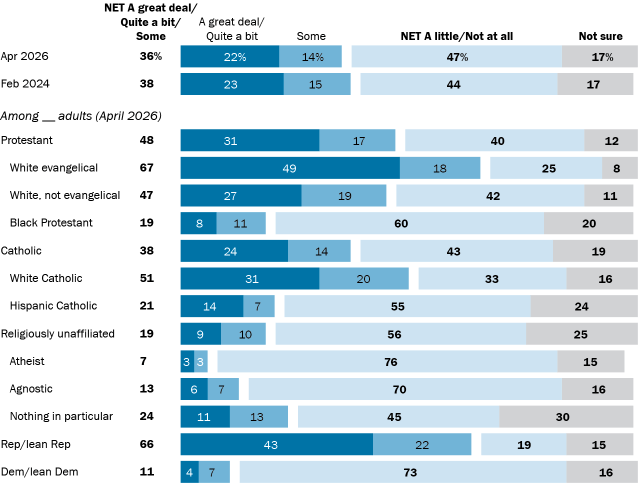
Around one-fifth of U.S. adults (22%) say Trump stands up a great deal or quite a bit for people with religious beliefs similar to their own. Another 14% say he stands up some.
By comparison, 47% say Trump stands up a little or not at all for people with religious beliefs like theirs; 17% are not sure.
Most Republicans say Trump stands up a great deal or quite a bit (43%) or some (22%) for people with their religious beliefs. By contrast, most Democrats (73%) say he stands up a little or not at all for people with their religious beliefs.
Most White evangelicals, like Republicans as a whole, say Trump stands up at least some for people with their religious beliefs.
| NET A great deal/Quite a bit/Some | A great deal/Quite a bit | Some | NET A little/Not at all | Not sure | Group | |
|---|---|---|---|---|---|---|
| April 2026 | 36 | 22 | 14 | 47 | 17 | 1 |
| Feb 2024 | 38 | 23 | 15 | 44 | 17 | 1 |
| Protestant | 48 | 31 | 17 | 40 | 12 | 2 |
| >White evangelical | 67 | 49 | 18 | 25 | 8 | 2 |
| >White, not evangelical | 47 | 27 | 19 | 42 | 11 | 2 |
| >Black Protestant | 24 | 8 | 11 | 60 | 20 | 2 |
| Catholic | 38 | 24 | 14 | 43 | 19 | 2 |
| >White Catholic | 51 | 31 | 20 | 33 | 16 | 2 |
| >Hispanic Catholic | 21 | 14 | 7 | 55 | 24 | 2 |
| Religiously unaffiliated | 19 | 9 | 10 | 56 | 25 | 2 |
| >Atheist | 7 | 3 | 3 | 76 | 15 | 2 |
| >Agnostic | 13 | 6 | 7 | 70 | 16 | 2 |
| >Nothing in particular | 24 | 11 | 13 | 45 | 30 | 2 |
| Rep/lean Rep | 66 | 43 | 22 | 19 | 15 | 3 |
| Dem/lean Dem | 11 | 4 | 7 | 73 | 16 | 3 |
By contrast, majorities of atheists (76%), agnostics (70%) and Black Protestants (60%) – three groups that traditionally lean Democratic – say Trump stands up a little or not at all for people with their religious beliefs.
About a quarter of Catholics say Trump stands up a great deal or quite a bit for their religious beliefs, while 14% say he stands up some. A larger share of Catholics (43%) say he stands up for their beliefs a little or not at all.
White Catholics are far more likely than Hispanic Catholics to say Trump stands up at least some for people with religious beliefs like theirs. Hispanic Catholics, in turn, have become more likely to say Trump doesn’t stand up for people with their religious beliefs: 55% now say he stands up a little or not at all for their religious beliefs, up from 40% when we last asked this question in February 2024.
Except for this significant change among Hispanic Catholics, Americans’ views on how much Trump stands up for people with their religious beliefs are largely unchanged since February 2024.
Note: Here are the questions used for this analysis, along with responses and the survey methodology.