

Pew Knight Initiative
The Pew-Knight Initiative supports new research on how Americans absorb civic information, form beliefs and identities, and engage in their communities.
Pew Research Center is a nonpartisan, nonadvocacy fact tank that informs the public about the issues, attitudes and trends shaping the world. Knight Foundation is a social investor committed to supporting informed and engaged communities. Learn more >
How many Americans show up in public life – and in what ways?
These questions have been on people’s minds since even before a global pandemic disrupted social activities for years and technologies like smartphones, social media and artificial intelligence began to change the way humans interact.
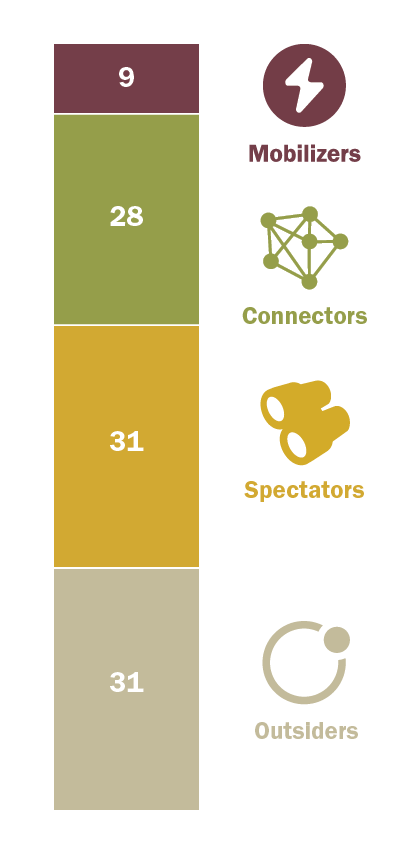
“How Americans Are Engaged With News, Politics, Religion and Civic Life”
| Group | Percentage |
|---|---|
| Mobilizers | 9 |
| Connectors | 28 |
| Spectators | 31 |
| Outsiders | 31 |
“How Americans Are Engaged With News, Politics, Religion and Civic Life”
Americans’ engagement with others is not one-dimensional, according to a new Pew Research Center study from the Pew-Knight Initiative. We looked across a range of behaviors: political activity, civic involvement, religious attendance and attention to news. What we found was that rather than falling along a single spectrum, U.S. adults sort into four distinct groups that reflect different patterns of participation:
- Mobilizers (9% of U.S. adults) are the most active across all the different areas. They volunteer, attend local government meetings, donate to political causes, follow the news closely and attend religious services at high rates. What sets them apart most clearly is their political action: They are by far the most likely to do things like volunteer for campaigns and contact elected officials.
- Connectors (28%) are involved in many ways, centering on community life, charitable giving and religious attendance. They vote, participate in groups, attend religious services and donate to nonpolitical causes at high rates, similar to Mobilizers. But they are much less likely to take political action.
- Spectators (31%) are much less likely than Mobilizers and Connectors to participate in civic or political activities, but they follow the news at similarly high rates. When they engage with news online, Spectators tend to do so by privately chatting about it or liking posts rather than publicly commenting or posting.
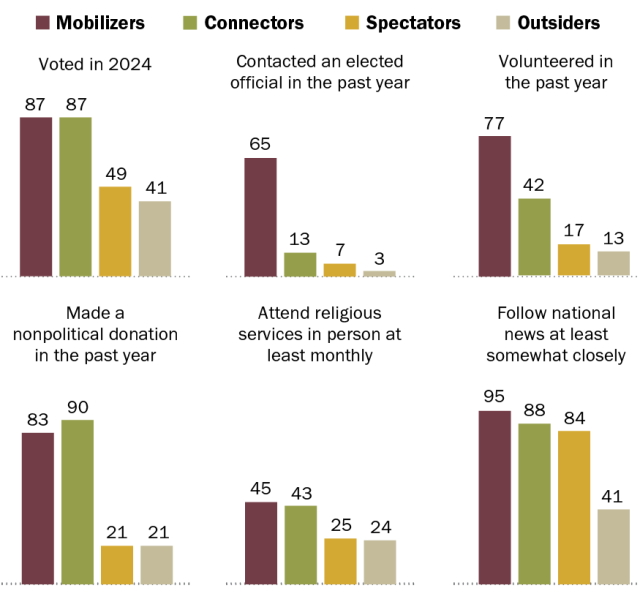
- Outsiders (31%) participate at relatively low levels across the activities measured in this study, including following the news. Still, they are not universally disengaged: 41% say they voted in 2024, and 24% attend religious services at least monthly.
| Mobilizers | Connectors | Spectators | Outsiders | |
|---|---|---|---|---|
| Say they voted in 2024 | 87 | 87 | 49 | 41 |
| Contacted an elected official in the past year | 65 | 13 | 7 | 3 |
| Volunteered in the past year | 77 | 42 | 17 | 13 |
| Made a nonpolitical donation in the past year | 83 | 90 | 21 | 21 |
| Attend religious services in person at least monthly | 45 | 43 | 25 | 24 |
| Follow national news at least somewhat closely | 95 | 88 | 84 | 41 |
Refer to the appendix for the full list of 19 questions that were used to create these groups, as well as how each group answered all of the questions. Read “How we measured Americans’ engagement in public life” for a detailed look at how we conducted this study.
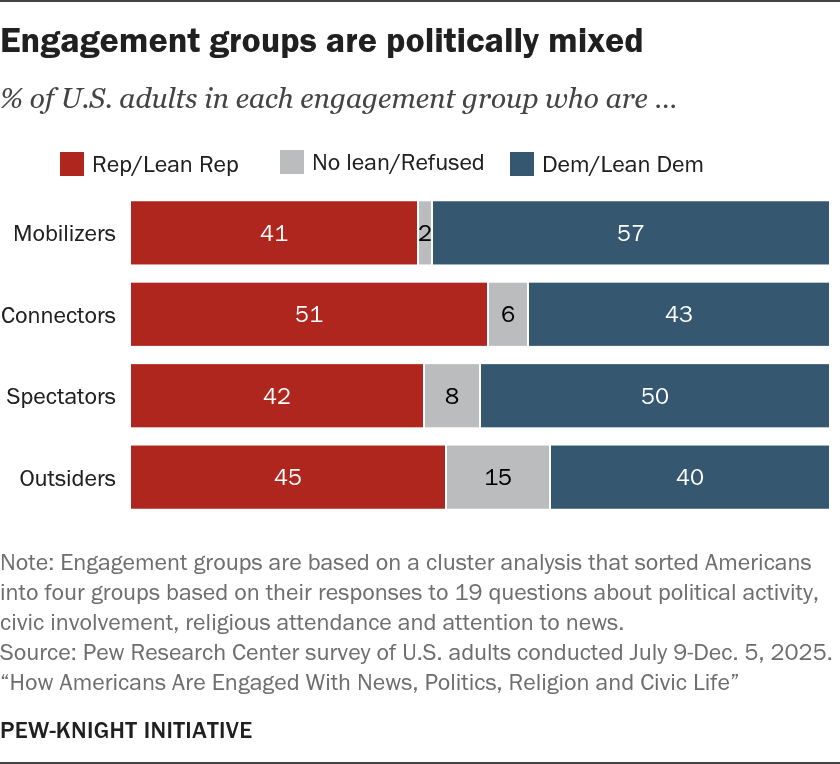
Although political polarization has been a defining fact of American life in the 21st century, none of the four groups is dominated by one political party.
| Rep/Lean Rep | No lean/Refused | Dem/Lean Dem | |
|---|---|---|---|
| Mobilizers | 41 | 2 | 57 |
| Connectors | 51 | 6 | 43 |
| Spectators | 42 | 8 | 50 |
| Outsiders | 45 | 15 | 40 |
The two most highly engaged groups lean modestly in different directions politically: Mobilizers are slightly more likely to be Democrats (or lean Democratic) and Connectors are a bit more likely to be Republicans or GOP leaners. But it is clear that members of both parties engage – or don’t – in a variety of ways.
Why study this now?
Concerns about whether Americans are retreating from various forms of engagement with society are not new. Declines in religious attendance, civic group memberships and attention to news have been well documented. And questions about how Americans participate have taken on new dimensions after the COVID-19 pandemic forced the cancellation of countless social activities.
Yet broad claims about whether Americans are “engaged” or “disengaged” – and how this is changing over time – are difficult to assess. Participation in public life takes many forms, from attending a school board meeting in person to sharing a news article online, and it is not easily captured by any single measure. The way people engage also is evolving along with technological changes.
To better capture the full range of how Americans participate, this study looked at several ways Americans engage (or don’t) with the world around them, using a large, one-time national survey. The survey was conducted in late 2025 and was designed to capture the opinions of Americans who engage at different levels, offering respondents the chance to complete the survey on paper, by phone, or online, and making multiple efforts to contact people who didn’t initially respond.
Below, we take a closer look at each of the four groups.
You can also explore more in depth:
- Age: How younger and older Americans engage in society differently
- Politics: How engagement plays out for both Republicans and Democrats
- Attitudes: How engagement is linked with Americans’ feelings about politics, news and the state of the country and their communities
- Knowledge: How engagement is linked with civic knowledge
 Mobilizers

“How Americans Are Engaged With News, Politics, Religion and Civic Life”
| Displayed a sign/bumper sticker or wore something for a candidate/cause in the past year | Attended a local government meeting in the past year | Discuss news every day | |
|---|---|---|---|
| Mobilizers | 74 | 44 | 61 |
| Connectors | 14 | 14 | 30 |
| Spectators | 13 | 11 | 28 |
| Outsiders | 4 | 5 | 6 |
“How Americans Are Engaged With News, Politics, Religion and Civic Life”
About one-in-ten U.S. adults (9%) are highly engaged across politics, civic life, news and religion.
Mobilizers stand out for the breadth and frequency of their participation. A large majority (77%) have volunteered in the past 12 months, and 73% have been members of a group, organization or association during this time. Among U.S. adults overall, roughly three-in-ten participate in these activities.
What sets the Mobilizers apart most clearly is their political activity over the past year – especially behaviors that are relatively rare among the broader public. About three-quarters of Mobilizers (74%) say they have displayed a sign, bumper sticker or clothing item for a political cause or candidate. Roughly two‑thirds (65%) say they have contacted an elected representative. And about one-in-five (21%) have volunteered for a political campaign.
Who are Mobilizers?
Demographically, Mobilizers are much more likely than Americans overall to have high levels of education and income. And as mentioned above, Mobilizers are more likely to identify with or lean toward the Democratic Party (57%) than the Republican Party (41%).
| Group | College+ | Some college | HS or less |
|---|---|---|---|
| Mobilizers | 53 | 28 | 19 |
| All U.S. adults | 35 | 28 | 35 |
| $100K+ | $30K-<$100K | <$30K | |
| Mobilizers | 47 | 36 | 13 |
| All U.S. adults | 31 | 43 | 20 |
Mobilizers also include higher shares of both conservative Republicans and liberal Democrats than U.S. adults as a whole. And they stand out in their ideological intensity: Republicans in this group are more likely than Republicans in other groups to describe themselves as very conservative, while Democrats are more likely to describe themselves as very liberal.
Refer to the detailed tables for demographic breakdowns of all four engagement groups.

| Conservative Republican | Mod/Lib Rep | Mod/Cons Dem | Liberal Democrat | Other | |
|---|---|---|---|---|---|
| Mobilizers | 32 | 9 | 22 | 35 | 2 |
| All U.S. adults | 26 | 19 | 25 | 20 | 10 |
 Connectors
“How Americans Are Engaged With News, Politics, Religion and Civic Life”
| Made a nonpolitical donation in the past year | Were part of a group or organization in the past year | Attend religious services in person at least monthly | |
|---|---|---|---|
| Mobilizers | 83 | 73 | 45 |
| Connectors | 90 | 65 | 43 |
| Spectators | 21 | 10 | 25 |
| Outsiders | 21 | 11 | 24 |
“How Americans Are Engaged With News, Politics, Religion and Civic Life”
As a group, Connectors are about triple the size of the Mobilizers, making up 28% of U.S. adults. They are active in many areas of public life but are less politically involved – and less interested in politics – than Mobilizers.
About two-thirds of Connectors (65%) were members of a group, association or organization in the past year, though they are less likely than Mobilizers to hold leadership roles within those groups. They tend to follow the news (national and local) and reported voting in 2024 at high rates, similar to Mobilizers. But they are less likely to contact elected officials, volunteer for campaigns or display public support for political causes (whether online or not).
Their engagement centers on community life rather than politics. Nine‑in‑ten say they have donated to nonpolitical organizations like charities. Connectors also attend religious services at a similar rate to Mobilizers.
Who are Connectors?
The Connectors resemble the Mobilizers in some ways: They tend to have higher levels of education and income than the general public. They are also older and somewhat more likely to be White. They are made up of slightly more Republicans than Democrats.
Refer to the detailed tables for demographic breakdowns of all four engagement groups.
“How Americans Are Engaged With News, Politics, Religion and Civic Life”
| Group | Ages 18-29 | 30-49 | 50-64 | 65+ |
|---|---|---|---|---|
| Connectors | 10 | 28 | 26 | 35 |
| All U.S. adults | 19 | 34 | 24 | 23 |
| White | Hispanic | Black | Asian* | |
| Connectors | 70 | 11 | 9 | 5 |
| All U.S. adults | 59 | 18 | 11 | 6 |
| College+ | Some college | HS or less | ||
| Connectors | 52 | 27 | 20 | |
| All U.S. adults | 35 | 28 | 35 | |
| $100K+ | $30K-<$100K | <$30K | ||
| Connectors | 45 | 42 | 8 | |
| All U.S. adults | 31 | 43 | 20 |
“How Americans Are Engaged With News, Politics, Religion and Civic Life”
 Spectators
| Follow national news at least somewhat closely | Liked or saved online posts about news in the past week | Privately chatted about or shared news online in the past week | |
|---|---|---|---|
| Mobilizers | 95 | 85 | 89 |
| Connectors | 88 | 39 | 62 |
| Spectators | 84 | 75 | 85 |
| Outsiders | 41 | 7 | 12 |
About three-in-ten Americans are Spectators (31%). These are people who follow the news at high rates but largely stay on the sidelines of other civic and political activities.
For example, 84% say they follow national news at least somewhat closely, and three-quarters say they liked or saved an online post about news in the past week. But they are much less likely than Mobilizers or Connectors to vote, volunteer or belong to a group or organization.
Even when Spectators engage with news online, they are much more likely to like a post or privately chat about it than to publicly comment. Many also say they discuss news with others at least a few times a week. But most do not describe themselves as highly interested in politics.
Who are Spectators?
Spectators are by far the youngest group: 28% are under 30 and 64% are under 50. They stand out for their internet use – 56% say they use the internet “almost constantly.” They are also less likely to be White, and more likely to identify as politically moderate compared with Mobilizers and Connectors.
Refer to the detailed tables for demographic breakdowns of all four engagement groups.
“How Americans Are Engaged With News, Politics, Religion and Civic Life”
| Group | Ages 18-29 | 30-49 | 50-64 | 65+ |
|---|---|---|---|---|
| Spectators | 28 | 36 | 20 | 15 |
| All U.S. adults | 19 | 34 | 24 | 23 |
| $100K+ | $30K-<$100K | <$30K | ||
| Spectators | 25 | 47 | 24 | |
| All U.S. adults | 31 | 43 | 20 | |
| White | Hispanic | Black | Asian* | |
| Spectators | 49 | 25 | 13 | 8 |
| All U.S. adults | 59 | 18 | 11 | 6 |
“How Americans Are Engaged With News, Politics, Religion and Civic Life”
 Outsiders
| Volunteered in the past year | Voted in 2024 | Attend religious services in person at least monthly | |
|---|---|---|---|
| Mobilizers | 77 | 87 | 45 |
| Connectors | 42 | 87 | 43 |
| Spectators | 17 | 49 | 25 |
| Outsiders | 13 | 41 | 24 |
About three-in-ten Americans (31%) participate at low levels across the activities measured in this study. Outsiders are less engaged than Americans overall on every kind of measure – from more demanding activities like volunteering and attending meetings to lower-threshold behaviors like voting or following the news. They are also less likely to attend religious services, even though they are no less likely to say they believe in God.
Some Outsiders do participate in these activities – 41% say they voted in 2024, and 24% say they attend religious services in person at least monthly – but this group is clearly the least engaged. Very few take part in political activities like volunteering or advocacy.
While Outsiders are similar to Spectators in their rates of voting and volunteering, they stand out for their much lower level of attention to the news. For example, 41% of Outsiders say they follow national news at least somewhat closely, compared with 84% of Spectators. And just 7% of Outsiders say they have liked or saved a post about the news online in the past week – versus 75% of Spectators.
Who are Outsiders?
| Group | College+ | Some college | HS or less |
|---|---|---|---|
| Outsiders | 23 | 28 | 48 |
| All U.S. adults | 35 | 28 | 35 |
| $100K+ | $30K-<$100K | <$30K | |
| Outsiders | 20 | 43 | 31 |
| All U.S. adults | 31 | 43 | 20 |
Outsiders are similar to the U.S. population as a whole in terms of age and gender. They are fairly evenly split by political party, and about half (48%) describe their political views as moderate. They are distinguished primarily by lower levels of education and income: About half have a high school diploma or less education, and 31% are in lower-income households.
Refer to the detailed tables for demographic breakdowns of all four engagement groups.
CORRECTION (July 17, 2026): In the chart titled “How 4 groups vary by key measures of social and civic engagement,” some y-axes have been rescaled for consistency across the graphic. The figures and findings in this report were not affected.


