This report from the Pew-Knight Initiative examines how Americans engage in public life across a range of activities, including politics, civic and community involvement, news consumption and religious participation. It analyzes how patterns of engagement, when clustered together, can form distinct groups within the U.S. public. It also explores how these engagement groups differ in their demographics, attitudes and levels of civic knowledge.
The report draws from nationally representative surveys of U.S. adults (refer to “How we did this” below). Many questions in these surveys asked about behaviors in the past 12 months, which for most respondents included the 2024 presidential election. Responses reflect the activities Americans took part in during this specific period. Patterns around political activity in particular may look somewhat different at other points in the political cycle.
Why we did this
People participate in public life in different ways – from voting and volunteering to following the news and taking part in religious or community activities. But these behaviors are often studied separately, making it difficult to see how they come together in people’s day-to-day lives. We conducted this study to provide a more integrated picture of how the public engages across these different domains.
We also used a specially designed survey with the awareness that some surveys can struggle to reach Americans who are less likely to participate in public life – because these same people also may be less likely to participate in surveys.
How we did this
This analysis draws on two Pew Research Center surveys.
The main data source is the Cross‑Sectional Engagement Survey, fielded July 9 to Dec. 5, 2025, among 5,393 adults. People could respond online, on paper or by telephone, and we reached out multiple times to people who didn’t initially respond. Refer to the methodology for details.
We also used data from Wave 179 of the American Trends Panel (ATP), a nationally representative panel of randomly selected U.S. adults, conducted Sept. 8-14, 2025, among 5,195 respondents via web and phone.
To classify Americans into engagement groups, we did a cluster analysis of the Cross-Sectional Engagement Survey based on 19 measures of participation across the range of activities mentioned above. Respondents in the ATP survey were assigned to these groups based on how similar their patterns of behavior were to those identified in the cross‑sectional survey. We used the ATP survey to examine engagement groups’ levels of civic knowledge and views of politics and news. Refer to “How we measured Americans’ engagement in public life” for details on questionnaire design and data analysis approaches.
Americans who participate more in public life are more interested in politics – and more likely to have positive feelings about the state of their local communities.
In a new study, we sorted U.S. adults into four groups based on their answers to questions about how they engage in public life. The least active group, Outsiders, are less likely than other groups to say they have negative feelings about the state of the country.
Outsiders are also less likely to trust news organizations. But trust in the federal government is similarly low across all four groups – and engagement makes little difference.
Highly engaged Americans are more interested in politics
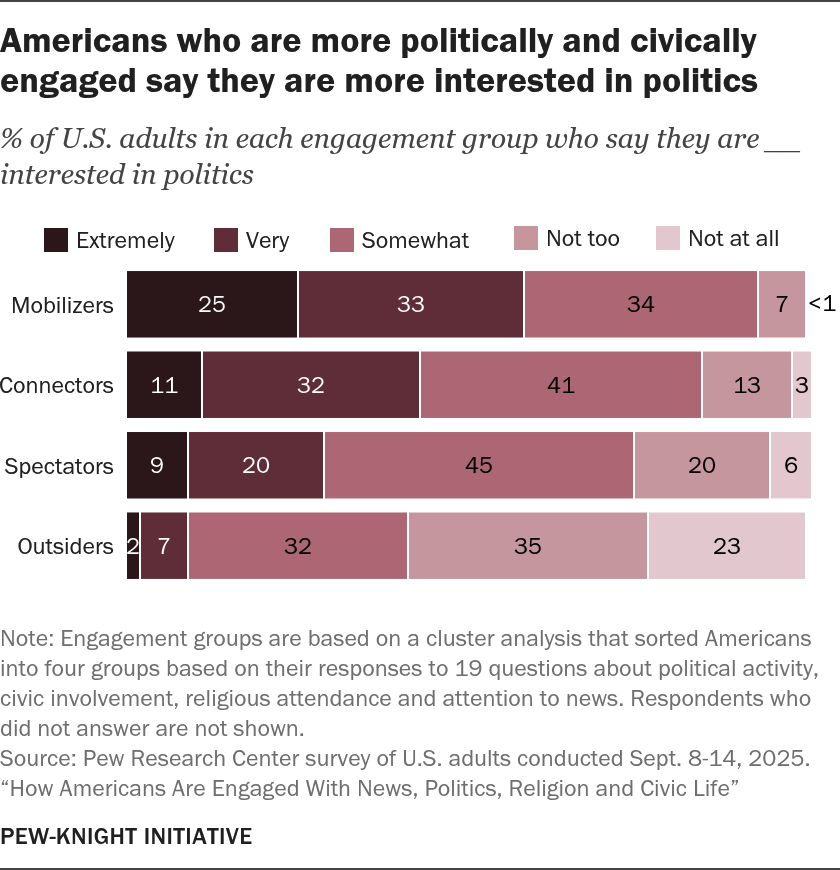
Americans who are more politically and civically engaged say they are more interested in politics
% of U.S. adults in each engagement group who say they are __ interested in politics
Note: Engagement groups are based on a cluster analysis that sorted Americans into four groups based on their responses to 19 questions about political activity, civic involvement, religious attendance and attention to news. Respondents who did not answer are not shown.
Source: Pew Research Center survey of U.S. adults conducted Sept. 8-14, 2025.
“How Americans Are Engaged With News, Politics, Religion and Civic Life”
PEW-KNIGHT INITIATIVE
Share this chart
Americans who are more politically and civically engaged say they are more interested in politics
% of U.S. adults in each engagement group who say they are __ interested in politics
Note: Engagement groups are based on a cluster analysis that sorted Americans into four groups based on their responses to 19 questions about political activity, civic involvement, religious attendance and attention to news. Respondents who did not answer are not shown.
Source: Pew Research Center survey of U.S. adults conducted Sept. 8-14, 2025.
“How Americans Are Engaged With News, Politics, Religion and Civic Life”
PEW-KNIGHT INITIATIVE
Americans who are more engaged in public life are consistently more likely to say they are interested in politics. This pattern aligns with decades of research noting political interest as a driving force behind civic engagement.
A majority of Mobilizers (58%) say they are extremely or very interested in politics. Fewer than half of Connectors (43%) say the same, as do an even smaller share of Spectators (28%).
Only 9% of Outsiders say they’re highly interested in politics. Among this least engaged group, a majority say they are either not too interested (35%) or not at all interested (23%) in politics.
This pattern holds across party lines:Within each engagement group, Democrats and Republicans (including independents who lean toward each party) report similar levels of interest in politics.
About the engagement groups
This study sorts Americans into four groups based on their answers to 19 questions about how they engage (or don’t engage) in society through political activity, civic involvement, religious service attendance and attention to news. The four groups are:
Mobilizers: Doing it all. This group is the smallest and the most active across politics, civics, news and religion.
Connectors: Involved, but less political. This group is larger than the Mobilizers and also highly engaged in many ways – including joining groups and making donations – but much less likely than the Mobilizers to be heavily involved in political activities.
Spectators: Keeping an eye on things. They follow the news at high rates but are much less likely than the more engaged groups to participate directly in other ways.
Outsiders: Less involved in most ways. This group is less likely than others to report taking part in most of the activities we asked about – including voting, volunteering and following the news.
How engagement relates to feelings about America and local communities
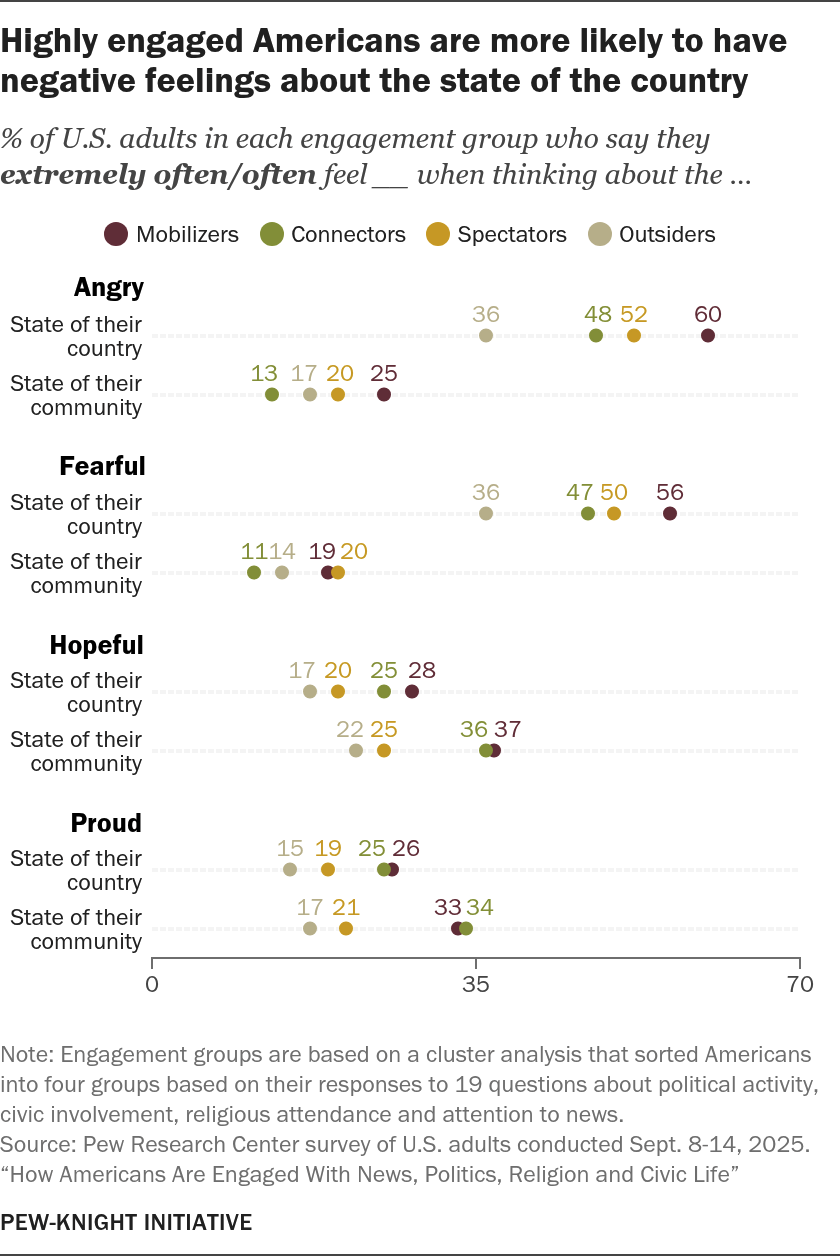
Highly engaged Americans are more likely to have negative feelings about the state of the country
% of U.S. adults in each engagement group who say they extremely often/often feel __ when thinking about the …
Note: Engagement groups are based on a cluster analysis that sorted Americans into four groups based on their responses to 19 questions about political activity, civic involvement, religious attendance and attention to news.
Source: Pew Research Center survey of U.S. adults conducted Sept. 8-14, 2025.
“How Americans Are Engaged With News, Politics, Religion and Civic Life”
PEW-KNIGHT INITIATIVE
Share this chart
Highly engaged Americans are more likely to have negative feelings about the state of the country
% of U.S. adults in each engagement group who say they extremely often/often feel __ when thinking about the …
Note: Engagement groups are based on a cluster analysis that sorted Americans into four groups based on their responses to 19 questions about political activity, civic involvement, religious attendance and attention to news.
Source: Pew Research Center survey of U.S. adults conducted Sept. 8-14, 2025.
“How Americans Are Engaged With News, Politics, Religion and Civic Life”
PEW-KNIGHT INITIATIVE
No matter how engaged they are, Americans are more likely to report feeling angry and fearful than hopeful or proud when thinking about the state of the country. But negative emotions about the state of local communities are much less common.
There are a few noticeable patterns in these questions based on how engaged people are:
The most engaged adults are the most likely to have negative feelings about the state of the country. Six-in-ten Mobilizers say they feel angry extremely often or often when thinking about the state of the country, compared with about half or fewer within all other groups. A similar pattern appears on the question of feeling fearful.
More engaged groups are also more inclined to say they have positive feelings about the state of their local community. For instance, 37% of Mobilizers and 36% of Connectors say they often or extremely often feel hopeful about their community, compared with 25% of Spectators and 22% of Outsiders. There is a similar pattern when it comes to feelings of pride.
Connectors – who are highly involved in civic and community life but less involved in politics – are less likely than Mobilizers to say they often feel angry or fearful about the state of their community and their country.
Americans have low trust in federal government regardless of engagement level
Low trust in federal government across Americans’ engagement levels
% of U.S. adults in each engagement group who say they think they can trust the federal government to do what is right just about always/most of the time
Note: Engagement groups are based on a cluster analysis that sorted Americans into four groups based on their responses to 19 questions about political activity, civic involvement, religious attendance and attention to news.
Source: Pew Research Center survey of U.S. adults conducted Sept. 8-14, 2025.
“How Americans Are Engaged With News, Politics, Religion and Civic Life”
PEW-KNIGHT INITIATIVE
Share this chart
Low trust in federal government across Americans’ engagement levels
% of U.S. adults in each engagement group who say they think they can trust the federal government to do what is right just about always/most of the time
Note: Engagement groups are based on a cluster analysis that sorted Americans into four groups based on their responses to 19 questions about political activity, civic involvement, religious attendance and attention to news.
Source: Pew Research Center survey of U.S. adults conducted Sept. 8-14, 2025.
“How Americans Are Engaged With News, Politics, Religion and Civic Life”
PEW-KNIGHT INITIATIVE
Trust in the federal government is low no matter how engaged people are. But trust in news and information sources differs by group, especially among Outsiders.
Trust in the federal government
Roughly one-in-five adults in each group say they think they can trust the federal government to do what is right just about always or most of the time.
Overall, Republicans are more likely than Democrats to express trust in the federal government – consistent with Republicans controlling the White House and Congress when the survey was conducted.
Trust in information sources
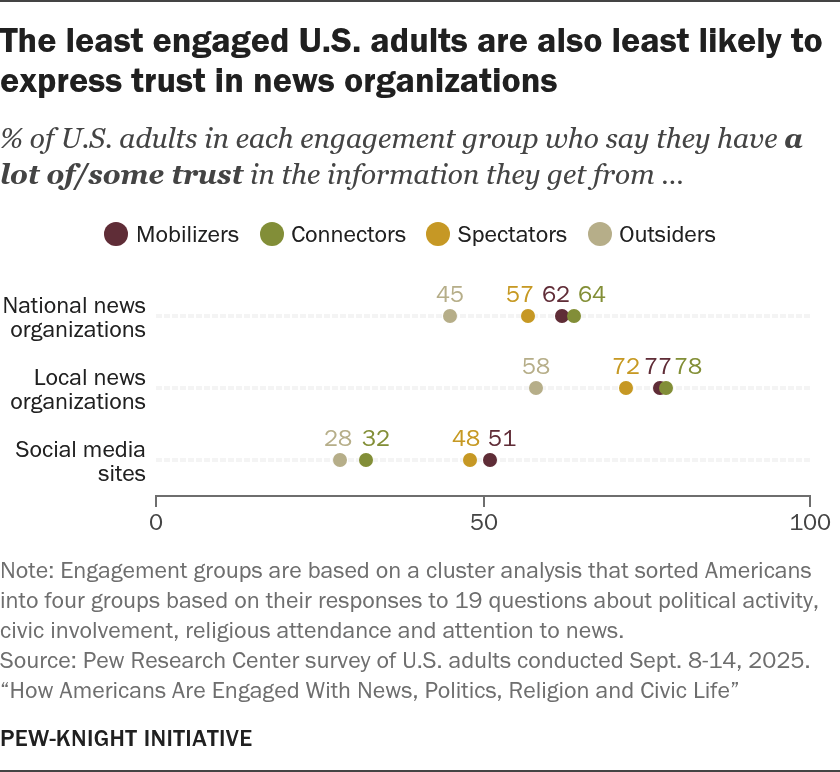
Unlike trust in the federal government, trust in the news media differs more clearly by level of engagement.
Majorities of Mobilizers (62%), Connectors (64%) and Spectators (57%) say they have at least some trust in the information they get from national news organizations. By comparison, fewer Outsiders (45%) say the same. About one‑in‑five Outsiders (18%) say they have no trust at all in national news organizations.
Trust in local news organizations is higher overall than trust in national news. But there is a similar pattern by engagement: Outsiders are less likely than other groups to say they have at least some trust in the information they get from local news organizations.
About half of Mobilizers (51%) and Spectators (48%) say they have at least some trust in the information they get from social media. Smaller shares of Connectors (32%) and Outsiders (28%) say the same.
The least engaged U.S. adults are also least likely to express trust in news organizations
% of U.S. adults in each engagement group who say they have a lot of/some trust in the information they get from …
Note: Engagement groups are based on a cluster analysis that sorted Americans into four groups based on their responses to 19 questions about political activity, civic involvement, religious attendance and attention to news.
Source: Pew Research Center survey of U.S. adults conducted Sept. 8-14, 2025.
“How Americans Are Engaged With News, Politics, Religion and Civic Life”
PEW-KNIGHT INITIATIVE
Share this chart
The least engaged U.S. adults are also least likely to express trust in news organizations
% of U.S. adults in each engagement group who say they have a lot of/some trust in the information they get from …
Note: Engagement groups are based on a cluster analysis that sorted Americans into four groups based on their responses to 19 questions about political activity, civic involvement, religious attendance and attention to news.
Source: Pew Research Center survey of U.S. adults conducted Sept. 8-14, 2025.
“How Americans Are Engaged With News, Politics, Religion and Civic Life”
PEW-KNIGHT INITIATIVE
As with other sources, Outsiders are most likely to say they have no trust at all in information from social media, with three-in-ten expressing this view.
However, Mobilizers and Outsiders – the two groups with the starkest differences in trust – have similar age compositions. This suggests that engagement, not just age, is associated with Outsiders’ lower trust.
Doubts about fairness of news media exist across all engagement groups
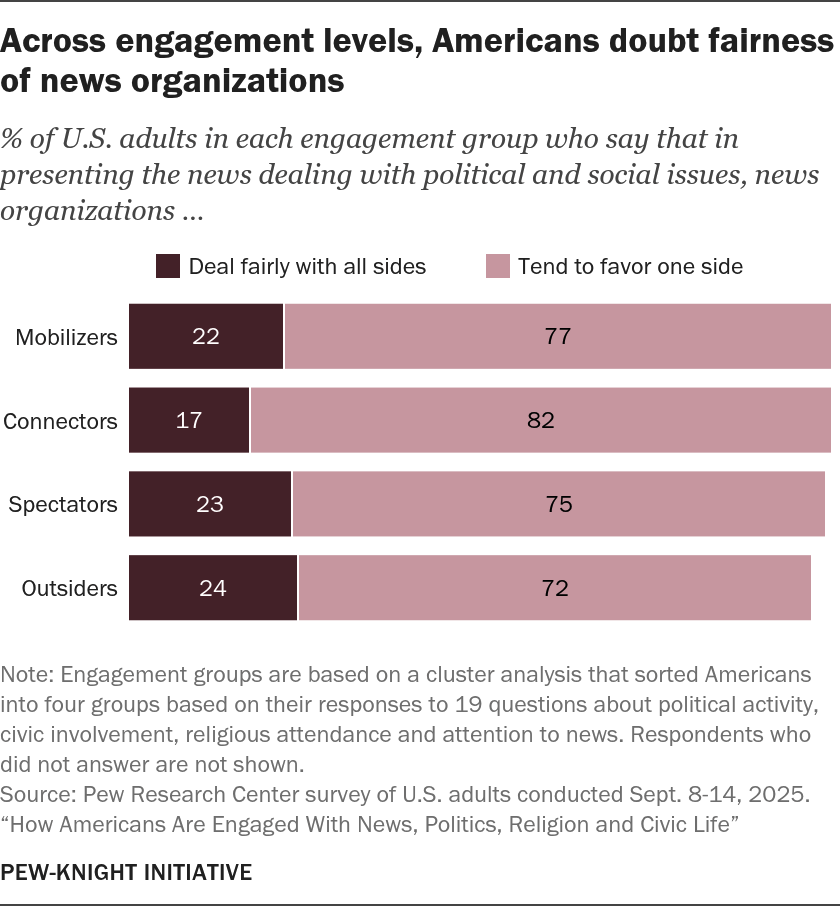
Across engagement levels, Americans doubt fairness of news organizations
% of U.S. adults in each engagement group who say that in presenting the news dealing with political and social issues, news organizations …
Note: Engagement groups are based on a cluster analysis that sorted Americans into four groups based on their responses to 19 questions about political activity, civic involvement, religious attendance and attention to news. Respondents who did not answer are not shown.
Source: Pew Research Center survey of U.S. adults conducted Sept. 8-14, 2025.
“How Americans Are Engaged With News, Politics, Religion and Civic Life”
PEW-KNIGHT INITIATIVE
Share this chart
Across engagement levels, Americans doubt fairness of news organizations
% of U.S. adults in each engagement group who say that in presenting the news dealing with political and social issues, news organizations …
Note: Engagement groups are based on a cluster analysis that sorted Americans into four groups based on their responses to 19 questions about political activity, civic involvement, religious attendance and attention to news. Respondents who did not answer are not shown.
Source: Pew Research Center survey of U.S. adults conducted Sept. 8-14, 2025.
“How Americans Are Engaged With News, Politics, Religion and Civic Life”
PEW-KNIGHT INITIATIVE
Levels of engagement do not always translate into major differences in how Americans view the news media. Across all engagement groups, for instance, many U.S. adults are skeptical that news organizations are fair.
Most Americans, regardless of how much they take part in civic life, say news organizations tend to favor one side when covering political and social issues. Connectors (82%) are modestly more likely than other groups to say this.
Across all engagement groups, Republicans are more likely than Democrats to say news organizations favor one side politically. Still, majorities of Democrats in every group also hold this view.
The four engagement groups also express similar views on the news media’s “watchdog” role. Across these groups, most Americans say that media criticism keeps political leaders from doing things that shouldn’t be done, although Outsiders are slightly less likely to express this view. The view that criticism keeps political leaders from doing their jobs is much less common in all four groups.

 Mobilizers: Doing it all. This group is the smallest and the most active across politics, civics, news and religion.
  Connectors: Involved, but less political. This group is larger than the Mobilizers and also highly engaged in many ways – including joining groups and making donations – but much less likely than the Mobilizers to be heavily involved in political activities.
 Spectators: Keeping an eye on things. They follow the news at high rates but are much less likely than the more engaged groups to participate directly in other ways.
 Outsiders: Less involved in most ways. This group is less likely than others to report taking part in most of the activities we asked about – including voting, volunteering and following the news.