
One challenge pollsters face when weighting surveys based on people’s self-reported political party affiliation is that the population target can change fairly quickly. One year, Americans may be evenly divided between Republicans and Democrats. The next year, politics may shift and one party clearly outnumbers the other in supporters.
Weighting to the shares of Republicans and Democrats nationwide has the potential to align a poll with an outdated snapshot of the country. This can happen if there is political change between when the benchmark survey was fielded and when the current poll was fielded.
(This is part of a larger Pew Research Center report about political weighting – adjusting a survey to reflect the political composition of the United States as accurately as possible. For an overview and the report’s key takeaways, read “Weighting Polls on Party Affiliation and Past Vote.”)
An underappreciated fact about polling is how survey panels can neutralize this problem. The key is understanding that with a panel, there can be two measurements of political party affiliation for each panelist:
- One measured contemporaneously with the benchmark (in the past)
- Another measured in the current poll (in the present)
Pollsters can use the past measurement in weighting, so that the benchmark and weighting variable are apples to apples (i.e., party affiliation measured for the population and in the survey of interest at roughly the same point in time). For reporting and analytic purposes, though, pollsters use the current measurement. That way, their analysis reflects current public opinion, not public opinion from months ago.
Here is a real-world example from Pew Research Center’s American Trends Panel:
In early and mid-2025, we measured political party affiliation for all panelists, whether in the Center’s National Public Opinion Reference Survey (NPORS) benchmarking survey itself – for those new to the panel in 2025 – or just after NPORS came out of the field for current panelists. At the time, NPORS found Americans were about evenly split (46% Republican or leaning Republican and 45% Democratic or leaning Democratic).
Fast forward to spring 2026. There had been a record-long federal government shutdown and debate over the administration’s tariff and immigration enforcement policies, among other national news stories. It was possible that some Americans’ political party identification shifted during this period from spring 2025 to spring 2026.
From May 26 to June 1, 2026, the Center conducted another panel survey (described here as the May 2026 poll) and re-asked party affiliation. At that point, we had two party affiliation measurements from the same people: the past measurement contemporaneous with the benchmark and the current measurement from the latest poll.
Per standard practice, we weighted the May 2026 poll on party affiliation as well as other variables. Critically, the past measurement of party affiliation (from summer 2025) was aligned with the benchmark taken at about the same time (2025 NPORS).
When reporting results from the May 2026 poll, researchers used the current political party affiliation measurement. That current measurement was not used in the weighting. In other words, the poll was allowed to capture real change in Americans’ political views since the benchmark survey (and the past panel measurement) was fielded. The measurement from the May 2026 poll was 45% Republican or leaning Republican and 49% Democratic or leaning Democratic (similar to the 4 percentage point gap of 43% Republican or leaning Republican and 47% Democratic or leaning Democratic found in the 2026 NPORS survey, which was taking place around the same time).
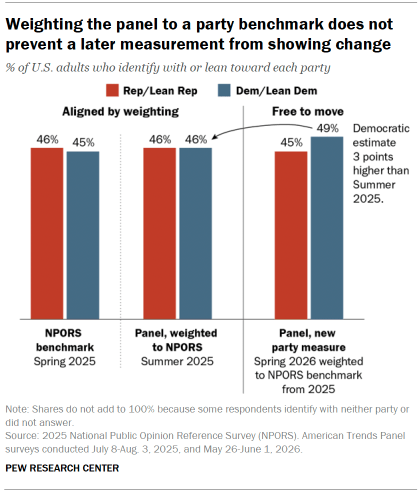
That example demonstrates how it’s possible to both align a poll with a party affiliation benchmark and allow the current poll to get a new measurement. This is only possible, however, with a survey panel or reinterview with the same respondents.
For one-off surveys, there is no past measurement taken contemporaneously with a benchmark survey. Typically, all a pollster can do is gather a current measurement of political party. This situation is not bad, per se. It just means the pollster’s options are more limited.
They could weight to a party affiliation estimate obtained from some external source, such as NPORS or an average from other polling organizations. Arguably, that choice prioritizes bias reduction over being able to report a party affiliation estimate from the pollster’s new poll, assuming that the estimate from an external source is judged to be more accurate. Alternatively, the pollster could refrain from weighting on party affiliation and report a party affiliation estimate from the poll.
Only when there is a prior measurement for the same respondents, as with a panel, can a pollster do both.
Jump ahead for FAQs about political weighting, including its shortcomings.


