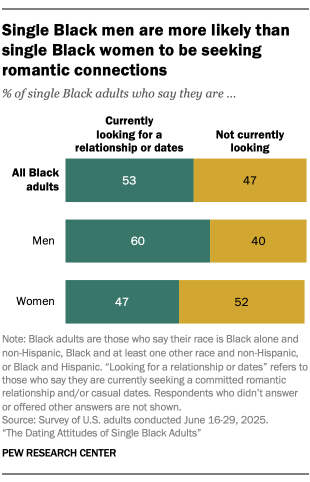
Among single Black adults, men are more likely than women to say they are looking for a romantic relationship or dates. And among those currently looking, women are more likely than men to say they want a committed romantic relationship rather than casual dates.
Single Black men and women who are looking for a relationship or dates tend to value many of the same qualities in a potential match. Majorities say it’s extremely or very important for a good spouse or partner to be caring and compassionate, romantic, to help with household chores, and to believe in God.
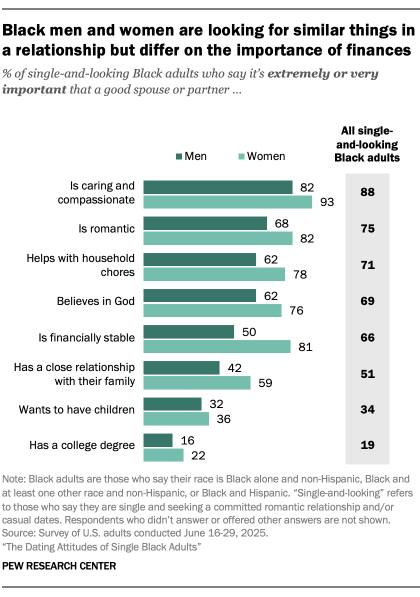
However, women place greater importance than men on most of these characteristics.
Single Black women are also far more likely than men to say it’s important that their partner is financially stable. And they’re more likely to say they would not consider a relationship with someone who earns much less than they do or has significant debt.1
These findings come from a Pew Research Center survey of 4,271 Black adults conducted in June 2025.
Singles make up a large share of Black Americans: 42% of Black adults are not married, living with a partner or in a committed romantic relationship. By comparison, 29% of other U.S. adults are single.
And among all singles, Black adults are more likely than White adults to say they are looking for a relationship or dates (53% vs. 36%) and about as likely to say this as Hispanic adults (49%).2
This report explores three questions:
- What types of relationships are Black singles are looking for, if any?
- What characteristics do Black singles consider when assessing a potential partner?
- Why do Black singles who are not currently in a relationship say this is the case?
What share of U.S. Black adults are single?
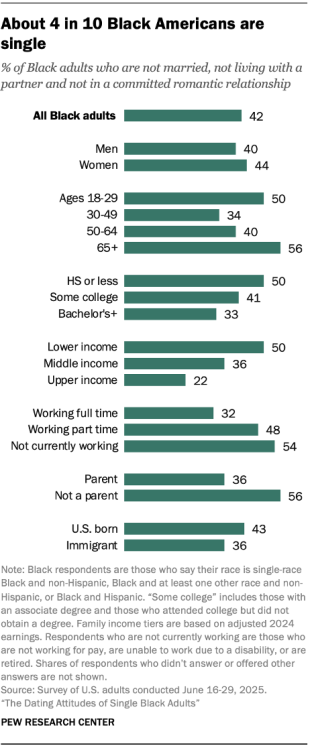
About four-in-ten Black adults are single (42%), according to a Pew Research Center survey conducted in June 2025.
In this analysis, single adults are those who are not married, not living with a partner and not in a committed romantic relationship.
Black women and men are about as likely to be single (44% and 40%), but there are gaps among other demographic subgroups.
Being single is more common among:
- Black adults in the youngest (ages 18 to 29) and oldest (ages 65 and older) age categories, when compared with those ages 30 to 49 and 50 to 64
- Black adults with a high school diploma or less education, compared with those with some college education and those with a bachelor’s degree or more
- Black adults with lower income, when compared with those with middle and upper incomes
- Black adults who are not parents, compared with Black parents
What kinds of relationships are Black singles looking for?
About half of single Black adults (53%) are “single and looking” – meaning they are seeking a committed romantic relationship, casual dates or both.
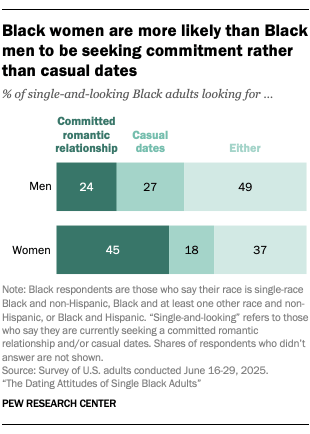
Among those who are single and looking, Black women are more likely than men to say they are seeking a committed romantic relationship only (45% vs. 24%).
Meanwhile, Black men are more likely than women to say they are seeking casual dates only (27% vs. 18%).
Black men are also more likely than women to say they are open to either a committed relationship or casual dates (49% vs. 37%).
To read more about the dating outlook of Black singles by other characteristics, refer to the detailed tables in the appendix.
What are dealbreakers for Black singles?
We also asked single-and-looking Black adults about the reasons they might rule out someone as a partner. The largest shares say they would probably or definitely not consider ever being in a committed romantic relationship with someone who has a significant amount of debt (56%), lives far away (43%), is raising children from another relationship (38%) or has different religious views (38%).
Single-and-looking Black women and men also differ in whom they would rule out as a partner. Women are more likely than men to say they would probably or definitely not consider being in a committed relationship with someone who makes significantly less money than them (42% vs. 18%) or has significant debt (64% vs. 48%).
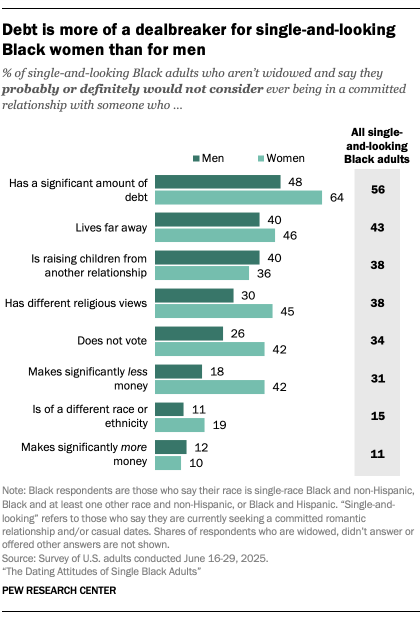
Additionally, single-and-looking Black women are more likely than Black men to rule out partners over civic, religious or racial differences:
- 42% of women would not consider being in a committed relationship with someone who does not vote, compared with 26% of men.
- 45% of women say they would not consider someone who has different religious views than their own; 30% of men say the same.
- 19% of women would not consider someone who is of a different race or ethnicity, compared with 11% of Black men.
On other factors, Black women and men are more alike. Similar shares say they would not consider a partner who lives far away from them (46% of women and 40% of men), who is raising children from another relationship (36% and 40%) or who makes significantly more money than them (10% and 12%).
Why do single-and-looking Black adults say they are single?
We offered single-and-looking Black adults a list of factors and asked them to choose the ones they believe are major reasons they are not currently in a relationship.
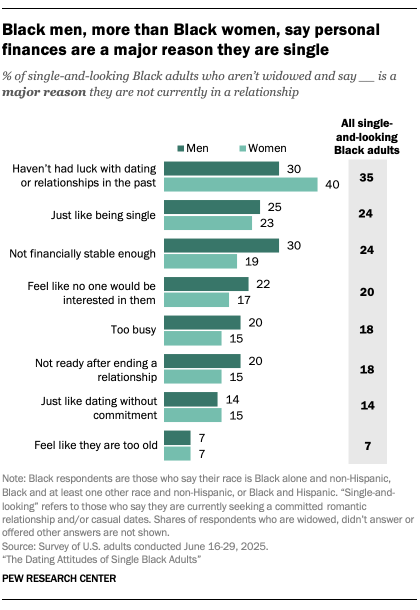
Not having luck with dating or relationships in the past is cited most often by single-and-looking Black adults as a major reason, though it’s chosen more commonly by women than men (40% vs. 30%).
Not being financially stable enough is another top reason, but it’s cited more often by men than women (30% vs 19%).3
What about Black adults who are not looking for a relationship?
We also asked Black singles who say they are not looking for a relationship why they are single.
Black singles who are not looking are substantially more likely than those who are looking to say they just like being single (42% vs. 24%). They are also less likely to cite bad luck in past relationships as a major reason (24% vs. 35%).
On the other reasons we asked about, there were no significant differences between single Black adults who are not looking for a relationship and those who are.