This Pew Research Center report on Israeli and Palestinian views of peaceful coexistence between Israel and an independent Palestinian state uses data from nationally representative surveys conducted in Israel and the West Bank and East Jerusalem.
We surveyed 1,001 Israeli adults from April 5 to May 6, 2026, and 1,038 Palestinian adults from March 30 to April 28, 2026. Surveys were conducted face-to-face in both places under the direction of Gallup. All responses are weighted to be representative of the adult population in each country. Read more about our international survey methodology.
Respondents in Israel and the West Bank and East Jerusalem were asked the following question: “Do you think a way can be found for Israel and an independent Palestinian state to coexist peacefully with each other, or not?” Those who provided a substantive response (“Yes,” “No” or volunteered “It depends”) were then asked, “In your own words, can you tell us why you feel that way?”
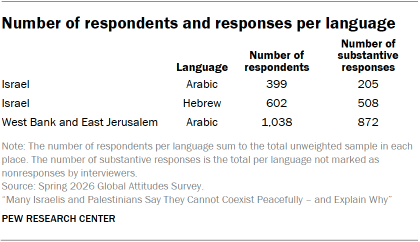
Responses were transcribed by interviewers in the language in which the interviews were conducted. More than 1,500 substantive responses were collected in Arabic and Hebrew. They were translated by cApStAn, a professional translation firm.
In the sections that follow, we detail how we coded these responses to use for analysis, as well as properties of the responses.
Some survey respondents did not answer the initial question about peaceful coexistence and, thus, were not asked to explain their answers. In addition, some respondents who were asked to explain their answers chose not to do so. This means the open-ended responses come from a subset of respondents.
Recognizing that the subset of respondents who explained their views in their own words may not be representative of the overall public in Israel or in the West Bank and East Jerusalem, we have presented the open-ended responses not as numerical point estimates but rather as direct quotes to illustrate each thematic issue.
Codebook development
To develop a codebook that captures the main things people in Israel and the West Bank and East Jerusalem talked about in relation to the prospect of peaceful coexistence between Israel and an independent Palestinian state, three Center researchers read through the responses in English, after they had been professionally translated from Arabic and Hebrew.
They then identified the key themes that commonly appeared in the responses using open coding. After developing an initial codebook, the researchers tested it on a random sample of 149 responses to evaluate the codebook’s conceptual validity, then reviewed disagreements and refined the codebook before coding the remaining responses.
Coding responses
The total of 1,585 responses were divided between the three researchers who developed the original codebook so that each response was coded by two researchers. Coding discrepancies were then reviewed and reconciled. Each researcher coded over 1,000 responses.
Below is a summary of the codebook. Codes are divided by the substantive response from which they were filtered. Keywords listed with each code represent examples indicating how a unit of information could be coded and are not a complete list of all concepts per code.
Researchers were not limited to a single code per response but instead chose to assign each response to as many codes as applicable.
Yes, can coexist
Interest in peace – I/the people want peace, benefits of peace, mutual interests, interpersonal relationships, past coexistence as proof it can work
Inevitability of peace – Neither group is going anywhere therefore we must learn to coexist, minimize harm, all wars end in peace, pressure from the international community to resolve the conflict, there is no other option
Diplomatic solution – Reckoning with the diplomatic process, affirming the Palestinian claim to statehood, past experiences with diplomacy, borders, rejection of the one-state solution
Conditional – Include the word “if”/use explicitly conditional language, if there is political will, if both sides compromise, contingent on specific proposals, international intervention, re-education of younger generations, change in leadership
No, cannot coexist
Land – The land cannot/should not be divided, rightful ownership, the other side is trying to seize all the land
Occupation of the West Bank – Material conditions related to the occupation, house demolitions, checkpoints, settlers, Israeli policies that target Palestinians
Threat to Israel – A Palestinian state poses a threat to Israel, surrounded by enemies
Violence – History of violence and war between the two peoples, October 7th, the war in Gaza, explicit mentions of violence and violent intent
Distrust – There is no trust, I don’t trust the other side, fear, the other side are traitors, liars
Fundamental incompatibility – Religious, cultural and ideological differences that cannot be reconciled, rejection of the other side’s national identity, rights or claims to statehood, hatred
No interest in peace – I/the people don’t want peace, the other side does not want peace
Lack of leadership and political will – Mentions of leaders by name, government, no political support for peace
Characteristics of the responses
Item nonresponse – the rate at which respondents say they “don’t know” or refuse to answer the question – varies across the two places surveyed.
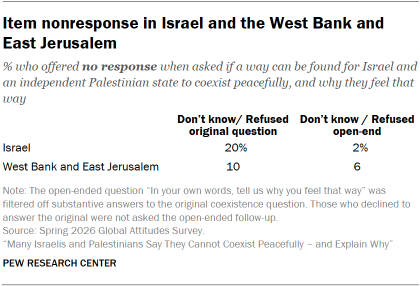
In Israel, 20% of respondents did not provide an answer to the original question about coexistence, including 14% of respondents who identified themselves as Jewish and 46% of respondents who self-identified as Arab. Another 2% gave a substantive answer to the question about coexistence but declined the open-ended follow-up.
In the West Bank and East Jerusalem, 10% of respondents said they “don’t know” or refused to answer the question about coexistence. And an additional 6% gave a substantive answer to the coexistence question but did not provide an open-ended response.
Selection of quotes
Open-ended responses included in the report were professionally translated and have been edited for clarity. They have been purposefully – not randomly – selected to illustrate key points and may not be representative of all responses for a given public. Quotes may also have been shortened in the report for concision. We view quotations as the opinions of the survey participants and do not attempt to check them for factual accuracy.