The work arrangements of moms and dads who are married or living together have changed considerably in recent decades. As of 2025, just over half (52%) of different-sex couples with children under 18 consist of two full-time working parents. This is up from 46% a decade ago and 31% in 1975, according to Pew Research Center analysis of U.S. Census Bureau data.
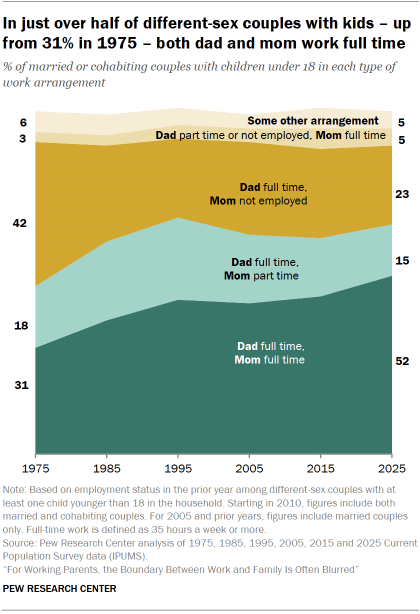
The share of couples where the dad works full time and the mom is not employed has dropped from 42% in 1975 to 23% in 2025.
To understand how parents see the impact of these different work arrangements, we asked working parents how their setup has affected:
- Their family’s financial situation
- Their children’s well-being
- Their relationship with their spouse or partner
- Their ability to advance in their job or career
This question was part of a larger survey about the experiences of U.S. working parents. Read key findings from the full study.
We find that parents in families where both the mom and the dad work at least part time are more likely to see financial benefits than those in families where the dad works full time and the mom isn’t employed. This is especially the case in families where both parents work full time.
In turn, those in families with a full-time working dad and a mom who isn’t employed are the most likely to see their arrangement as positive for their children’s well-being. (This finding reflects only dads’ opinions, as the survey sampled only employed parents.)
While this analysis focuses on couples, it is important to acknowledge that not all working parents are partnered: 14% of working parents are neither married nor living with a partner, as of 2025.
How family work arrangements differ by race and ethnicity
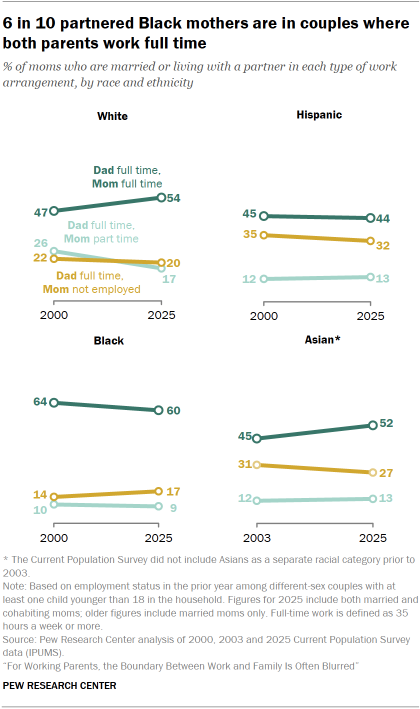
Most Black mothers married to or living with a male partner are in a family where both parents work full time (60%). This was already the case in 2000, when 64% were in this type of work arrangement. (This analysis focuses on trends in mothers’ work status because most fathers work full time and have done so in the past.)
Smaller shares of White (54%), Asian (52%) and Hispanic (44%) mothers in different-sex couples are in a family with two full-time working parents. The shares of White and Asian moms in this type of work arrangement have risen over the past 25 years.
The family work arrangements of Hispanic moms have been stable since 2000. About a third (32%) aren’t employed while their spouse or partner works full time. This is higher than the shares of Asian (27%), White (20%) and Black (17%) moms in such an arrangement today.
How family work arrangements differ by education
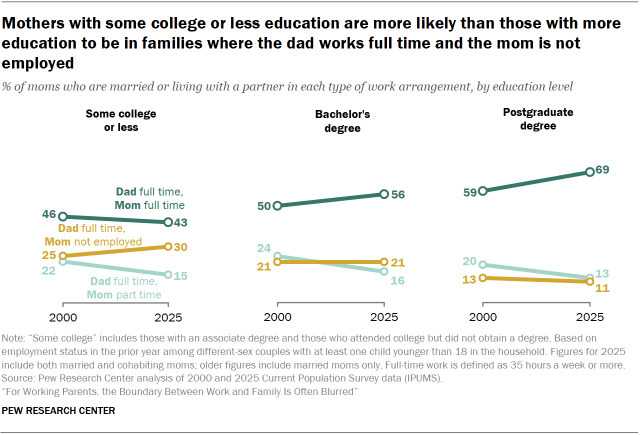
About seven-in-ten moms with a postgraduate degree married to or living with a male partner (69%) are in families where both parents work full time. A smaller majority of moms with a bachelor’s degree (56%) are in this type of work arrangement. Both shares are up from 25 years ago.
In contrast, fewer than half of moms with some college or less education (43%) are in couples where both parents work full time. Three-in-ten of these moms are in families where the dad works full time and the mom is not employed. This compares with 21% among moms with a bachelor’s degree and 11% of moms with a postgraduate degree.
This in part reflects the relationship between educational attainment and labor force participation among women in general.
How parents view the impact of their work arrangements
We explored how parents see the impact of their family work arrangements in our survey of working parents.
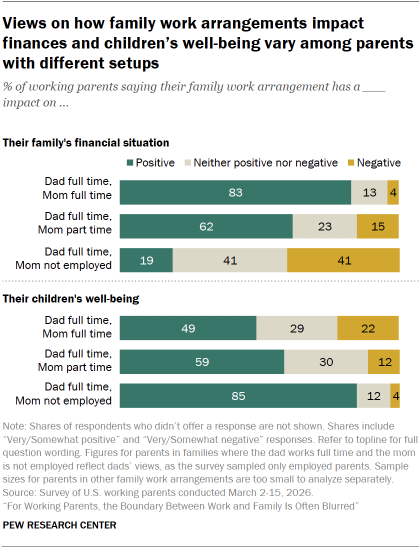
Most parents in families where both dad and mom work full time (83%) say this arrangement has had a positive impact on their family’s finances. About six-in-ten parents in families where the dad works full time and the mom works part time (62%) say the same.
A far smaller share (19%) of parents in families where the dad works full time and the mom is not employed say this arrangement has helped them financially. About twice as many (41%) say it’s had a negative impact. (This finding reflects only dads’ opinions, as the survey sampled only employed parents.)
Views are different when it comes to children’s well-being. Most in families where the dad works full time and the mom isn’t employed (85%, again reflecting dads’ views) say this arrangement has been good for their children. About six-in-ten parents in families where the dad works full time and the mom works part time (59%) say the same.
Parents in families where both work full time are less likely to see a positive impact on their children’s well-being. About half (49%) say this arrangement has had a positive impact, while 22% say it’s been negative, and 29% say it’s been neither positive nor negative.
When it comes to how their work arrangement impacts their relationship with their spouse or partner, more parents in each group report positive impacts than negative ones. Still, parents in families where the dad works full time and mom works part time or isn’t employed are more likely to have positive views.
Parents in each group largely say their family work arrangement has had neither a positive nor negative impact on their ability to advance in their job or career.
(The survey sample does not include enough working parents in families where the mom works full time and the dad works part time or is not employed to analyze separately.)