To understand how different-sex couples share household and parenting tasks when both parents have full-time jobs, we asked parents in this type of family who does more when it comes to these responsibilities. The data shows that, in families with a mother and a father, moms often take on more of the load.
Read more about how family work arrangements have changed.
Among married or cohabiting parents in different-sex couples with two full-time working parents:
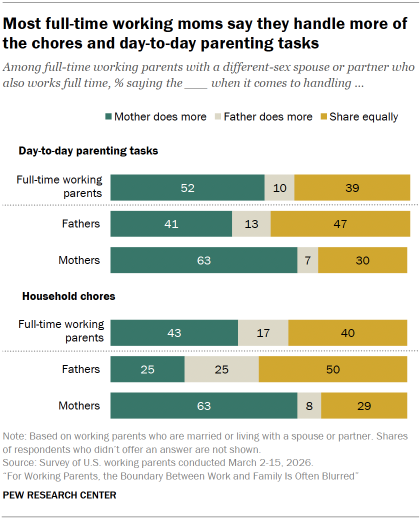
- 52% say the mom does more of the day-to-day parenting tasks. Only 10% say the dad does more, and 39% say these tasks are shared about equally.
- 43% say the mom does more of the household chores. Fewer (17%) say the dad does more, and 40% say it’s about equal.
But mothers and fathers perceive the division of parenting tasks and chores differently. Most moms report that they themselves handle more of the day-to-day parenting and household chores than their spouses or partners do (63% each). In turn, dads are much more likely than moms to say these responsibilities are divided about equally.
When it comes to how paid work is divided, 41% of parents in households where both the mother and father work full-time say the dad spends more time working on a typical day, while 21% say the mom does and 39% say both spend about the same amount of time working. These figures don’t vary by gender.
Even in families where the mother spends more time working than the father, parents are much more likely to say the mom does more parenting and household tasks than to say the dad does more. Among parents in these types of families:
- 39% say the mom does more of the parenting tasks, 19% say the dad does more and 42% say things are divided about equally.
- 38% say the mom does more of the household chores, 22% say the dad does more and 39% say it’s about equal.
These questions are part of a larger survey of 2,422 U.S. working parents conducted March 2-15, 2026. Read the key findings from the full study.
(This analysis focuses on different-sex couples because there aren’t enough same-sex couples in the sample to analyze separately. Read more about same-sex parents raising kids.)
Are parents satisfied with the division of labor at home?
Here again, it depends on who you ask.
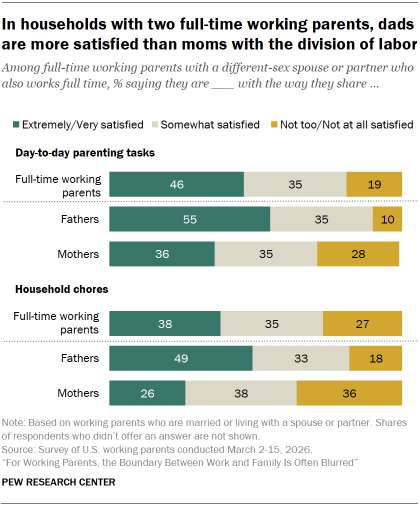
Dads in families with two full-time working parents are more likely than moms to say they are extremely or very satisfied with how they and their spouse or partner divide:
- Parenting tasks (55% of dads are satisfied vs. 36% of moms)
- Household chores (49% vs. 26%)
How satisfied parents are with the division of labor at home depends heavily on whether tasks are shared equally or not.
In families where both the mother and father work full-time, parents who say they and their spouse or partner share parenting tasks about equally are more likely than those who say the mom does more to be satisfied with how these tasks are divided.
- 65% of moms who share these tasks equally say they are satisfied, versus 22% of those who say they do more than their spouse or partner.
- 71% of dads who share these tasks equally are satisfied, versus 45% of those who say their spouse or partner does more.
Moms are also more likely to be satisfied with the division of household chores when they and their spouse or partner share them about equally than when they themselves do more (54% vs. 11%).
Most dads who say they split chores with their spouse or partner about equally also say they are satisfied with this arrangement (61%). The number of dads who say their spouse or partner does more household chores is too small to analyze separately.
Additionally, there aren’t enough moms or dads who say the dad does more parenting tasks or household chores to look at satisfaction with these arrangements.
Who’s more likely to take off work for childcare issues?
Outside of the daily tasks involved in parenting and maintaining a household, working parents also have to adapt when the unexpected happens.
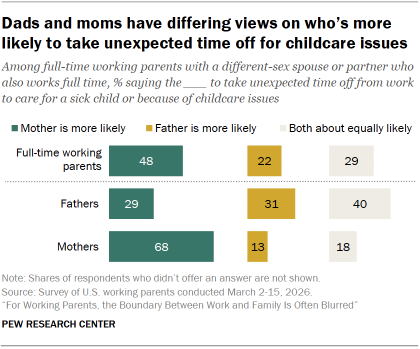
In different-sex couples where both the mother and father work full time, 48% say the mom would be more likely to take unexpected time off from work to care for a sick child or because of childcare issues. Another 29% say both parents would be equally likely to take time off, and 22% say the dad would be more likely to do this.
As is the case when asked about household chores and day-to-day parenting tasks, moms and dads have different perceptions of who would be more likely to take time off in these situations:
- 68% of moms say they would be more likely to take time off from work in this type of situation, compared with 29% of dads who say this about their spouse or partner.
- 40% of dads – versus 18% of moms – say they and their spouse or partner would be equally likely to take time off work.
How do parents decide who takes off work when unexpected childcare situations arise?
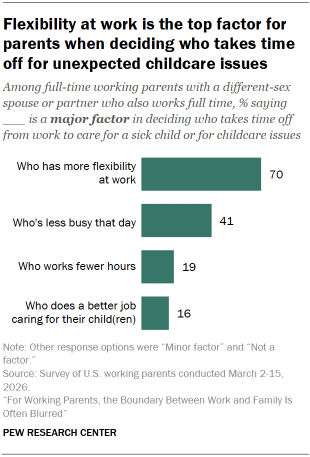
Flexibility on the job is key, according to parents.
Most (70%) say who has more flexibility at work is a major factor in deciding who would take time off to care for a sick child or because of other unexpected childcare issues. This is much larger than the shares who say each of the following is a major factor in this decision:
- Who’s less busy that day (41%)
- Who works fewer hours (19%)
- Who does a better job caring for their children (16%)