Pew Research Center’s latest surveys in Israel, the West Bank and East Jerusalem were conducted amid U.S. and Israeli airstrikes on Iran – as well as Iranian missile and drone attacks on Israel, the West Bank and countries in the Persian Gulf.
When did the surveys take place?
This year, Pew Research Center surveyed in Israel from April 5 to May 6, and in the West Bank and East Jerusalem from March 30 to April 28. Our field period began while hostilities were still ongoing and continued following the declaration of a ceasefire on April 7.
Against this backdrop, we asked Israelis and Palestinians in the West Bank and East Jerusalem about their personal safety: whether they have access to a protective shelter, and whether they think the war will make them safer or less safe in the long run.
For more on how Israelis and Palestinians think about the war, refer to “Israelis, Palestinians, Americans See War in Iran Differently.”
Who has access to a shelter?
Roughly nine-in-ten Israelis report having access to some kind of bomb shelter – typically either a safe room in their home or a public shelter nearby. Only 7% of Palestinians in the West Bank and East Jerusalem say the same.
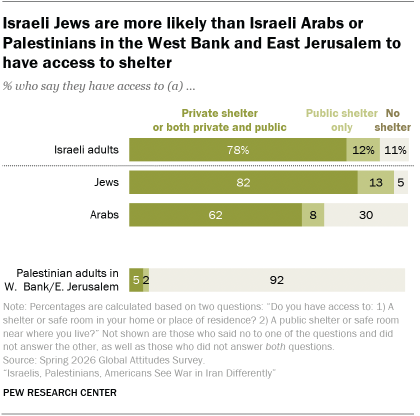
In Israel, 78% of adults surveyed have access to a private shelter – but Israeli Jews are more likely than Israeli Arabs to have such a shelter in their homes (82% vs. 62%). Israeli Jews are also significantly more likely than Israeli Arabs to report having access to a public shelter near where they live.
In the West Bank and East Jerusalem, just 5% of people surveyed say they have access to a private shelter, and 2% say they have access only to a public shelter. An overwhelming majority say they don’t have access to either.
Palestinians in East Jerusalem are slightly more likely than those in the West Bank to report having access to a public shelter near where they live (12% vs. 2%). Both groups are about equally unlikely to say they have access to a shelter or safe room inside their home or place of residence.
The long-term impact of the conflict on personal safety
We asked people in Israel and the West Bank and East Jerusalem how they think the U.S.-Israeli military action against Iran will affect their personal safety in the long term.
Views in Israel
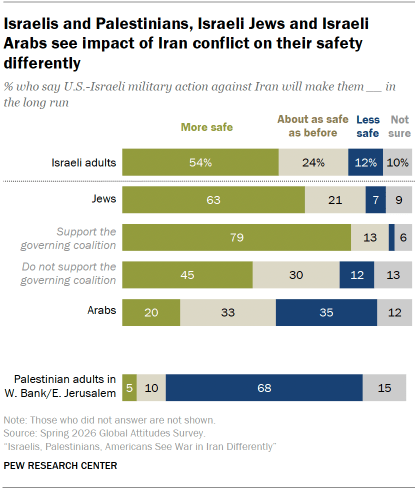
By nearly five-to-one, more Israelis say the military action against Iran will make them safer (54%) than less safe (12%) in the long run. Around a quarter think it will leave them about as safe as they were before the war, while 10% are not sure how the conflict will affect their personal safety in the long term.
Roughly eight-in-ten Israeli Jews who support Prime Minister Benjamin Netanyahu’s governing coalition think military action against Iran will make them safer in the long run – a significantly larger share than among Israeli Jews who don’t support Netanyahu’s coalition (45%). Israeli Arabs are even less likely to say the current conflict will make them safer (20%).
Having access to a private shelter is related to these feelings of safety, even after controlling for ethnicity, income and other demographic factors. Israelis who have access to a private shelter are more likely than Israelis without one to say military action against Iran will increase their personal safety in the long term (58% vs. 41%).
Views in the West Bank and East Jerusalem
Palestinians in the West Bank and East Jerusalem have very different views of the long-term impact of the conflict on them personally. Only 5% expect to be safer as a result of U.S.-Israeli military action against Iran, while roughly seven-in-ten expect to be less safe.
An additional 10% of Palestinians think they will be about as safe as they were before the war, and 15% are uncertain. (Because so few people in the Palestinian areas report having access to a shelter, we are unable to analyze how attitudes vary based on that access.)