To better understand public opinion about the U.S.-Israeli military action and Iran’s response, Pew Research Center asked whether each country involved in the conflict is doing enough to avoid civilian casualties.
These questions are part of a larger survey of Americans, Israelis and Palestinians conducted this spring. The U.S. survey was conducted March 23-29, 2026, while hostilities were ongoing. In Israel, the West Bank and East Jerusalem, most of the field period took place after a ceasefire was declared in early April.
Views differ widely on whether each country is fulfilling its responsibilities to civilians:
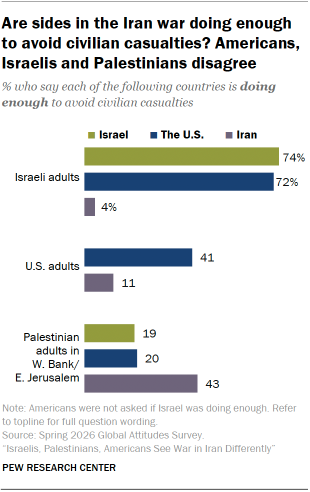
- Americans are roughly split on whether the United States is doing enough to avoid civilian casualties, while most Israelis say the U.S. is doing enough and Palestinians disagree.
- Majorities in both the U.S. and Israel agree that Iran is not doing enough to protect civilians, but in the West Bank and East Jerusalem, a plurality hold the opposite view.
- Israelis are also much more likely than Palestinians in the West Bank and East Jerusalem to say Israel is doing enough to avoid civilian casualties. (Americans were not asked this question.)
- Israeli Jews are much more confident than Israeli Arabs about U.S. and Israeli efforts to protect civilians. About a third of Israeli Arabs say Israel is doing enough to avoid civilian casualties (28%), and a similar share say the same about the U.S. (22%). Fewer say so about Iran (12%).
Is the U.S. seen to be doing enough to avoid civilian casualties?
Around four-in-ten Americans say the U.S. definitely or probably is doing enough to avoid civilian casualties, though a slightly larger share (45%) think their country is not doing enough. An additional 13% say they aren’t sure.
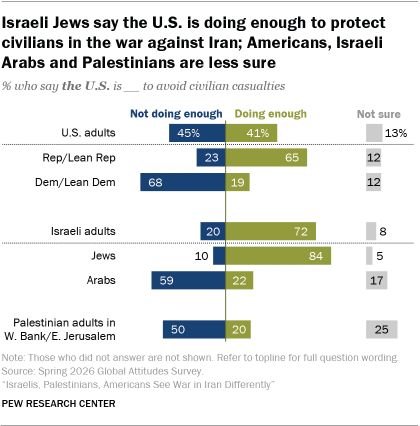
Republicans and independents who lean toward the Republican Party are at least three times as likely as Democrats and Democratic-leaners to say the U.S. is doing enough (65% vs. 19%).
Israelis have more confidence in U.S. efforts to protect civilians than Americans do: 72% say the U.S. is doing enough to avoid civilian casualties – including 41% who say the U.S. is definitely doing enough, more than twice the share of Americans who hold this view (17%).
Israeli Jews are much more likely than Israeli Arabs to say the U.S. is doing enough to protect civilians (84% vs. 22%). One-in-five Israelis say the U.S. isn’t doing enough, and Arabs are considerably more likely than Jews to express this view (59% vs. 10%).
In the West Bank and East Jerusalem, one-in-five adults say the U.S. is doing enough to avoid civilian casualties. Palestinians ages 18 to 34 are more likely to hold this view than those 50 and older (25% vs. 13%). Half of all Palestinians surveyed in the West Bank and East Jerusalem say the U.S. isn’t doing enough to protect civilians, and another quarter are not sure.
Is Iran seen to be doing enough to avoid civilian casualties?
In the U.S., 11% of adults surveyed say Iran is doing enough to avoid civilian casualties, while nearly seven-in-ten say Iran is probably or definitely not doing enough to protect civilians. Roughly one-in-five Americans aren’t sure about Iran’s military conduct.
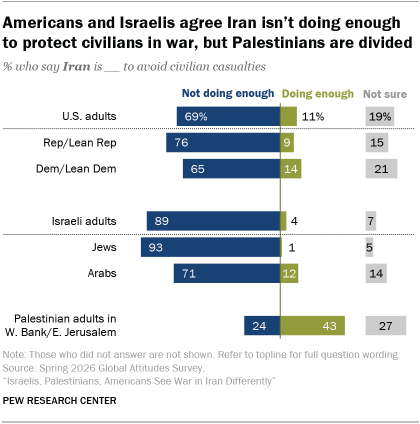
Republicans are slightly more likely than Democrats to express skepticism about Iran’s efforts, while Democrats are slightly more likely to be unsure.
Israelis, who have been targeted by Iranian airstrikes, are very critical of Iran’s actions: Only 4% say Iran is doing enough to avoid civilian casualties. Nearly nine-in-ten say Iran is not doing enough to protect civilians, including 79% who say it definitely isn’t doing enough.
While there is a gap between Israeli Jews and Israeli Arabs on the question about Iran, it is smaller than the differences in their views of U.S. and Israeli efforts to avoid harm to civilians. Just 1% of Jews and 12% of Arabs in Israel say Iran is doing enough to protect civilians. Large majorities of Israeli Jews and Arabs agree that Iran is not doing enough on this front (93% and 71%, respectively).
Palestinians in the West Bank and East Jerusalem, who have also been subject to Iranian airstrikes, have a much more positive view of Iran’s efforts to protect civilians than Israelis do. A 43% plurality of Palestinians say Iran is definitely or probably doing enough to avoid civilian casualties. Smaller shares say Iran isn’t doing enough (24%) or they aren’t sure (27%).
To read more about Israelis’ and Palestinians’ views of their personal safety and access to shelter, refer to “Amid Iran conflict, how do Israelis and Palestinians feel about their safety?”
Is Israel seen to be doing enough to avoid civilian casualties?
About three-quarters of Israelis say their own country is doing enough to protect civilians, including 52% who say it is definitely doing enough. One-in-five say Israel is not doing enough.
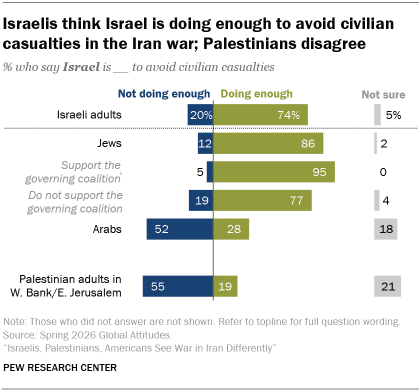
A large majority of Israeli Jews say Israel is doing enough to avoid civilian casualties – and Jews who support Prime Minister Benjamin Netanyahu’s governing coalition are even more likely to say this than Jews who do not support it (95% vs. 77%).
About three-in-ten Israeli Arabs agree their country is doing enough to protect civilians. But roughly half say Israel probably or definitely isn’t doing enough – more than triple the share of Jews who say this (12%). And about one-in-five Arabs say they aren’t sure, compared with only 2% of Jews who give the same response.
Palestinians in the West Bank and East Jerusalem are even more critical than Israeli Arabs of Israel’s efforts to protect civilians. About one-in-five Palestinians say Israel is doing enough to avoid civilian casualties, while a slim majority of 55% say the opposite. An additional 21% say they aren’t sure. Those under the age of 35 are somewhat more likely to say Israel is doing enough than Palestinians 50 and older (21% vs. 13%).