Americans Broadly Disapprove of U.S. Military Action in Iran
Most Americans say striking Iran was the wrong decision and disapprove of Trump’s handling of the conflict, with stark partisan divides.
Most Americans say striking Iran was the wrong decision and disapprove of Trump’s handling of the conflict, with stark partisan divides.

Our latest politics data every month
All
Publications
More than half of U.S. teens say they are worried about the possibility of a shooting happening at their school, with one-in-four saying they are very worried.
Predictions from experts about the future of well-being in a tech-saturated world, from @pewresearch and @ImagineInternet.
Many experts say digital life will continue to expand people’s boundaries and opportunities. Yet nearly a third think that people’s overall well-being will be more harmed than helped in coming years.
Foreign policy experts on opposite sides of the Atlantic have markedly different assessments of the way democracy is working in their countries.
Read five facts about religion in Saudi Arabia — a country that is the birthplace of Islam and, as such, holds special importance for Muslims worldwide.
The vast majority of proposed amendments die quiet, little-mourned deaths in committees and subcommittees.
More members of the U.S. House of Representatives are choosing not to seek re-election than at any time in the past quarter-century.
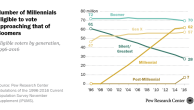
As of November 2016, an estimated 62 million Millennials were voting-age U.S. citizens – moving closer in number to the 70 million Baby Boomers.
Average tariff rates, while useful for comparison, can obscure the wide range of rates imposed on different classes of imports and on specific products.
The trends in Americans’ views of social media tell a complex story. Read about the dynamics of Americans’ feelings toward social media.
Amid shifts in demographics and partisan allegiances, registered voters are now evenly split between the Democratic Party and the GOP.
Americans’ views of politics and elected officials are unrelentingly negative, with little hope of improvement on the horizon. 65% of Americans say they always or often feel exhausted when thinking about politics. By contrast, just 10% say they always or often feel hopeful about politics.
Pew Research Center’s political typology provides a roadmap to today’s fractured political landscape. It organizes the public into nine distinct groups, based on an analysis of their attitudes and values. Even in a polarized era, the 2021 survey reveals deep divisions in both partisan coalitions.
Partisanship remains the strongest factor dividing the American public. Yet there are substantial divisions within both parties on fundamental political values, views of current issues and the severity of the problems facing the nation.