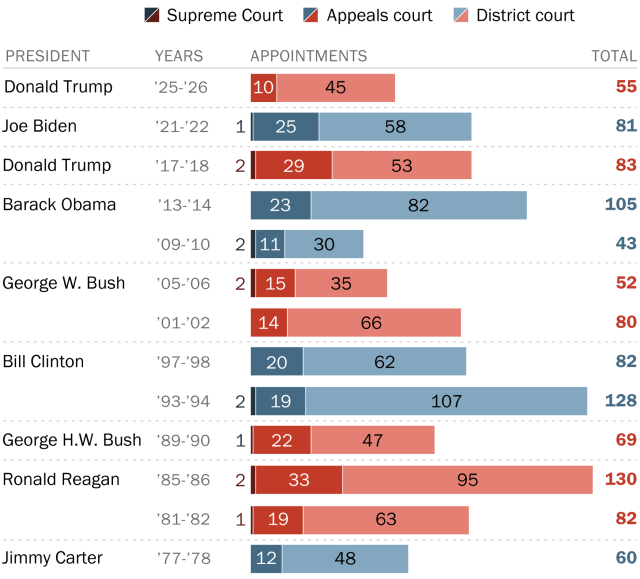
President Donald Trump has appointed fewer federal judges so far in his second term than at the same point in his first term. In fact, Trump’s pace of judicial appointments trails that of most other recent presidents, according to a Pew Research Center analysis of data from the Federal Judicial Center.
The analysis comes ahead of midterm elections that will decide control of the U.S. Senate. If Democrats take control of the chamber from Republicans in November, they could further slow Trump’s judicial appointments. Judges are an important part of every president’s legacy because they have lifetime appointments, so they can serve long after the president who appointed them leaves office.
Since returning to the White House in 2025, Trump has appointed 55 judges to the federal judiciary. That’s among the lowest pre-midterm totals of any presidential term since Jimmy Carter.
| President | Supreme Court justices | Appeals court judges | District court judges | Total | Party |
|---|---|---|---|---|---|
| Donald Trump (2025-2026) | 0 | 10 | 45 | 55 | R |
| Joe Biden (2021-2022) | 1 | 25 | 58 | 81 | D |
| Donald Trump (2017-2018) | 2 | 29 | 53 | 83 | R |
| Barack Obama (2013-2014) | 0 | 23 | 82 | 105 | D |
| Barack Obama (2009-2010) | 2 | 11 | 30 | 43 | D |
| George W. Bush (2005-2006) | 2 | 15 | 35 | 52 | R |
| George W. Bush (2001-2002) | 0 | 14 | 66 | 80 | R |
| Bill Clinton (1997-1998) | 0 | 20 | 62 | 82 | D |
| Bill Clinton (1993-1994) | 2 | 19 | 107 | 128 | D |
| George H.W. Bush (1989-1990) | 1 | 22 | 47 | 69 | R |
| Ronald Reagan (1985-1986) | 2 | 33 | 95 | 130 | R |
| Ronald Reagan (1981-1982) | 1 | 19 | 63 | 82 | R |
| Jimmy Carter (1977-1978) | 0 | 12 | 48 | 60 | D |
Joe Biden, by comparison, had appointed 81 federal judges by this point in his tenure, while Trump had appointed 83 at this juncture in his first term. Barack Obama had appointed 105 by the same point in his second term.
(This analysis looks only at judges appointed to the 91 district courts and 13 appeals courts governed by Article III of the U.S. Constitution, as well as the U.S. Supreme Court. It excludes judges appointed to specialized and territorial courts.)
The 55 judges Trump has appointed so far in his second term include 45 district court judges, who preside over federal criminal and civil cases, and 10 appeals court judges, who handle appeals of lower court decisions. He has not appointed any new members to the U.S. Supreme Court this term after making three such appointments during his full first term.
Trump especially lags behind his recent predecessors when it comes to appeals court judges. He has appointed 10 appellate judges so far in his second term, compared with 25 for Biden, 29 for Trump in his first term and 23 for Obama at the same point in their terms. Appeals court judges sit one level below the Supreme Court and often have the final word on key legal disputes.
Why has Trump appointed fewer judges than other presidents?
The pace of presidential appointments to the judiciary can depend on several factors.
Presidents can only appoint judges when there are vacancies to fill – that is, when judges leave their positions through resignation, retirement or death. Trump has had comparatively few vacancies to fill in his second term. At the appeals court level, for example, only three judges stepped down or announced their intention to do so between the 2024 presidential election and the end of Trump’s first year back in the White House. By comparison, 30 appeals court judges stepped down between the 2020 election and the end of Biden’s first year, according to an analysis by the Brookings Institution.
The pace of appointments can also depend on how long it takes for the White House to identify, vet and nominate potential judges, and how long it takes for the Senate to confirm them. Trump announced the first judicial nominee of his second term nearly four months after taking office, and the Senate confirmed her more than two months after that.
Another key factor is whether the Senate is controlled by the president’s own party or the opposition party, and by how many seats. The current Senate has a narrow Republican majority, and Democrats have often voted against Trump’s judicial nominees in large numbers. If Democrats win control of the chamber in November, Senate Republicans are reportedly planning to prioritize Trump’s judicial appointees in the postelection “lame duck” period.
Three of Trump’s judicial nominees are currently awaiting a vote by the full Senate. Another 13 are awaiting a vote in the Senate Judiciary Committee before they can advance to the full Senate.