
Since 2015, the share of Americans who say they use cash for all or almost all of their purchases in a typical week has fallen by half, from 24% to 12%. And 42% now say they don’t use cash for any purchases in a typical week, up from 24% in 2015, according to a 2026 Pew Research Center survey.
As cash has declined in popularity, which payment methods have taken its place?
The Federal Reserve Bank of Atlanta tracks the use of many payment methods in its annual Survey and Diary of Consumer Payment Choice. The survey asks U.S. adults to report on every transaction they made over a three-day period, including details about which payment method they used and how much they paid.
Use of credit cards is on the rise
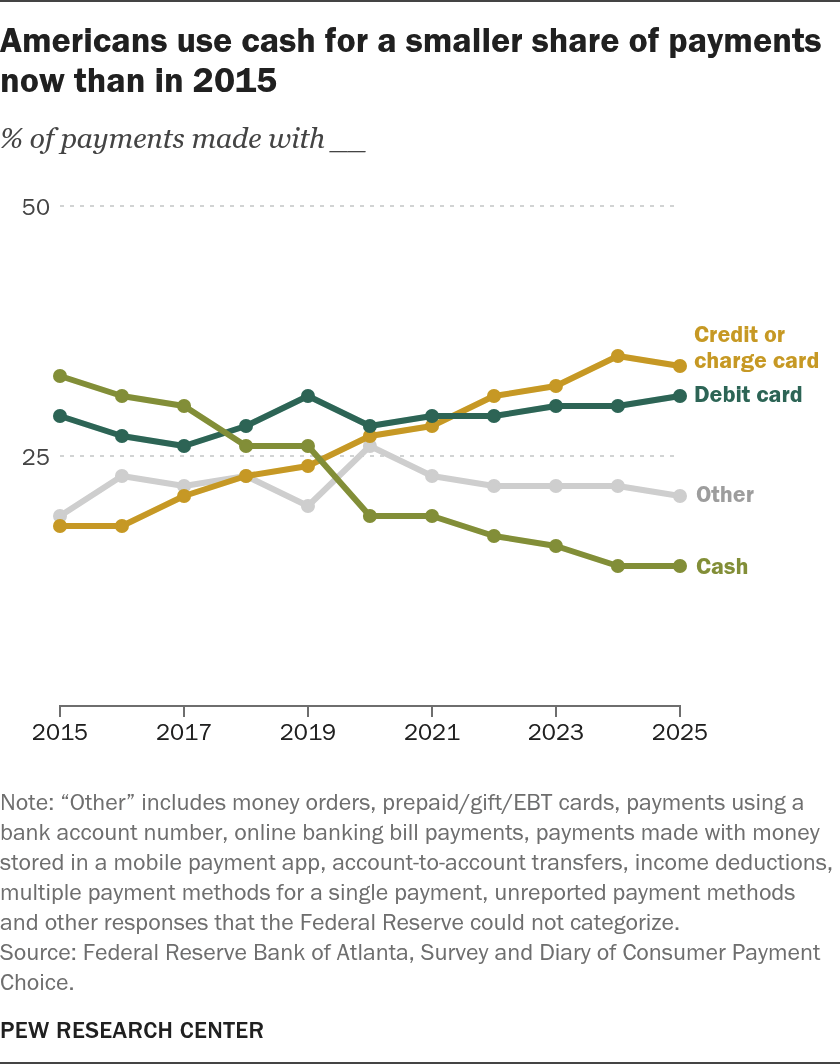
Since 2015, Americans have overwhelmingly used three payment methods for their purchases: cash, credit cards and debit cards. But as cash has become a less common option, credit cards have gotten more popular. Debit card payments have stayed relatively steady.
| Year | Cash | Debit card | Credit or charge card | Other |
|---|---|---|---|---|
| 2015 | 33 | 29 | 18 | 19 |
| 2016 | 31 | 27 | 18 | 23 |
| 2017 | 30 | 26 | 21 | 22 |
| 2018 | 26 | 28 | 23 | 23 |
| 2019 | 26 | 31 | 24 | 20 |
| 2020 | 19 | 28 | 27 | 26 |
| 2021 | 19 | 29 | 28 | 23 |
| 2022 | 17 | 29 | 31 | 22 |
| 2023 | 16 | 30 | 32 | 22 |
| 2024 | 14 | 30 | 35 | 22 |
| 2025 | 14 | 31 | 34 | 21 |
In 2015, cash was the most used payment type of any that the Federal Reserve asked about. A third of payments that year were in cash, followed by debit cards (29%) and credit cards (18%). All other payment options the survey asked about – including checks, mobile payment apps and online banking – combined for another 19%.
In 2018, Americans used debit cards for a larger share of payments than cash for the first time. And starting in 2022, they used credit cards more often than debit cards.
In 2025, credit cards made up the highest share of payments at 34%. Debit cards followed at 31%, meaning that credit and debit cards together accounted for nearly two-thirds of all payments. The share of payments made in cash fell to 14%, the third-most common method in the survey.
How people pay for purchases can vary by transaction amount
The average value of a cash purchase was $58 in 2025, compared with $74 for debit card purchases and $80 for credit card purchases, according to the Federal Reserve survey.
The purchases people make with prepaid, gift or EBT cards tend to be the smallest, averaging $35 in 2025. Purchases made with checks, account transfers and online banking tend to be the largest, averaging between $400 and $700. And purchases made with money stored in mobile payment apps fall in between, averaging $98.
How do Americans want to pay for things?
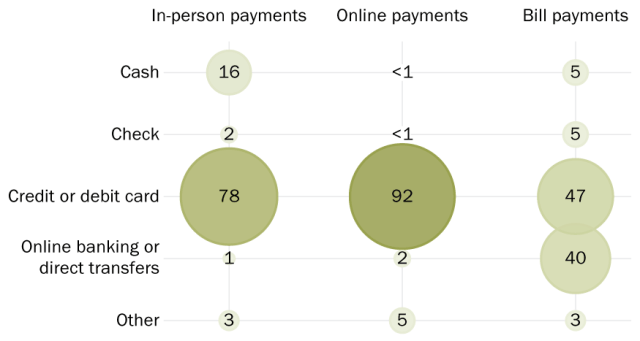
The Federal Reserve survey also asks Americans how they would prefer to make different types of payments.
| In-person payments | Online payments | Bill payments | |
|---|---|---|---|
| Cash | 16 | <1 | 5 |
| Check | 2 | <1 | 5 |
| Credit or debit card | 78 | 92 | 47 |
| Online banking or direct transfers | 1 | 2 | 40 |
| Other | 3 | 5 | 3 |
For in-person payments, a combined 78% of people said in 2025 that they would prefer to pay with a credit or debit card, while 16% would prefer to pay in cash. Fewer than 3% each said they’d prefer any of the other methods the survey asked about, such as checks, money orders or prepaid cards.
Those preferences have changed somewhat since 2015, when a combined 73% preferred credit or debit cards for in-person payments and 23% preferred cash.
Americans are even more likely to prefer credit or debit cards for online purchases than for in-person payments. But for bill payments, 47% prefer credit or debit cards, while 40% prefer online banking or direct transfers. Another 5% prefer to pay bills in cash, and 5% prefer check.
When people pay with credit or debit cards, most of the time that’s their preferred payment method. Nine-in-ten in-person credit and debit card payments are made by people who want to pay that way. In contrast, 70% of cash payments are made by people who prefer to pay some other way – mainly with credit or debit cards.
