
More than half of states have laws that prohibit betting or wagering on elections, at least under certain circumstances, according to a Pew Research Center analysis of data from the National Conference of State Legislatures (NCSL).
This analysis comes amid a recent surge in trading volume on prediction markets Kalshi and Polymarket. Both platforms allow people to trade on real-life events, including elections, by buying contracts staked on yes-or-no outcomes. This differs from traditional betting or gambling, where a central party – the “house” – sets odds of a particular outcome happening.
Several states, such as Arizona and Kentucky, recently have taken legal action against the companies behind prediction markets for allegedly violating their laws against election betting. Lawmakers in more than a dozen states have also introduced bills that specifically aim to regulate prediction markets in some way.
Federal regulators contend that platforms like Kalshi and Polymarket allow people to trade financial products – not place bets – so they should be exempt from state-level gambling bans. The U.S. Commodity Futures Trading Commission (CFTC) has sued several states to prevent them from regulating prediction markets.
Related: Trading volume on prediction markets has soared in recent months
Which states prohibit election betting in some way?
Nearly half of states (23) prohibit election betting entirely, according to our analysis of NCSL data. For example, Arkansas law says “no person shall make any bet or wager upon the result of any election” in the state. Kentucky also banned the practice this year.
Another nine states vary in how they regulate election betting and the exact circumstances under which it’s illegal.

| State | Election betting legality | FIPS |
|---|---|---|
| Alabama | No explicit law | 1 |
| Alaska | No explicit law | 2 |
| Arizona | Entirely illegal | 4 |
| Arkansas | Entirely illegal | 5 |
| California | No explicit law | 6 |
| Colorado | Entirely illegal | 8 |
| Connecticut | No explicit law | 9 |
| Delaware | Entirely illegal | 10 |
| District of Columbia | No explicit law | 11 |
| Florida | No explicit law | 12 |
| Georgia | Entirely illegal | 13 |
| Hawaii | No explicit law | 15 |
| Idaho | Entirely illegal | 16 |
| Illinois | Entirely illegal | 17 |
| Indiana | Illegal in some scenarios | 18 |
| Iowa | Illegal in some scenarios | 19 |
| Kansas | No explicit law | 20 |
| Kentucky | Entirely illegal | 21 |
| Louisiana | Entirely illegal | 22 |
| Maine | No explicit law | 23 |
| Maryland | Entirely illegal | 24 |
| Massachusetts | Illegal in some scenarios | 25 |
| Michigan | Entirely illegal | 26 |
| Minnesota | No explicit law | 27 |
| Mississippi | Entirely illegal | 28 |
| Missouri | No explicit law | 29 |
| Montana | No explicit law | 30 |
| Nebraska | Entirely illegal | 31 |
| Nevada | Entirely illegal | 32 |
| New Hampshire | No explicit law | 33 |
| New Jersey | Entirely illegal | 34 |
| New Mexico | No explicit law | 35 |
| New York | Entirely illegal | 36 |
| North Carolina | Entirely illegal | 37 |
| North Dakota | Illegal in some scenarios | 38 |
| Ohio | No explicit law | 39 |
| Oklahoma | Entirely illegal | 40 |
| Oregon | Illegal in some scenarios | 41 |
| Pennsylvania | Illegal in some scenarios | 42 |
| Rhode Island | Illegal in some scenarios | 44 |
| South Carolina | Entirely illegal | 45 |
| South Dakota | Illegal in some scenarios | 46 |
| Tennessee | Entirely illegal | 47 |
| Texas | Entirely illegal | 48 |
| Utah | Entirely illegal | 49 |
| Vermont | No explicit law | 50 |
| Virginia | No explicit law | 51 |
| Washington | No explicit law | 53 |
| West Virginia | Illegal in some scenarios | 54 |
| Wisconsin | Entirely illegal | 55 |
| Wyoming | No explicit law | 56 |
The remaining 18 states and the District of Columbia do not have any laws about election betting specifically, though some have broader regulations that state officials say encompass election betting.
In at least some states, the earliest versions of these regulations date back to the 19th century. An Idaho statute from 1887, for example, made election betting a misdemeanor – three years before the territory officially became a state.
In some of the nine states with partial restrictions on election betting, it is illegal for people in certain positions to wager on elections. In Oregon, for instance, candidates for office can’t bet on their own contest. Other states, such as South Dakota, criminalize election betting only when its intention is to disrupt people from voting or influence people’s choices in an election.
Iowa, Massachusetts, Pennsylvania and Rhode Island penalize bookmakers, “pool sellers” and other people who organize or administer election-betting schemes – but not people who simply place bets or wagers.
Penalties for election betting also vary across the country. In most states where the practice is unlawful, it’s considered a misdemeanor punishable by a fine, incarceration or both.
But other states, such as Illinois and Nebraska, may prosecute election betting as a felony depending on the circumstances, such as the amount of money involved or the accused person’s previous gambling offenses. Utah considers it a felony if a candidate in an election is the person who makes a bet.
A handful of states impose additional penalties for people convicted of betting on elections. Delaware and New York strip violators of the right to vote, and Wisconsin makes it unlawful for people who bet on an election to vote in that particular race.
More commonly, states prevent people convicted of election betting from holding certain positions. That’s the case in Indiana, North Dakota, Pennsylvania and West Virginia, where a conviction for or history of election betting bars people from serving as election officials or poll workers. Arkansas bans people convicted of election betting from holding any state office or being employed by the state.
Which states are moving to regulate prediction markets?
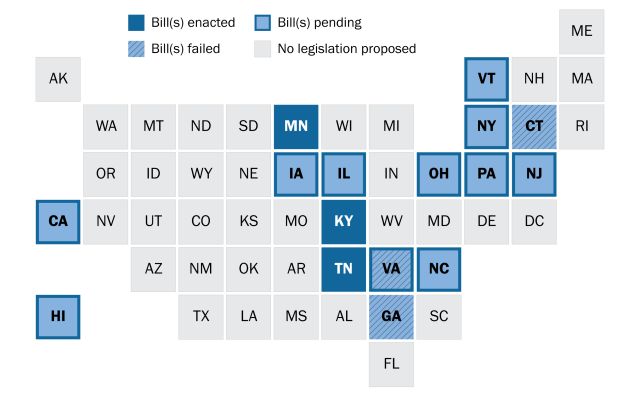
Lawmakers in at least 16 states have introduced legislation this year to regulate prediction markets in some way, according to NCSL. Some of those bills, if passed, would put restrictions on whether prediction markets can operate in the state and who can use them to make trades, including on elections. The majority of the states that introduced legislation on prediction markets this year already regulate election betting.
In May, Minnesota became the first state to prohibit Kalshi, Polymarket and similar platforms statewide. The law includes some exceptions: for example, people can still make trades on weather and on event contracts that could double as insurance policies, allowing them to hedge against risky outcomes. The federal government has sued to block the Minnesota ban.
| State | Status of legislation in 2026 | FIPS |
|---|---|---|
| Alabama | None | 1 |
| Alaska | None | 2 |
| Arizona | None | 4 |
| Arkansas | None | 5 |
| California | One or more bills pending | 6 |
| Colorado | None | 8 |
| Connecticut | Bill failed | 9 |
| Delaware | None | 10 |
| District of Columbia | None | 11 |
| Florida | None | 12 |
| Georgia | Bill failed | 13 |
| Hawaii | One or more bills pending | 15 |
| Idaho | None | 16 |
| Illinois | One or more bills pending | 17 |
| Indiana | None | 18 |
| Iowa | One or more bills pending | 19 |
| Kansas | None | 20 |
| Kentucky | Multiple bills enacted | 21 |
| Louisiana | None | 22 |
| Maine | None | 23 |
| Maryland | None | 24 |
| Massachusetts | None | 25 |
| Michigan | None | 26 |
| Minnesota | One bill enacted | 27 |
| Mississippi | None | 28 |
| Missouri | None | 29 |
| Montana | None | 30 |
| Nebraska | None | 31 |
| Nevada | None | 32 |
| New Hampshire | None | 33 |
| New Jersey | One or more bills pending | 34 |
| New Mexico | None | 35 |
| New York | One or more bills pending | 36 |
| North Carolina | One or more bills pending | 37 |
| North Dakota | None | 38 |
| Ohio | One or more bills pending | 39 |
| Oklahoma | None | 40 |
| Oregon | None | 41 |
| Pennsylvania | One or more bills pending | 42 |
| Rhode Island | None | 44 |
| South Carolina | None | 45 |
| South Dakota | None | 46 |
| Tennessee | One bill enacted | 47 |
| Texas | None | 48 |
| Utah | None | 49 |
| Vermont | One or more bills pending | 50 |
| Virginia | Bill failed, one or more bills pending | 51 |
| Washington | None | 53 |
| West Virginia | None | 54 |
| Wisconsin | None | 55 |
| Wyoming | None | 56 |
Kentucky and Tennessee have also enacted legislation related to prediction markets this year. In addition to an election betting ban, Kentucky lawmakers in April levied a tax on prediction market operators and prohibited associations from contracting with prediction markets to offer event contracts. In May, Tennessee passed a bill that makes it a felony for a person to attempt to influence the outcome of an event while having made a prediction market trade related to that event.
In at least 12 states, bills related to prediction markets are still pending. And in at least four states, such bills have failed to become law.
These state-level bills address a variety of topics related to prediction markets. Some aim to put age restrictions on prediction market sites. Others aim to prohibit state officials and employees from using prediction markets. And a few propose subjecting prediction markets to certain regulatory frameworks or licensing requirements.
In addition to legislative efforts, some governors have taken executive action to regulate prediction markets. Executive orders in Maryland and New York, for instance, prohibit state employees from engaging in insider trading on prediction market platforms.