For the latest data on prediction market trading volume, read “Prediction markets’ trading volume doubled between May and July, largely driven by sports.”
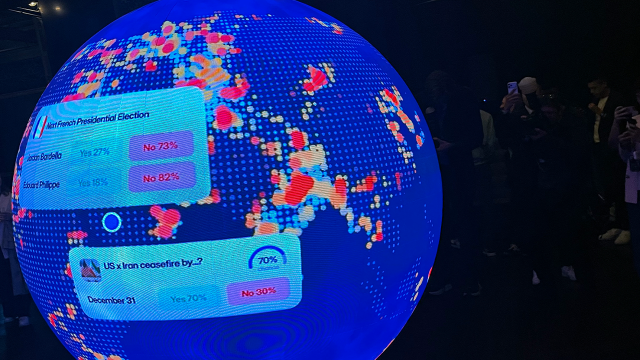
Prediction markets allow people to trade on the outcome of real-world events, from basketball games to elections. And trading volume on Kalshi and Polymarket – the two leading prediction markets – has increased dramatically since mid-2025.
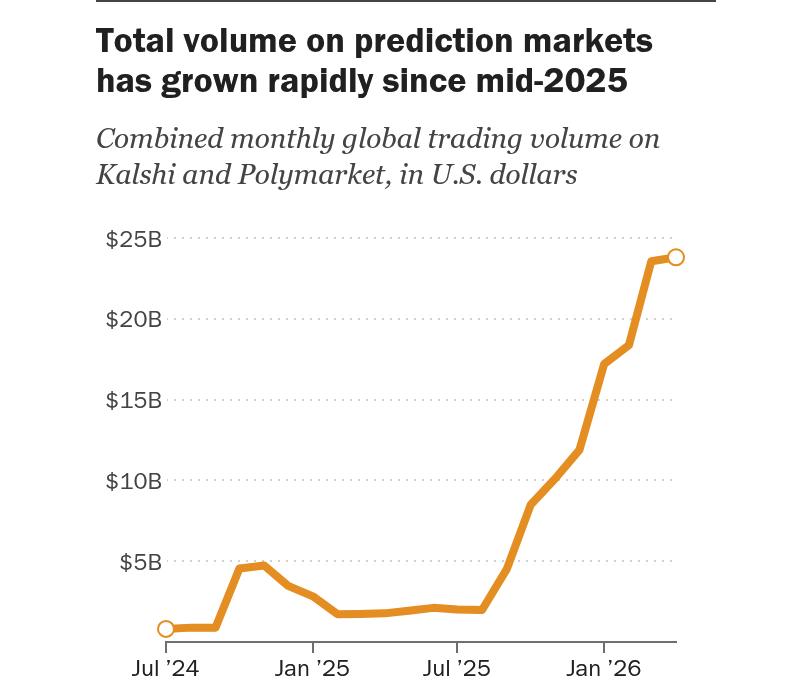
Combined monthly global trading volume on these platforms has risen from less than $5 billion in September 2025 to about $24 billion in April 2026, according to a Pew Research Center analysis of data from The Block, a digital assets media and information firm.
For comparison, the total amount of money wagered through legal sportsbooks in the United States was around $14 billion per month in 2025, on average.
To trade on the outcome of events, prediction market users buy and sell event contracts with binary outcomes valued between $0 and $1. The price of the contract is meant to represent the likelihood of the outcome happening. For example, a “yes” contract valued at 40 cents is meant to represent a 40% chance that an outcome will happen. Once a market is resolved, a winning contract is worth $1. In other words, a user pays 40 cents to buy the contract and receives $1 if the outcome happens.
In the U.S., Kalshi is regulated by the Commodity Futures Trading Commission (CFTC). Polymarket usually refers to Polymarket International, which is not regulated by the CFTC. Americans can use a VPN to place trades there. Polymarket US is newly regulated by the CFTC for American users, but its trading volume is much smaller than Polymarket International’s. In April 2026, Polymarket US saw $1.3 billion in trading volume, compared with $9 billion on Polymarket International.
Which topics are most popular on prediction markets?
Sports, politics and cryptocurrency are the topics with the highest volume on both major prediction markets. These topics have made up 91% of global trading volume on Kalshi and 90% on Polymarket since July 2024. But there are big differences in just how popular those topics are on each platform:
- Sports has made up 80% of total trading volume on Kalshi and 39% on Polymarket since July 2024.
- Cryptocurrency has accounted for 7% of total volume on Kalshi and 20% on Polymarket.
- Politics has made up just 4% of total volume on Kalshi but 32% on Polymarket.
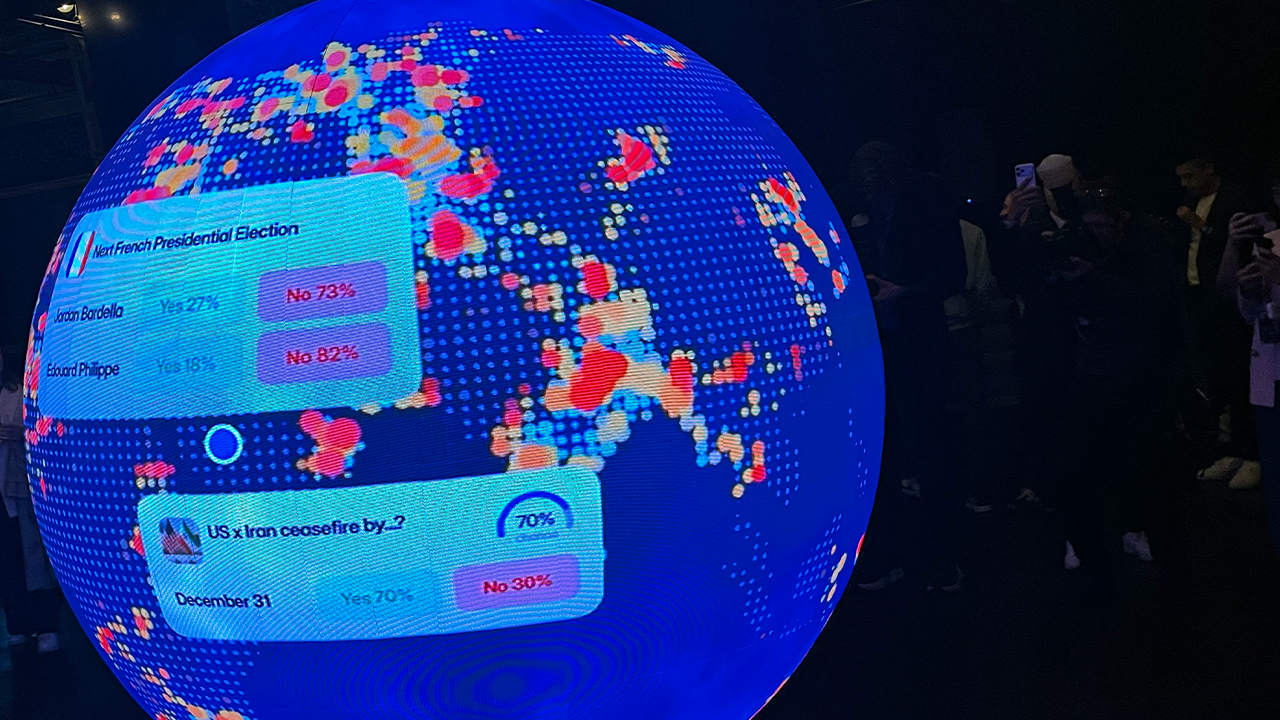
Kalshi and Polymarket allow people to trade on many other topics, too – from what public figures will say during public appearances (so-called “mention markets”) to the weather in cities around the world. All of these topics are a small share of overall volume on both platforms.
Interest in sports is fairly consistent on both platforms. But topics can rise and fall in response to real-world events.
Notably, political markets made up 90% of the trading volume on Kalshi and 65% on Polymarket in October and November 2024 – around the time of the U.S. presidential election. At the time, Kalshi had not yet introduced sports trading.