While global population growth is projected to slow over the rest of the century, Africa stands out for its relatively young and growing population.
Here are five facts about the changing population in Africa, based on a Pew Research Center analysis of the United Nations’ World Population Prospects. The latest data is from 2023, so figures for 2024 and beyond are UN projections.
Africa’s population has grown more than sixfold since 1950. That’s an increase of about 1.3 billion people.
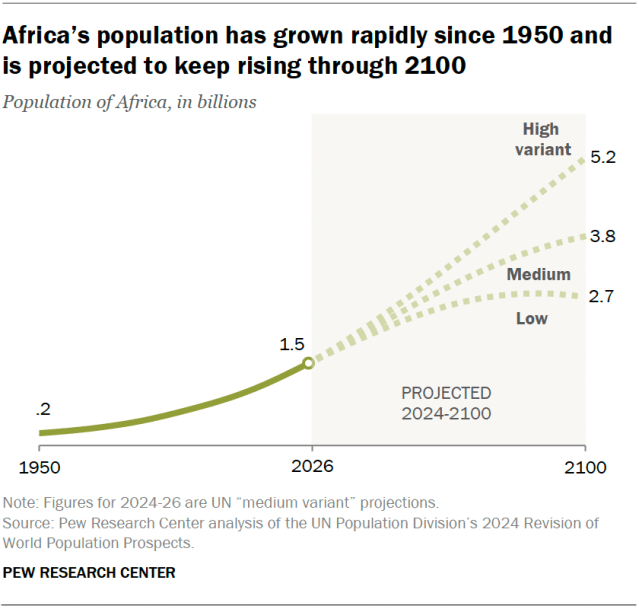
This growth is projected to continue through the end of the century. Under the UN’s “medium variant” projection, Africa’s population is expected to reach 3.8 billion people by 2100.
Under the UN’s “high variant” scenario – in which the total fertility rate is projected to be 0.5 births per woman above that of the medium variant scenario – it would grow more quickly, peaking at 5.2 billion in 2100. Even under the “low variant” scenario – in which the total fertility rate is projected to be 0.5 births below that of the medium variant scenario – the region’s population would total 2.7 billion in 2100, though that would peak earlier, at 2.8 billion around 2087.
Today, 28% of all people under 25 live in Africa, as does 19% of the overall population.
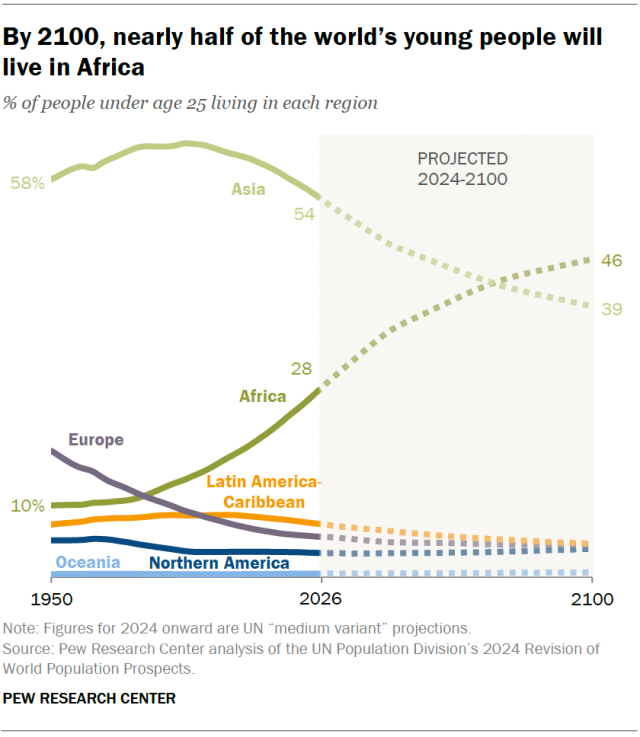
The shares of young people in Africa have increased since 1950 and are projected to be even larger in 2100.
For example, Africa was home to 10% of the world’s young people in 1950 (most lived in Asia, as is the case today). As of 2026, 28% of young people live in Africa.
While Asia continues to be home to the largest share of young people, Africa is expected to surpass it by 2073 under the medium variant scenario. And by 2100, 46% of all people under 25 are projected to live in Africa, compared with 39% in Asia.
By 2100, Africa is expected to have 12 of the world’s 25 most populous countries.
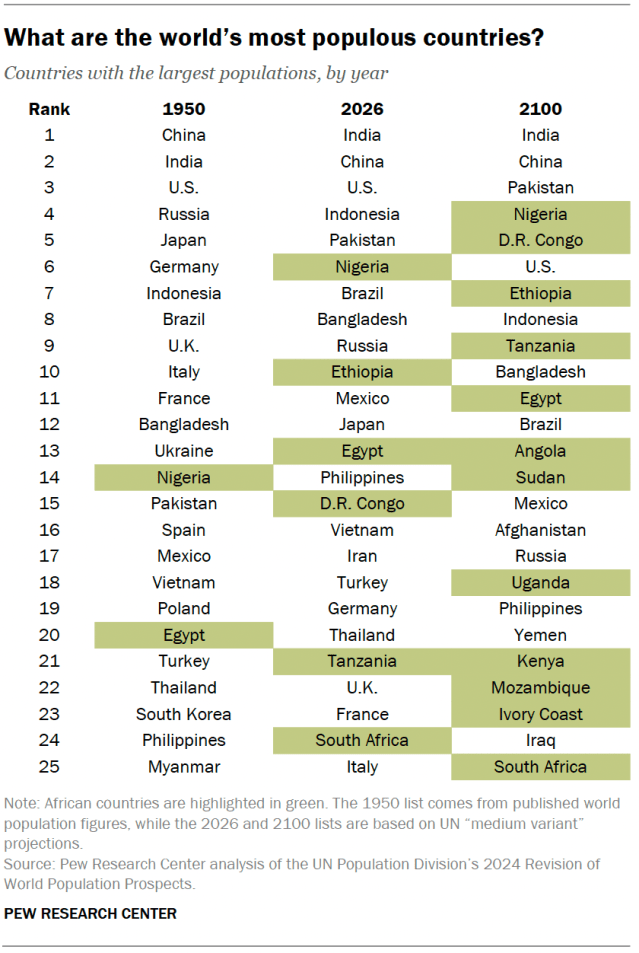
Nigeria currently has the largest population in Africa and is the sixth-most populous nation in the world. It is one of six African countries that are among the world’s 25 most populous nations today, according to UN estimates.
By 2100, Nigeria is expected to be the fourth-most populous country in the world, followed by the Democratic Republic of the Congo in fifth place, Ethiopia in seventh and Tanzania in ninth.
As the most populous countries list becomes increasingly African, it will become decreasingly European. By 2100, Russia is projected to be the only European country among the world’s 25 most populous nations, and it is expected to fall from ninth place today to 17th as its population declines.
India and China are projected to remain the world’s most populous countries in 2100.
Africa is the only world region where fertility remains above the replacement level.
What is the replacement-level fertility?
The replacement-level fertility is the total fertility rate needed to maintain a population at a constant size. Globally, this is estimated to be around 2.1 births per woman, although this varies according to mortality rates. Replacement levels tend to be particularly high in Africa.
Africa’s fertility rate – about 3.9 births per woman – is substantially higher than the global replacement level of around 2.1 births per woman.
But there is significant variation in fertility rates across the region. For example, Chad’s current fertility rate is 5.8 births per woman, compared with 1.8 in Tunisia.
Africa’s fertility rate is projected to remain higher than those of other regions throughout the 21st century.
Still, Africa is seeing a decline in fertility. The UN projects that its fertility rate will decline from 3.9 to 2.8 by 2050, dropping to 2.0 births per women by the end of the century. The region’s fertility has already fallen substantially from its peak of 6.7 births per woman in 1972.
Related: 5 facts about global fertility trends
The median age in Africa is projected to rise from about 19 years today to 35 in 2100.
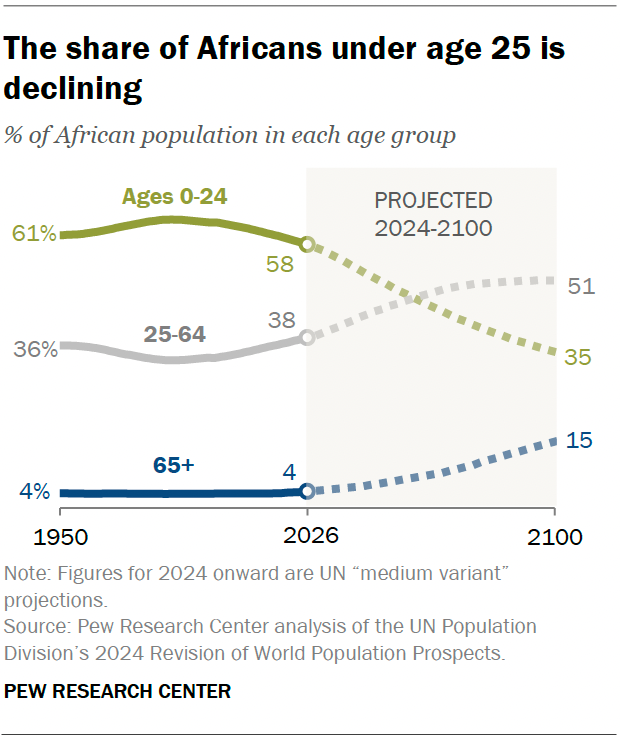
This is because fertility rates are falling and life expectancies are increasing.
Even though Africa will be home to the most young people of any world region by 2100, the share of its population under 25 will decline steadily through the end of the century. From 1950 to the present, around 60% of Africans have been in this age group. But by 2100, about 35% of Africans are projected to be younger than 25.
Over the same period, the share of African adults ages 25 to 64 is projected to rise to 51%, while those ages 65 and older are expected to make up 15% of the region’s population by 2100. The older population would be more than triple its current share.
This shift would bring Africa closer in line with global demographic patterns: Worldwide, adults ages 25 to 64 have been the largest age group for years.