Americans believe the global influence of several nations is shifting, including the influence of the United States itself, according to a March survey of 3,507 U.S. adults.
To better understand how Americans view the global power landscape, we asked if each of 12 countries’ influence in the world has been getting stronger, getting weaker or staying about the same in recent years.
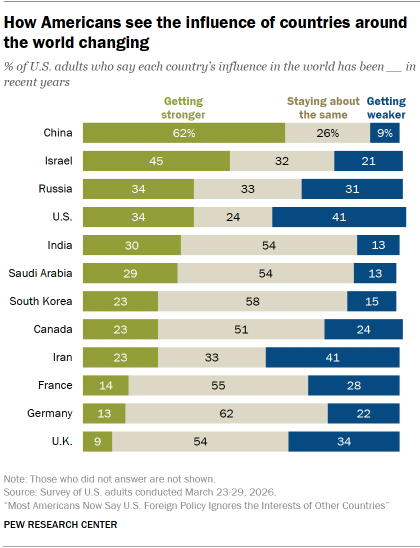
- China is the only country that a majority of Americans say is getting stronger, though a 45% plurality also say Israel is getting stronger.
- On balance, Americans think U.S. influence is getting weaker rather than stronger. Still, the share who think its influence is strengthening has grown in recent years, especially among Republicans. (Read the first section of this report for more on how Americans view their country’s role in the world.)
- Around four-in-ten (41%) believe Iran’s global influence is waning, up from 28% last year. (The survey was conducted about three weeks after the Iran war began.)
- While evaluations of Russia are currently split – about one-third each see its influence getting stronger, getting weaker and staying the same – the share of those who say it is weakening has increased since last year.
- Most see the influence of France, Germany and the United Kingdom staying about the same, but more say these European powers are getting weaker than getting stronger.
- Majorities also describe the influence of India, Saudi Arabia and South Korea as staying about the same, but more say they are strengthening than weakening.
- Around half of Americans (51%) say Canada’s influence is staying about the same, while roughly a quarter each think it’s getting stronger and getting weaker.
How have ratings of global influence changed over time?
The survey highlights significant changes in the way Americans think about the influence of several countries, including those that they most often name as global superpowers: the U.S., China and Russia.
The most common stance on the U.S. is that its influence has been getting weaker, but the share saying this is down 11 percentage points since 2025. At the same time, the share saying U.S. influence is getting stronger has grown. This is the result of shifting views among Republicans, who are now far more likely to say U.S. influence is getting stronger and far less likely to say it is getting weaker than at any point since we first asked the question in 2022.
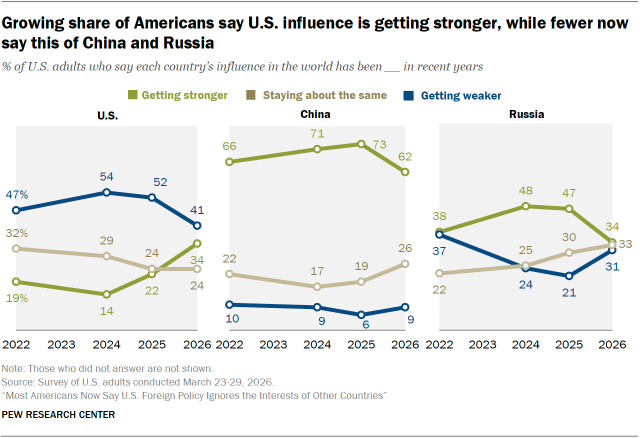
When it comes to China, fewer Americans say its influence has been getting stronger than said so last year, though this is still the majority opinion (held by 62%).
Similarly, Americans are now 13 points less likely to say Russia’s influence is growing. This marks a significant change in pattern: Where Americans were more likely to see Russia’s influence getting stronger than anything else in 2025, about one-third each now say its influence is getting stronger, weaker and staying the same.
Read our recent reports on Americans’ overall opinions of China and Russia for more.
There have been additional shifts in opinion since last year:
- More Americans see Iran getting weaker now than last year (41% vs. 28%) making this the plurality opinion for the first time since we began tracking these views in 2024.
- A growing share say Israel’s global influence is strengthening: 45%, up 7 points from last year. Simultaneously, Americans’ overall opinion of Israel is getting more negative.
- The share of those who say the U.K. is getting stronger has dropped 7 points, while the share who see it getting weaker has grown 6 points.
- Germany’s influence is perceived to be leveling off: Just 13% say it’s getting stronger, down 8 points from last year, while the share who see it staying about the same is up 9 points.
How do ratings of global influence differ by party?
Partisans have differing opinions about the influence of certain countries in the world – especially the U.S.
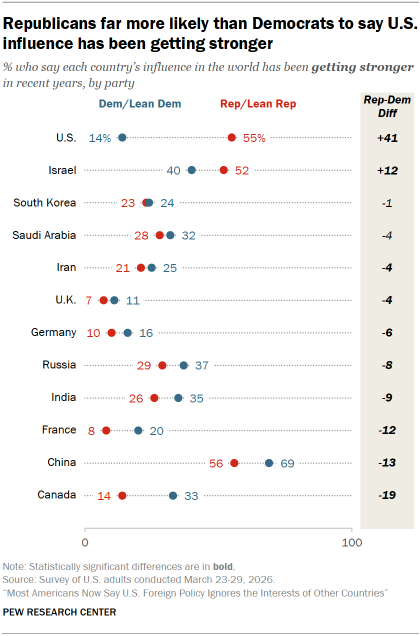
A majority of Republicans and Republican leaning independents (55%) say U.S. influence has been getting stronger, compared with 14% of Democrats and Democratic leaners. Republicans are also more likely to see Israel’s influence getting stronger.
Republicans ages 65 and older are the group most likely to see the influence of the U.S. and Israel as getting stronger. For example, 62% of these Republicans see Israel strengthening, compared with about half or fewer in all other age groups across both parties.
For their part, Democrats are more likely than Republicans to say most other countries we asked about are growing in influence, allies and adversaries alike.
China, Iran and Russia are each considered stronger by Democrats than by Republicans, as are traditional U.S. partners like Canada, France and Germany. Even so, China is the only country of these six that a majority of Democrats say is strengthening in influence.
How have partisan ratings changed?
Ratings of influence for several countries are generally moving in the same direction across parties, though Republicans’ views have shifted more than Democrats’ since the end of the Biden administration.
The share of Republicans who see U.S. influence getting stronger is up 21 points since last year and 45 points since 2024. The share among Democrats is up just 3 points since last year but down since Biden was in office.
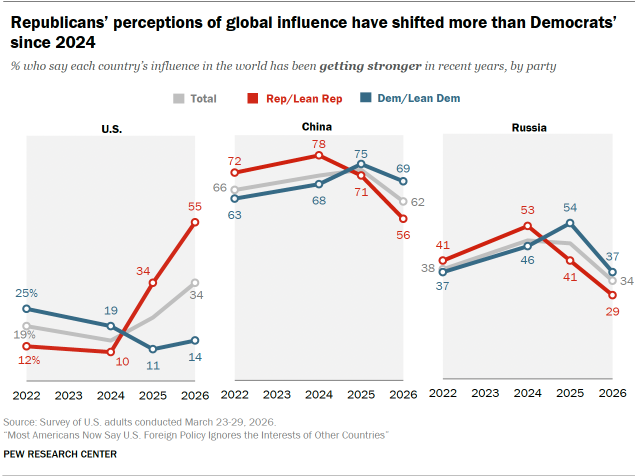
Republican views are shifting more substantially on China, too: 56% of Republicans say China is getting stronger, down 22 points from 2024. After peaking in 2025, the share of Democrats who see China getting stronger is on par with two years ago.
The pattern is similar for Russia. The share of Democrats saying Russia’s influence is strengthening peaked at 54% in 2025 before dropping to 37% today. But looking at the two-year trend, it is Republicans who have shifted more: The share who see Russia getting stronger has dropped 24 points since 2024.
Compared with 2025, Republicans today are 22 points more likely to say Iran is getting weaker. Democrats are also more likely to see Iran getting weaker than they were last year, but the change is smaller (+6 points).
Ideological differences among Republicans
While Republicans are more likely than Democrats to say the influence that the U.S. and Israel each have in the world is getting stronger, it is conservative Republicans who are particularly likely to say this.
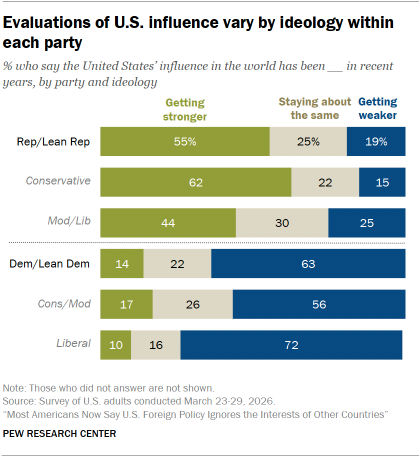
- 62% of conservative Republicans say U.S. influence has been getting stronger in recent years, compared with 44% of their moderate or liberal counterparts.
- 57% of conservative Republicans say Israel’s influence has been getting stronger, compared with 46% of moderate and liberal Republicans.
Conservative Republicans are also especially likely to see the influence of European powers waning. For example, while most Americans say the U.K.’s influence has been holding steady in recent years, roughly half of conservative Republicans say it’s been getting weaker.
Ideological differences among Democrats
Liberal Democrats differ from moderate and conservative Democrats in their views of some countries’ global influence. For example, they are more likely to see Saudi Arabia (+9 points), India (+8) and Israel (+6) getting stronger.
When it comes to the U.S., liberal Democrats are more likely than moderates and conservatives to say their country has gotten weaker in recent years (72% vs. 56%). And like conservative Republicans, liberal Democrats are more likely to see the U.K.’s influence slipping.
How do ratings of global influence differ by age?
Americans’ ratings of the influence certain countries have in the world differ by age.
- Adults ages 65 and older are more likely than those ages 18 to 29 to see U.S. influence getting stronger (43% vs. 32%).
- Americans ages 18 to 29 are the group most likely to see South Korean influence getting stronger. About one-third (32%) hold this view, compared with roughly two-in-ten or fewer in older age groups.
- Young adults are also about twice as likely as their older peers to say Saudi Arabia is growing weaker on the world stage (23% vs. around one-in-ten among older age groups).