To better understand how Americans assess the power of various countries, we asked 1,765 U.S. adults an open-ended question: “What country or countries are global superpowers, where ‘superpower’ means a country that is both militarily and economically dominant?”
Respondents could name up to six countries in their answer.
Americans most often name the United States as a global superpower: 57% mention it alone or alongside one or more other countries.
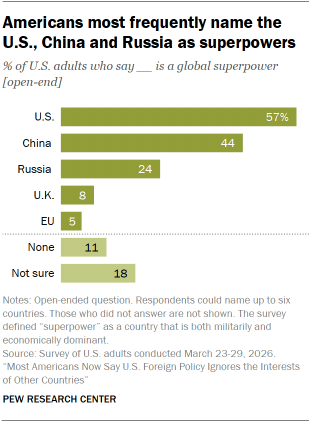
Many also name China (44%) and Russia (24%) as superpowers.
Among the other key findings:
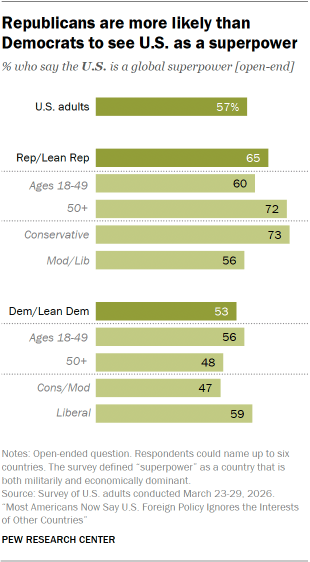
- Republicans and Republican-leaning independents are more likely than Democrats and Democratic leaners to list the U.S. as a superpower (65% vs. 53%).
- There is no consensus about how many global superpowers there are: 11% of Americans say there are none, 27% name one country in their answer, 16% name two, and 27% name three or more.
- Democrats most commonly perceive a “multipolar” world, meaning one with three or more superpowers. Republicans most often view the world as “unipolar” and say the U.S. is its only superpower.
Which countries do Americans think are superpowers?
A majority of U.S. adults (57%) say the U.S. is a militarily and economically dominant global superpower. Fewer say the same about China (44%) and Russia (24%).
Some Americans say there are no global superpowers (11%) or that they aren’t sure (18%).
Age differences
Majorities of Americans in all age groups see the U.S. as a global superpower.
But there are differences by age in perceptions of China and Russia, with younger Americans more likely than older ones to view both countries as dominant international powers.
Partisan differences
Republicans are more likely than Democrats to say the U.S. is a superpower (65% vs. 53%).
Conversely, Democrats are somewhat more likely than Republicans to see China that way (49% vs. 42%).
A quarter of adults in each party see Russia as a superpower.
Age differences in each party
Republicans ages 50 and older are more likely than those under 50 to say the U.S. is a superpower (72% vs. 60%), though younger Republicans are more likely than older ones to say they are unsure.
Among Democrats under 50, 56% consider the U.S. a superpower, compared with 48% of those ages 50 and older. Younger Democrats are also more likely than older ones to see China and Russia as superpowers.
How many superpowers do Americans say there are?
We also counted how many countries respondents named in their list of superpowers. (They could include up to six in their answer.)
In international affairs, the number of perceived superpowers is often referred to as “polarity.” People who believe there is one global superpower perceive a “unipolar” world, those who believe there are two superpowers perceive a “bipolar” world, and so on.
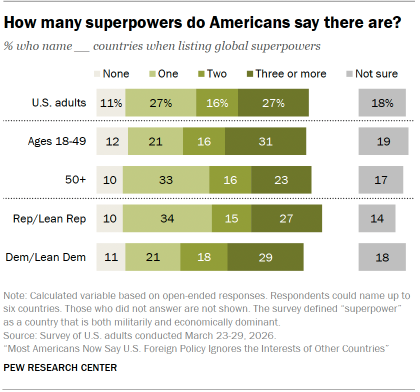
Americans are divided about how many global superpowers there are. Roughly one-in-ten (11%) say there are no global superpowers, 27% say there is one, 16% say there are two, and 27% say there are three or more. Another 18% aren’t sure.
Age differences
A third of adults ages 50 and older say there is only one superpower, compared with 21% of those ages 18 to 49. Conversely, around a third of younger Americans (31%) say there are three or more superpowers, while 23% of older adults say the same.
Partisan differences
Among Republicans, 34% perceive a unipolar world and 27% perceive a multipolar world – that is, one with three or more superpowers. For Democrats, 21% see a unipolar world and 29% see a multipolar one.
Age differences in each party
Republicans ages 50 and older are more likely than their younger counterparts to say the world is unipolar (43% vs. 27%).
Among Democrats, those ages 50 and older are 10 percentage points more likely than their younger peers to say the world is unipolar (27% vs. 17%). Younger Democrats, in turn, are more likely than older ones to say there are two superpowers or that there are three or more.
In a unipolar world, which country is the superpower?
Of the 27% of U.S. adults who mention only one superpower, most say that single dominant country is the U.S (69%).
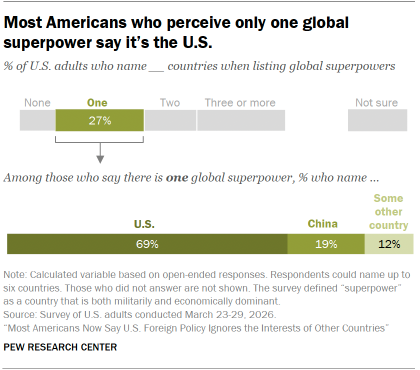
Another 19% of these Americans instead say the world’s sole superpower is China. And 12% name some other country.
Partisan differences
Around eight-in-ten Republicans who say there is only one superpower (81%) say it is the U.S.
Among Democrats, 51% of those who think there’s only one superpower also say it is the U.S., while 34% say it’s China.
In a bipolar or multipolar world, which countries are superpowers?
For the 16% of U.S. adults who say there are two global superpowers, the countries they most often name are the U.S. and China (73%).
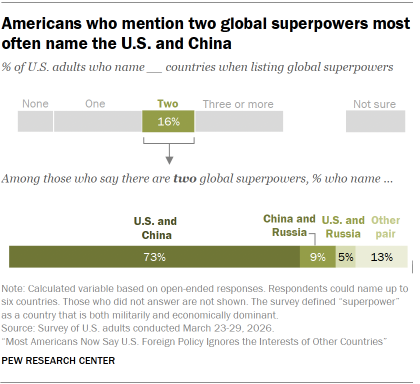
The other most frequent combinations are China and Russia (listed by 9%) and the U.S. and Russia (5%).
Meanwhile, the 27% of Americans who say there are three or more superpowers most often list the U.S., China and Russia among them.
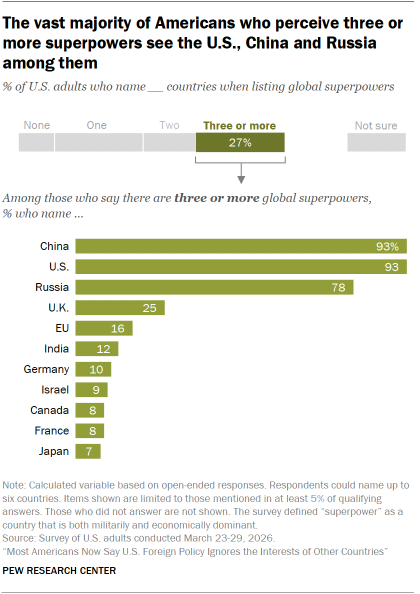
In fact, nearly all Americans who perceive a multipolar world (93%) name the U.S. and China in their answers.
Beyond those three countries, Americans who perceive a multipolar world often name the United Kingdom as a superpower as well.