
Since 2002, we have asked Americans to what extent they think the United States takes into account the interests of other countries when making foreign policy decisions.
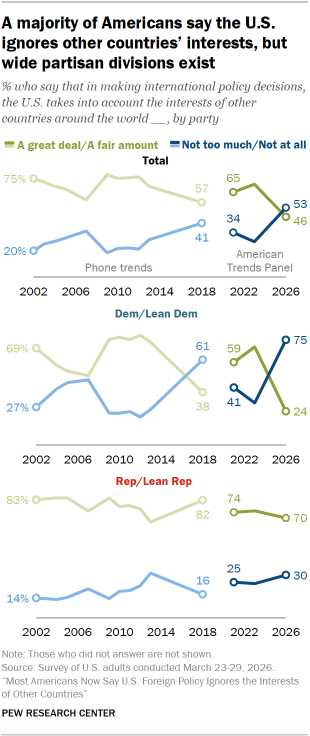
And for the first time, a new Pew Research Center survey finds that a majority (53%) believe the U.S. does not consider other countries’ interests much or at all.
This share is up sharply from 27% in 2023, during Joe Biden’s administration, with most of the change taking place among Democrats and Democratic-leaning independents.
Three-in-four Democrats now say the U.S. ignores the interests of other nations – the largest share we’ve measured in surveys going back two decades. Still, 61% of Democrats expressed this view in Donald Trump’s first term, as did roughly half toward the end of George W. Bush’s presidency.
Republican views have remained relatively consistent over time. In fact, for as long as we’ve asked this question, at least two-thirds of Republicans and Republican leaners have said the U.S. considers other countries’ interests a great deal or a fair amount when making foreign policy.
This is just one of several questions about America’s role on the global stage where we find drastically different views between Democrats and Republicans.
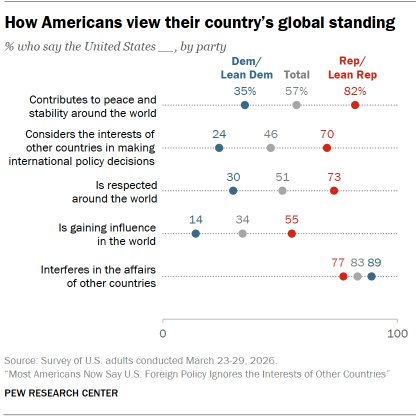
Republicans tend to see a world in which the U.S. contributes to peace and stability, takes into account the interests of other countries, is respected and has a growing influence in international affairs.
By contrast, Democrats tend to see a world in which the U.S. does not contribute to peace and stability, ignores the interests of other nations and is not respected. And most say its influence in the world is waning.
Partisans also differ in their views of the U.S. as a global superpower. When asked to list the countries they see as both militarily and economically dominant in the world, about two-thirds of Republicans name the U.S., significantly more than the roughly four-in-ten who name China. Democrats are about equally likely to name the U.S. (53%) and China (49%) as global superpowers.
There are also some notable differences within the two parties – in particular, differences by age among Republicans.
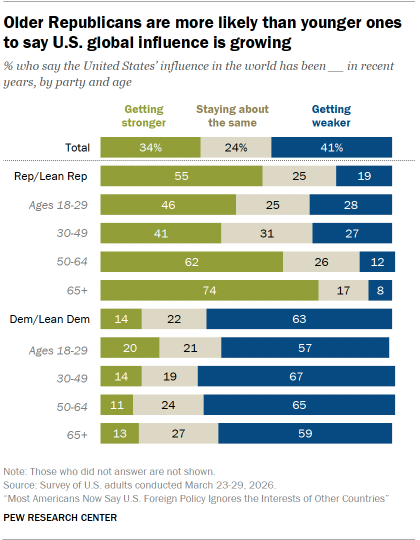
Younger Republicans are generally less likely than their older counterparts to think that the U.S. is respected and growing in influence, and that it considers the interests of other nations when making foreign policy decisions. They also name the U.S. as a global superpower less often.
Previous Center analyses based on this survey have highlighted age gaps among Republicans on other foreign policy issues as well. For instance, younger Republicans are less likely to express confidence in President Donald Trump’s ability to deal with Iran, Israel and NATO, among other issues.
There have been notable changes in recent years on some of the questions included in this report, including along partisan lines.
- Overall, the share of Americans who believe the U.S. contributes to global peace and stability has declined from 69% in 2023, during the Biden administration, to 57% today. Among Democrats, this share has dropped from 72% to 35%; among Republicans, it has risen from 70% to 82%.
- Since 2024, Republicans have become more likely to say American influence in the world is growing stronger, while Democrats are more likely to say it is becoming weaker today than two years ago.
However, large majorities from both parties agree on one question: 89% of Democrats and 77% of Republicans say the U.S. interferes in the affairs of other countries a great deal or a fair amount. Overall, 83% of U.S. adults express this view, up slightly from 80% in 2023.
More in this report
In addition to asking about U.S. influence in world politics, we asked about the global standing of 11 other countries.
- China is the only nation that a majority of Americans think is getting stronger, though a 45% plurality also say this about Israel.
- The share who believe Russia’s influence is growing has declined over the past year.
- A 41% plurality say Iran’s influence is getting weaker. (The survey was conducted March 23-29, roughly three weeks after the start of the Iran war.)
The survey also included an open-ended question which asked respondents to name the countries they consider global superpowers. Nearly six-in-ten (57%) mention the U.S., 44% mention China and 24% mention Russia.
Additionally, while most Americans say the U.S. does not consider the interests of other countries, the survey finds that 65% think it should do this when dealing with major international issues – even if it means making compromises. Democrats are much more likely than Republicans to hold this view.
Jump to the sections below to learn how Americans answered the following questions about the United States’ role in the world:
- Is the U.S. respected?
- Is U.S. influence getting stronger or weaker?
- Does the U.S. interfere in the affairs of other nations?
- Does the U.S. contribute to peace and stability?
- How should the U.S. weigh compromise and national interest in foreign policy?
Is the U.S. respected?
Overall, 91% of Americans think it is important for the U.S. to be generally respected by other countries. Equal shares of Democrats and Republicans express this view, including around six-in-ten in each party who see it as very important for the U.S. to be respected.
However, partisans are divided over whether the U.S. actually is respected around the world.
Around three-quarters of Republicans (73%) say the U.S. is respected, unchanged from last year. This includes 21% who say the U.S. is very respected and 52% who say it is somewhat respected.
There is a significant difference between the oldest and youngest Republicans on this question. Those ages 65 and older are 21 percentage points more likely than those ages 18 to 29 to say the U.S. is respected around the world (84% vs. 63%).
By contrast, 30% of Democrats say the U.S. is respected by other countries, down from 39% a year ago. Roughly a quarter of Democrats (23%) say that the U.S. is not at all respected.
Is U.S. influence getting stronger or weaker?
When asked about the United States’ global influence in recent years, a plurality of Americans (41%) say it has been getting weaker. But that share is the smallest it’s been since 2022.
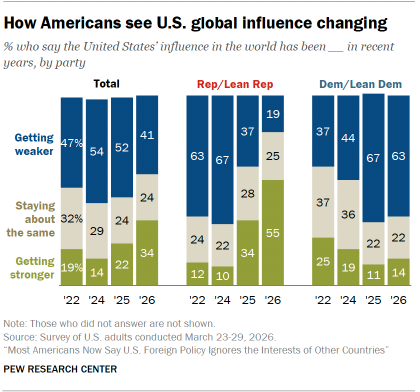
Instead, a growing number of Americans say U.S. influence is strengthening (34%). This change is driven almost entirely by Republicans: Today, 55% say U.S. global influence is getting stronger, up 21 points from 2025 and 45 points from 2024, the final year of Biden’s presidency.
There is a 25-point gap between older and younger Republicans on this question. Around two-thirds of those ages 50 and older (68%) say U.S. influence is getting stronger, compared with 43% of GOP adults under 50.
For their part, most Democrats (63%) say U.S. influence is getting weaker. These views are largely unchanged from last year, though Democrats are more likely to hold this view now than they were when Biden was in office. About equal shares of younger and older Democrats say U.S. influence is waning.
Ratings of U.S. influence also vary by ideology within each party. About six-in-ten conservative Republicans (62%) think U.S. influence has been getting stronger, compared with 44% of moderate and liberal Republicans. Conversely, 72% of liberal Democrats think U.S. influence is getting weaker, while a smaller majority of moderate and conservative Democrats agree (56%).
Does the U.S. interfere in the affairs of other nations?
A large majority of Americans (83%) believe the U.S. interferes in the affairs of other countries, including 39% who say it does so a great deal. Democrats are slightly more likely than Republicans to hold this view (89% vs. 77%).
Views vary by age within each party. Democrats under 50 are somewhat less likely than those ages 50 and older to think the U.S. interferes in the affairs of other countries. But younger Republicans are somewhat more likely than their older counterparts to say the same.
Does the U.S. contribute to peace and stability?
A majority of Americans (57%) say the U.S. contributes a great deal or a fair amount to peace and stability around the world. Republicans are much more likely than Democrats to express this opinion (82% vs. 35%), with Republicans ages 50 and older especially likely to do so (91% vs. 74% of Republicans under 50).
Even though most Americans say the country contributes to global peace, that share has declined from 69% in 2023. Partisan attitudes, however, have moved in opposing directions. Democrats are now much less likely to think the U.S. contributes to peace and stability (72% said this in 2023, versus 35% today), while Republicans have become more likely to hold this view (70% then, 82% today).
How should the U.S. weigh compromise and national interest in foreign policy?
Most Americans (65%) say that when dealing with major international issues, the U.S. should take into account the interests of other countries, even if it means making compromises with them.
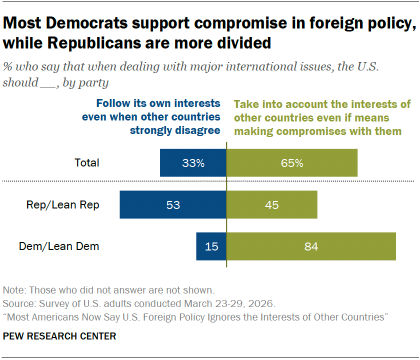
But here again, views differ by party. Democrats are much more likely to support this view than Republicans. A slim majority of Republicans (53%) believe the U.S. should follow its own interests when faced with major international issues, even when other countries strongly disagree.
Partisan views have not changed since we last asked this question a year ago.
CORRECTION (May 4, 2026): This report’s language has been updated to more accurately describe the share of Democrats who say the U.S. is not at all respected. No other findings are affected by these changes.