Pew Knight Initiative
The Pew-Knight Initiative supports new research on how Americans absorb civic information, form beliefs and identities, and engage in their communities.
Pew Research Center is a nonpartisan, nonadvocacy fact tank that informs the public about the issues, attitudes and trends shaping the world. Knight Foundation is a social investor committed to supporting informed and engaged communities. Learn more >
About half of U.S. adults (45%) say they ever listen to religious audio programming – such as music, sermons, talk shows or audio dramas – either via radio or online. Most listeners say they tune in because they find the content spiritually uplifting, relaxing or able to provide guidance for daily life. Fewer point to keeping up with news and current events as a major reason for listening.
Even so, political and social issues do come up in religious programming. About four-in-ten listeners say they hear commentary about these topics at least sometimes. And when we examined a month’s worth of religious radio broadcasts from July 2025, we found that some stations have multiple hours of programming each day that focus on political and social issues. Others seldom reference these topics outside of brief news reads or passing mentions.
The following analysis looks at the experiences of U.S. adults who listen to religious programming and encounter politics there, and how they feel about this type of content.
The findings are part of a larger study on religious radio in the U.S.
How listeners encounter political content in religious programming
Many adults who listen to religious programming don’t end up being exposed to much political content this way. About one-third of listeners (35%) say they rarely hear discussions of news and politics, and another 21% say they never do.
This reflects the different types of programming people choose to listen to:
- 37% of Americans listen to religious music, making it the most popular type of programming we asked about. Religious radio stations that primarily play music also tend to include relatively little political content, according to our content analysis.
- Stations that air primarily talk programming devote the most time to politics – a little over four hours per station per day, on average. But the audience for religious talk shows is smaller. About one-in-five Americans (18%) report listening to this type of programming.
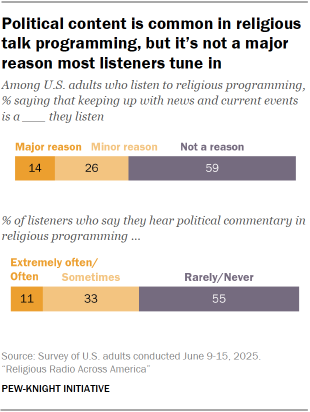
Among Americans who listen to religious talk shows, about six-in-ten (56%) say they hear political or social commentary there at least sometimes. A similar share of talk show listeners say they tune in to keep up with news and current events (59% say this is at least a minor reason). By comparison, of all religious programming listeners – not just those who listen to talk shows – 40% say that keeping up with news and current events is a reason they listen. And among people who listen to other types of religious programming but don’t listen to talk shows, just 28% say they tune in to keep up with current events.
How listeners feel about political content in religious programming
Among people who say they ever encounter political or social commentary in the religious radio programming they listen to:
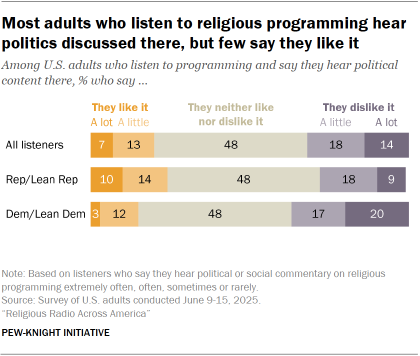
- 48% say they neither like nor dislike it.
- 20% like it; 32% dislike it.
Republicans are more likely than Democrats to say they like it a lot (10% vs. 3%), while Democrats are more likely to dislike it a lot (20% vs. 9%).
(This follow-up question was asked only of survey respondents who said they encounter political or social commentary in religious programming extremely often, often, sometimes or rarely. Respondents who said they never encounter political or social commentary were not asked whether they like it.)