
In most of the 37 countries Pew Research Center surveyed this year, a majority of adults have at least some awareness of artificial intelligence.
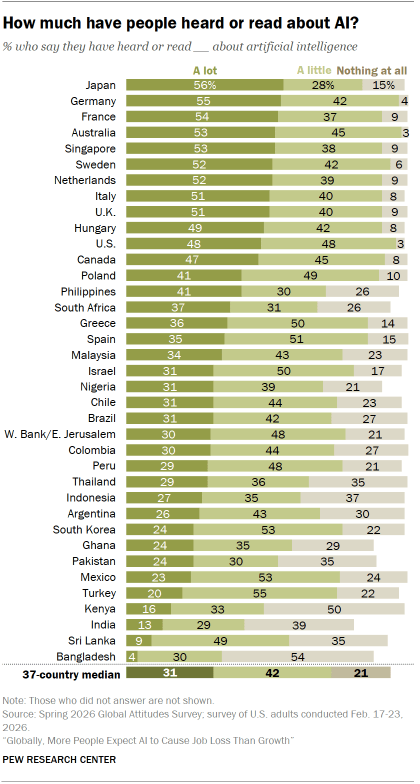
Still, the share of people who have heard or read a lot about the technology varies substantially, from more than half in Japan and Germany to around one-in-ten or fewer in Sri Lanka and Bangladesh.
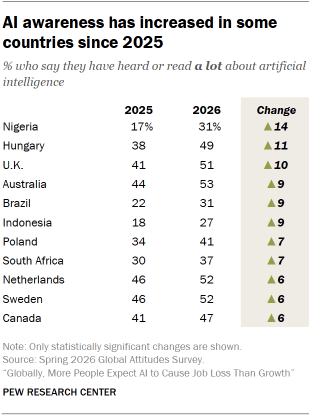
But awareness is growing. In 11 of the 25 countries where we also asked this question last year, the share of people who have heard a lot about AI has increased. Some of the largest shifts since last year have been in Nigeria (+14 percentage points), Hungary (+11) and the United Kingdom (+10).
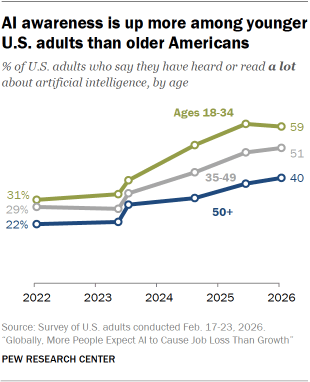
The share of Americans who have heard a lot about AI has nearly doubled since 2022, when we began asking the question in the United States.
This analysis is part of a broader study on how people around the world view AI. It is based on a survey of 42,151 adults in 36 countries conducted Feb. 8-May 13, 2026. U.S. data comes from two surveys, the first of 5,119 adults conducted Feb. 17-23, and the second of 3,488 adults conducted June 22-28.
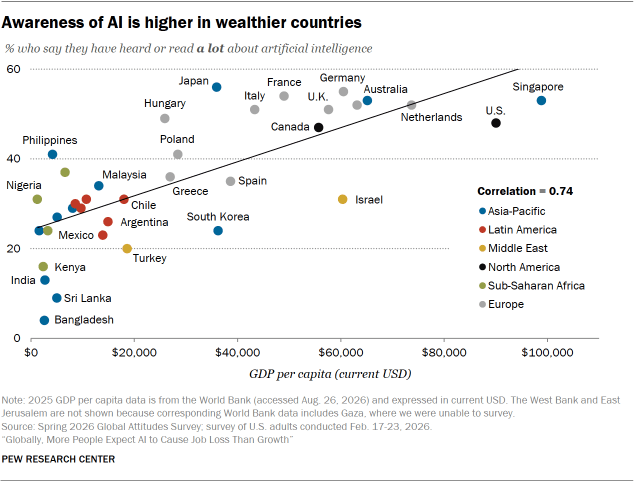
AI awareness and GDP per capita
AI awareness tends to be higher in countries with higher gross domestic product per capita. At one end of this spectrum is Singapore, where GDP per capita is close to $100,000 and 53% of adults have heard or read a lot about AI. By comparison, in Bangladesh, GDP per capita is about $2,600 and 4% of adults say they have heard or read a lot about AI. Read more on how people in middle- and high-income countries view AI.
Awareness by age
In nearly every country surveyed, younger adults are more likely than older adults to say they have heard or read a lot about AI.
In some places, this gap is quite large. In Chile, Greece, the Philippines, South Korea and Spain, for example, a majority of adults under 35 have heard a lot about AI, compared with around one-in-five or fewer among those ages 50 and older. Read more on global views of AI by age.
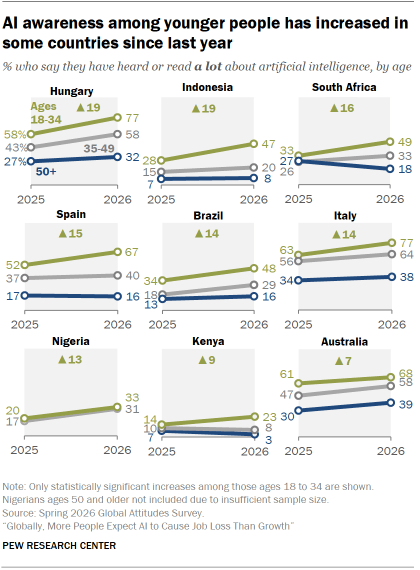
Awareness has also increased sharply among young people in many places. For example, in Hungary, younger people are now 19 points more likely to say they have heard or read a lot about AI than they were last year. In Indonesia, where young peoples’ awareness also grew by 19 points, awareness also did not change among older adults – those 50 and over – increasing the awareness gap.
In the U.S., awareness has grown more among adults ages 18 to 34 than among adults ages 50 and older since we began asking the question in 2022.
Awareness by education
In every country surveyed, people with more education are more likely than those with less education to say they have heard a lot about AI.
Awareness by gender
In around half of the countries surveyed, men are more likely than women to say they have heard a lot about AI. In some countries, women in turn are more likely to say they know nothing at all about the technology.
Awareness by household income
In nearly every country surveyed, people with higher household incomes are more likely to have heard a lot about AI. For example, higher-income Spaniards are twice as likely as lower-income Spaniards to say they have heard a lot about it (50% vs. 25%). The pattern is similar in the Philippines (53% vs. 26%).


