
Age is closely linked with how Americans take part in public life, with older and younger Americans often taking different paths to participation.
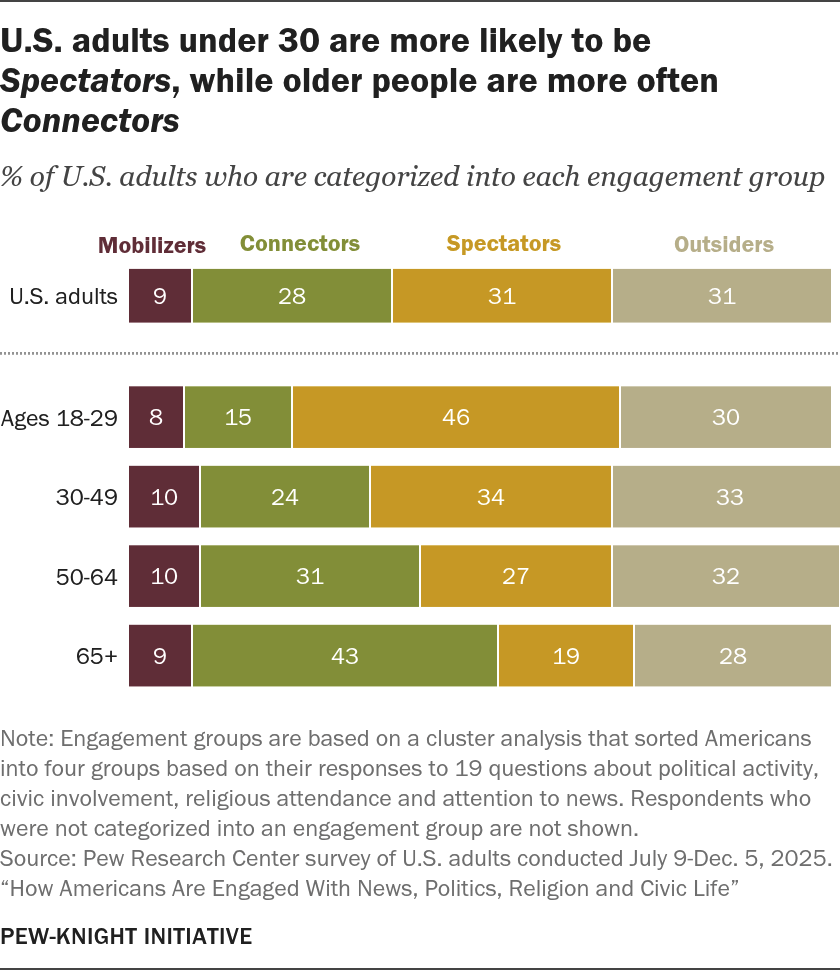
| Group | Mobilizers | Connectors | Spectators | Outsiders | |
|---|---|---|---|---|---|
| U.S. adults | U.S. adults | 9 | 28 | 31 | 31 |
| Ages 18-29 | Age | 8 | 15 | 46 | 30 |
| 30-49 | Age | 10 | 24 | 34 | 33 |
| 50-64 | Age | 10 | 31 | 27 | 32 |
| 65+ | Age | 9 | 43 | 19 | 28 |
Older adults are more likely to participate in long-standing civic activities like voting, donating money or attending religious services. Younger adults, meanwhile, are more likely to engage online, including by liking or privately sharing news content.
In a new study, we sorted Americans into four groups based on their answers to questions about engagement in public life. Older Americans are more likely than younger adults to be Connectors, who tend to participate in civic and community life. About four-in-ten people ages 65 and older (43%) are in this group – almost three times the share of adults ages 18 to 29 (15%).
In contrast, younger Americans are more likely to be Spectators – those who follow the news and interact with it online but are less engaged in other aspects of public life. Nearly half of adults under 30 are Spectators (46%), compared with 19% of adults 65 and older.
Similar shares of younger and older adults fall into the most and least engaged groups. About one-in-ten Americans regardless of age are Mobilizers, while roughly three-in-ten are Outsiders.
About the engagement groups
This study sorts Americans into four groups based on their answers to 19 questions about how they engage (or don’t engage) in society through political activity, civic involvement, religious service attendance and attention to news. The four groups are:
 Mobilizers: Doing it all. This group is the smallest and the most active across politics, civics, news and religion.
 Connectors: Involved, but less political. This group is larger than the Mobilizers and also highly engaged in many ways – including joining groups and making donations – but much less likely than the Mobilizers to be heavily involved in political activities.
 Spectators: Keeping an eye on things. They follow the news at high rates but are much less likely than the more engaged groups to participate directly in other ways.
 Outsiders: Less involved in most ways. This group is less likely than others to report taking part in most of the activities we asked about – including voting, volunteering and following the news.
Older Americans are more engaged in traditional ways

| Ages 18-29 | 30-49 | 50-64 | 65+ | |
|---|---|---|---|---|
| Voted in the 2024 presidential election | 45 | 55 | 66 | 77 |
| Donated >$25 to a nonpolitical group in the past year | 31 | 45 | 48 | 59 |
| Follow national news at least somewhat closely | 64 | 66 | 78 | 83 |
| Attend religious services in person at least monthly | 32 | 27 | 31 | 39 |
Older Americans are more involved than younger adults in many traditional civic activities, such as voting, donating, attending religious services and following the news.
About three-quarters of Americans ages 65 and older (77%) say they voted in the 2024 presidential election between Kamala Harris and Donald Trump. Each of the younger age groups was less likely to say they voted, and fewer than half of U.S. adults under 30 say they voted (45%).
Older Americans – who tend to have more financial resources – are also more likely than younger people to donate money or goods. About six-in-ten adults in the oldest age group (59%) say they gave more than $25 to a nonpolitical organization in the past 12 months, nearly double the share of the youngest age group (31%). And 18% of those 65 and older gave money to a political organization or campaign, versus just 6% of adults under 30.
When it comes to engagement in news and religion, older adults again are involved at higher levels than younger Americans:
- News consumption: 83% of those in the oldest age group say they follow national news very or somewhat closely, compared with 64% among adults under 30.
- Religious participation: 39% of Americans 65 and older say they attend religious services in person at least monthly, higher than all other age groups. The oldest group is also more likely than younger Americans to watch or participate in religious services online or on TV.
Younger Americans are more engaged online
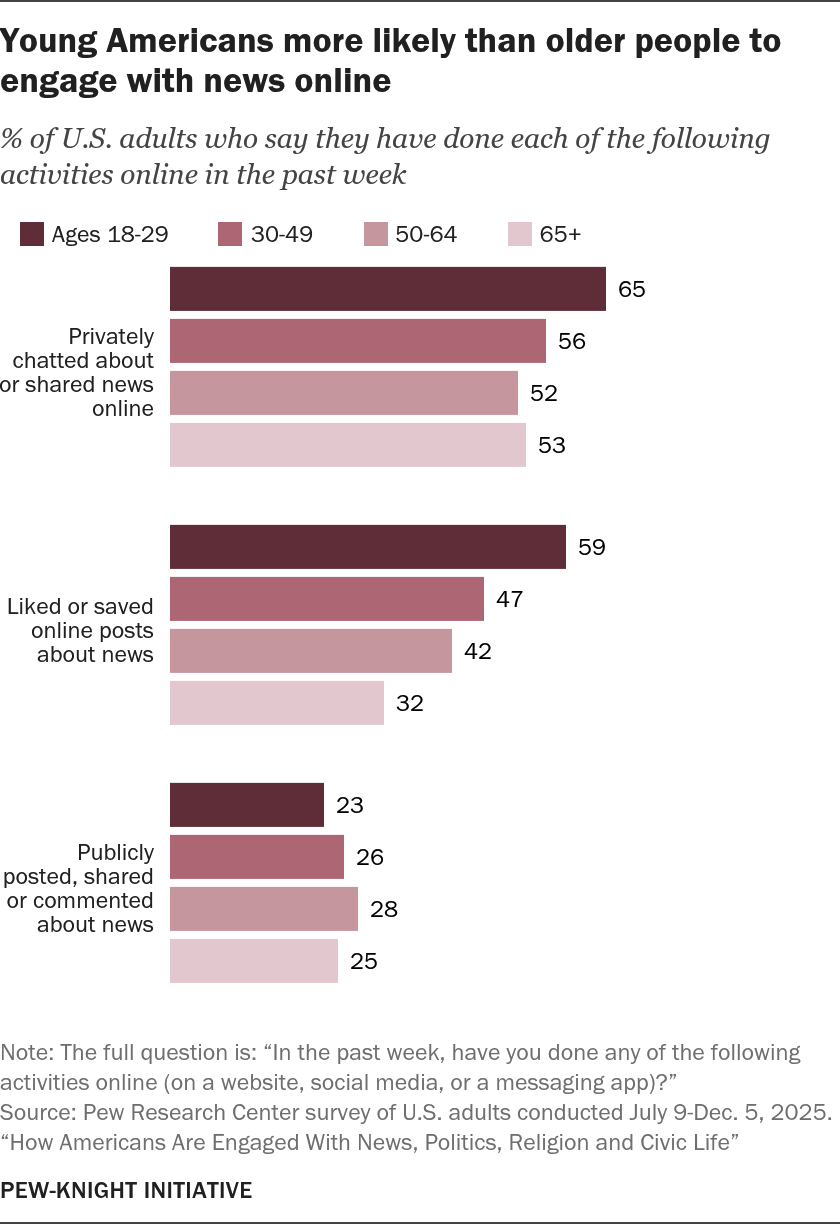
“How Americans Are Engaged With News, Politics, Religion and Civic Life”
| Ages 18-29 | 30-49 | 50-64 | 65+ | |
|---|---|---|---|---|
| Privately chatted about or shared news online | 65 | 56 | 52 | 53 |
| Liked or saved online posts about news | 59 | 47 | 42 | 32 |
| Publicly posted, shared or commented about news | 23 | 26 | 28 | 25 |
“How Americans Are Engaged With News, Politics, Religion and Civic Life”
Despite their lower levels of engagement in many political and civic activities, younger Americans are not entirely checked out. Instead, they tend to engage in more observational ways – especially when it comes to news in digital spaces.
About six-in-ten U.S. adults ages 18 to 29 say they have liked or saved posts about news online in the past week (59%), much higher than the share of those 65 and older who say this (32%).
Younger Americans are also more likely than older people to privately chat about or share news on social media or a messaging app. However, the same pattern doesn’t apply to publicly posting or commenting about news online: Roughly a quarter of Americans across age groups say they do so.
Aside from digital engagement, younger Americans are also modestly more likely than older people to volunteer. About a third of U.S. adults under 30 (32%) and a similar share of those ages 30 to 49 (31%) say they volunteered for an organization or association in the past 12 months. Smaller shares of people ages 50 to 64 (26%) and 65 and older (25%) say the same.


