As many working parents struggle with the cost of childcare, the issue has become a focus for policymakers across the political spectrum.
We asked 849 working parents with at least one child age 5 or younger about their experiences finding care.
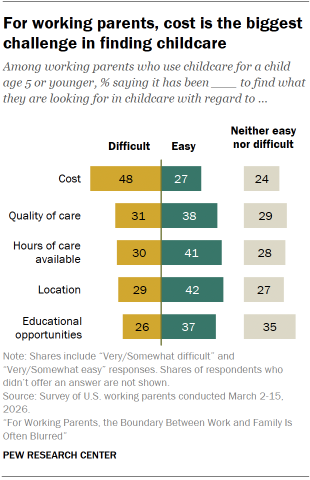
Parents value quality of childcare over any other factor. But across income levels, cost is among the biggest challenges in finding childcare that suits their needs.
About half (48%) of working parents who need care for a child age 5 or younger say it’s difficult to find an arrangement that meets their cost expectations.
Beyond quality, majorities of parents also place a great deal of importance on hours of availability, location and educational opportunities when looking for childcare.
Workplace childcare is an area where what parents value and what’s available to them are out of sync. A majority (59%) of working parents with children 5 or younger – including 68% of working moms with a kid in this age group – say it would be extremely or very helpful to have onsite childcare at their workplace. But just 7% say this is available to them.
Many parents use multiple care arrangements to cover their work hours. About four-in-ten working parents (39%) say they use more than one care arrangement for the same child.
These findings are part of a larger survey of 2,242 U.S. working parents conducted March 2-15, 2026. Read key findings from the full study.
Some parents struggle more than others finding childcare
There are wide income differences in parents’ ability to find what they’re looking for, beyond affordability, in a childcare arrangement.
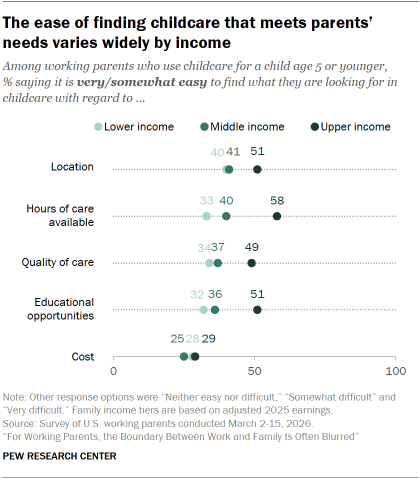
Among working parents with a child age 5 or younger, those with upper family incomes are more likely than those with middle and lower incomes to say it’s easy to find care that meets their needs on:
- Hours of care available
- Quality of care
- Educational opportunities
Parents’ work schedule also plays a role. Among parents who say they have an extremely or very predictable work schedule, 48% report that it’s easy to find care that meets their expectations on hours of availability. A much smaller share of parents with a somewhat or less predictable work schedule (30%) say the same.
For parents whose work hours vary, the difficulty of finding care often coincides with a need to cobble together several care arrangements each week. Among parents who say their work schedule is somewhat or less predictable, 45% say they use more than one care arrangement for the same child. This compares with 35% among parents with a predictable work schedule.
Income differences in childcare arrangements
For working parents with upper family incomes, daycare or preschool is the most common arrangement (used by 72%).
But among parents with lower or middle family incomes, there’s no dominant care arrangement.
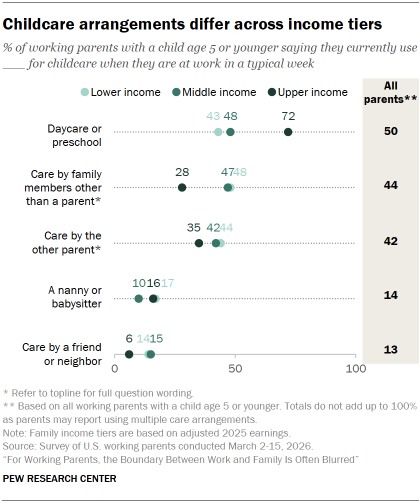
Lower- and middle-income parents are more likely than upper-income parents to arrange care provided by:
- Family members other than a parent
- Friends or neighbors
Finding care for school-age children
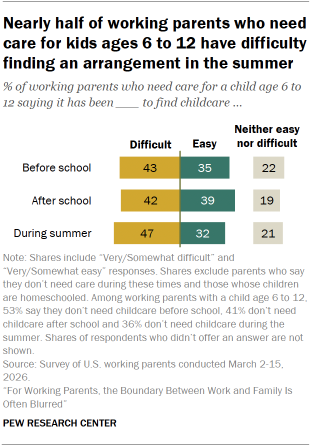
Working parents with school-age children also face challenges finding care arrangements to cover their work hours.
Among parents who say they need childcare for a child age 6 to 12, sizable shares report difficulty in finding care before school (43%), after school (42%) or during the summer (47%).