As part of a larger survey about their experiences, we asked working parents what work arrangements or employer-provided benefits would be the most helpful to them and whether those things are available at their current job.
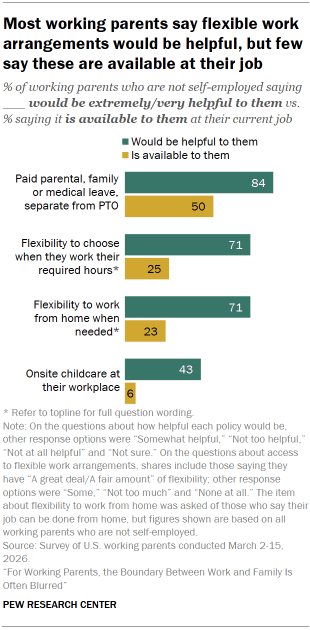
In many cases, the arrangements and benefits working parents think of as helpful aren’t widely accessible – and this is especially true for those with lower family incomes.
For example, more than eight-in-ten working parents who are not self-employed say having paid parental, family or medical leave would be extremely or very helpful to them. But only half have access to this benefit.
Majorities also say flexibility to work from home (71%) or flexibility to choose when they work their required hours (71%) would be highly helpful.
But much smaller shares say they have a great deal or a fair amount of flexibility to:
- Choose when they work their hours (25%)
- Work from home (23%)
Onsite childcare stands out for an especially large mismatch. Some 43% of working parents – and 59% of those with a child age 5 or younger – say this would be highly helpful. But just 6% of working parents say this is available at their workplace. Read more about working parents’ challenges finding childcare.
In contrast, most working parents say paid time off (PTO) and health insurance through their work would be helpful, and most say these are available to them.
The survey of 2,242 U.S. working parents was conducted March 2-15, 2026. Read key findings from the full study.
How workplace benefits and flexible arrangements vary by income
Among working parents who are not self-employed, those with upper and middle family incomes are much more likely than those with lower incomes to say they have access to:
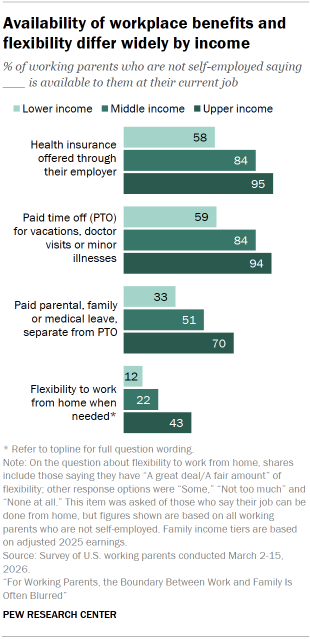
- Health insurance (95% and 84% vs. 58%)
- PTO (94% and 84% vs. 59%)
Upper-income parents are the most likely to say they have paid parental, family or medical leave separate from PTO. Seven-in-ten have access to this, compared with 51% of those with middle incomes and 33% of those with lower incomes.
Upper-income parents are also the most likely to say they have a great deal or a fair amount of flexibility to work from home. Some 43% say they can do this, compared with 22% of parents with middle incomes and 12% of those with lower incomes.
We don’t see similar gaps in parents’ flexibility to choose when they work their hours.
Some of these income differences reflect parents’ work status: Among parents who are not self-employed, those with lower family incomes are more likely to work part time (33% vs. 11% of those with middle incomes and 5% of those with upper incomes). In general, part-time workers are less likely to have these benefits and flexibility arrangements available to them. But even among those employed full time, lower-income parents are less likely than those in higher family income tiers to say these are available.
Lower-income parents who are not self-employed are also more likely to be paid by the hour (79% vs. 47% of those with middle incomes and 15% of those with upper incomes), and hourly workers are less likely to have these benefits and flexible work arrangements.
Having a predictable work schedule is another area where income differences emerge. Among lower-income parents who are not self-employed, 14% say their work hours are not too or not at all predictable. Smaller shares of those with middle or upper incomes say the same (9% and 7%).
Parents who say their work hours are not predictable are more likely than those with at least somewhat predictable hours to say it is difficult for them to balance their work and family responsibilities (71% vs. 53%).
Concerns about unexpected childcare needs
Balancing work and family life can be especially challenging when unexpected situations arise, like when a child is sick or childcare falls through.
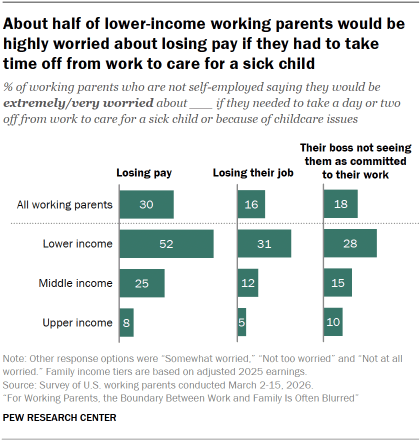
Overall, 30% of working parents who are not self-employed say they would be extremely or very worried about losing pay if they had to take time off in these situations.
Smaller shares say they’d be highly worried about losing their job (16%) or about their boss not seeing them as committed to their work (18%).
These situations create even more anxiety for parents with lower family incomes, who often have less access to employer-provided benefits or flexible work arrangements:
- 52% say they would be highly worried about losing pay, compared with 25% of parents with middle incomes and 8% of those with upper incomes.
- 31% would be similarly worried about losing their job, versus 12% and 5%.
- 28% would be worried about their boss not seeing them as committed to their work, versus 15% and 10%.
Single moms (who tend to have lower family incomes) are much more likely than married or cohabiting moms to say they would be extremely or very worried about:
- Losing pay (50% vs. 32%)
- Losing their job (26% vs. 15%).
Black and Hispanic working parents (42% and 43%) are more likely than White and Asian parents (22% and 26%) to say they would be highly worried about losing pay in these situations.
Flexibility to attend children’s activities during work hours
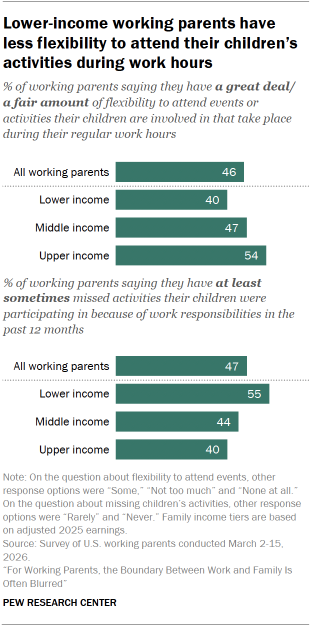
Most working parents (75%) say they have at least some flexibility to attend events or activities their children are involved in that take place during their regular work hours, including 46% who say they have a great deal or a fair amount of flexibility. A quarter say they don’t have much flexibility or have no flexibility at all for this.
Parents with upper family incomes are the most likely (54%) and those with lower family incomes are the least likely (40%) to say they have a lot of flexibility to attend their kids’ events during work hours.
Given this, it is perhaps not surprising that parents with lower incomes are the most likely to say they’ve missed activities their children were participating in at least sometimes in the past 12 months because of work responsibilities. Some 55% of lower-income parents say this is the case, compared with 44% of middle-income parents and 40% of upper-income parents.