
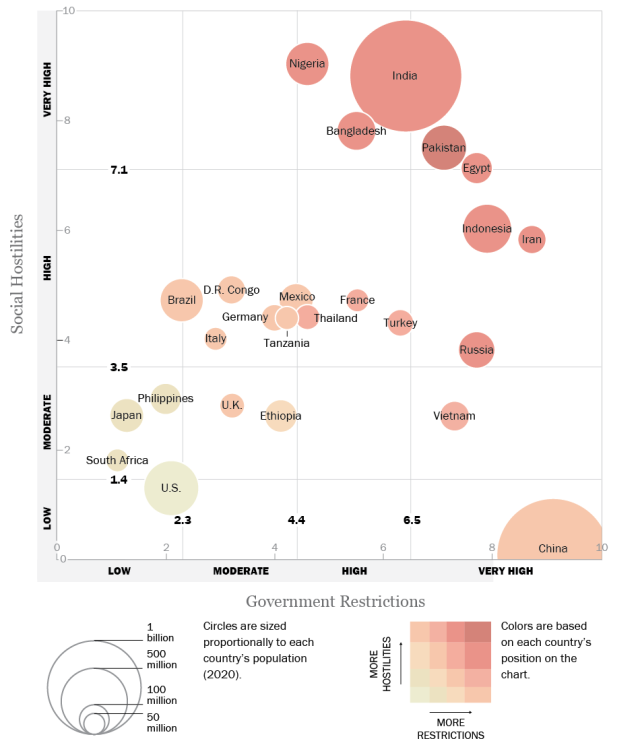
Of the 25 most populous countries in the world, India, Egypt, Pakistan, Iran and Indonesia had the highest overall levels of government restrictions on religion and social hostilities involving religion in 2023.12
At the other end of the spectrum, South Africa, the United States, Japan, the Philippines and the United Kingdom had the lowest levels among the 25 most populous countries.
The findings are based on each country’s combined scores on two indexes. The Government Restrictions Index (GRI) includes 20 indicators of how government officials, laws and policies restrict religion. The Social Hostilities Index (SHI) consists of 13 indicators of religion-related hostilities by private individuals, groups and organizations. Scores on each index range from 0 to 10.
The 25 countries analyzed here contain roughly three-quarters of the global population. However, the restrictions and hostilities measured on these indexes don’t necessarily affect all people in a country equally. They may have a disproportionate impact on religious minorities.
This section is part of a wider Pew Research Center study of restrictions on religion around the world in 2023. Read the report overview for a broader understanding of the study’s key findings. The rest of this section looks at the top 25 countries’ scores on each index.
Government Restrictions Index (GRI)
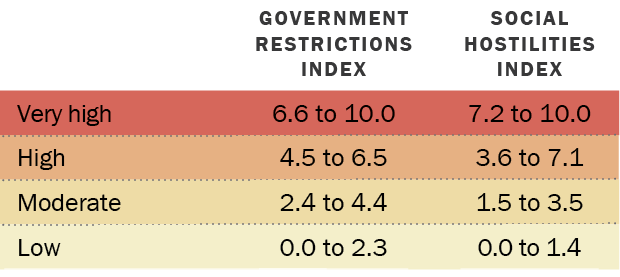
Of the world’s 25 largest countries, those with the highest GRI scores in 2023 were China, Iran, Indonesia, Egypt and Russia. All five had very high GRI scores (from 6.6 to 10 points).
“More Countries Had Elevated Levels of Social Hostilities Involving Religion in 2023”
| Government Restrictions Index | Social Hostilities Index | |
|---|---|---|
| Very high | 6.6 to 10.0 | 7.2 to 10.0 |
| High | 4.5 to 6.5 | 3.6 to 7.1 |
| Moderate | 2.4 to 4.4 | 1.5 to 3.5 |
| Low | 0.0 to 2.3 | 0.0 to 1.4 |
“More Countries Had Elevated Levels of Social Hostilities Involving Religion in 2023”
On the opposite end of the scale, South Africa, Japan, the Philippines, the U.S. and Brazil had the lowest levels of government restrictions on religion among the 25 most populous countries. They all fell in the low category on the index (from 0 to 2.3 points). For more details on how index categories are defined, refer to the Methodology.
Social Hostilities Index (SHI)
In 2023, Nigeria, India, Bangladesh, Pakistan and Egypt had the highest levels of social hostilities involving religion among the 25 most populous countries. All except Egypt had very high scores (from 7.2 to 10 points) on the SHI, while Egypt fell into the index’s high category (3.6 to 7.1).
At the other end of the scale are China, the U.S., South Africa, Japan and Vietnam, which had the lowest social hostilities scores among these 25 countries. China and the U.S. had low SHI scores (between 0.0 and 1.4), while South Africa, Japan and Vietnam were in the moderate category (between 1.5 and 3.5).
Some of the most populous countries’ scores fell in the same category on both indexes. For instance, Pakistan had very high levels of both government restrictions and social hostilities. France had high scores on both the GRI and SHI, while the U.K. had moderate scores on both indexes.
However, some other countries had high or very high GRI scores but moderate or low SHI scores. China, for example, had very high levels of government restrictions on religion in 2023 but low levels of social hostilities. (This also was true for China in each of the four prior years, starting in 2019.)
Meanwhile, Vietnam had very high levels of government restrictions in 2023 but moderate levels of social hostilities.
No country among the 25 most populous had low levels of government restrictions but very high levels of social hostilities.
For more information on the relationship between countries’ GRI and SHI scores, refer to a previous Pew Research Center analysis. Refer to Appendix A and Appendix B for details on individual countries’ categories on the two indexes in 2023.
How GRI scores changed from 2022 to 2023
Twenty-four of the 25 most populous countries either had small changes (less than 1 point) or no change on the GRI in 2023.
Several countries switched between categories even though the change was relatively small, numerically. For example, Tanzania had a decrease of 0.8 points (from 5.0 to 4.2), but it was enough to shift Tanzania out of the high category and into the moderate GRI level.13 One reason for the lower score was that unlike in the previous year, the sources used in this study contained no reports in 2023 of Tanzanian government harassment of converts to Christianity.
Turkey also had a small decrease in its GRI score (from 6.7 to 6.3) which lowered it from the very high category in 2022 to the high GRI level in 2023. This was partly because in 2023 the sources used in the study did not report any arrests in Turkey of people accused of “insulting religious values” on social media, as there had been the previous year.
Germany had the biggest GRI change, a full point, among the 25 most populous countries. Its score rose from 3.0 in 2022 to 4.0 in 2023, in part because authorities in cities and airports across the country restricted Jehovah’s Witnesses from using temporary display carts for religious literature, according to the U.S. State Department’s 2023 report on International Religious Freedom. (Even with the change, Germany’s GRI score remained moderate.)
How SHI scores changed from 2022 to 2023
Of the 25 most populous countries, more had changes on the Social Hostilities Index than on the Government Restrictions Index in 2023. Still, most of these countries (14) had only small changes on the SHI. Ten countries had modest changes (between 1.0 and 1.9 points), including seven with modest increases and three with modest decreases. One country among the 25 most populous – the U.S. – had no change in its SHI score.
The seven countries with modest SHI increases included Japan, which moved into the moderate SHI category when its score increased from 1.1 to 2.6 points. This was due in part to a reported increase in physical harassment and threats toward Jehovah’s Witnesses; in June, for example, a man kicked and injured a Jehovah’s Witness in her 70s while she was preaching.
And Turkey, Tanzania and the Democratic Republic of the Congo all moved from the moderate to the high SHI category. In Tanzania, there were tensions between Christians and Muslims stemming from perceived government favoritism toward Christians. In September, a viral video by a Muslim man accused Christians of making noise to disrupt the Islamic call to prayer, according to the State Department. The video was said to have “stoked anger among Muslims already frustrated with the political situation in Zanzibar.” The tensions, however, did not lead to violence. (Zanzibar is a semiautonomous region in the country.)
In the Democratic Republic of the Congo, continued violence by ISIS-DRC led to a higher SHI score. In March, the Islamist militant group targeted Christians in the village of Mukondi in the eastern part of the country, killing at least 38, injuring 17 others and burning Christian homes. The group also took credit for attacks that month on Christians in other villages that reportedly took the lives of 45 people, including a priest.
Bangladesh’s increased SHI score (from 6.1 to 7.8 points) moved it from the high to the very high category on the index in 2023. The increase was mostly due to deaths related to mob violence reported against minority religious groups in the Muslim-majority country. (To read more about Bangladesh’s score change and about other countries that changed SHI categories, refer to our analysis of countries with the most extensive social hostilities.)
Ethiopia and the Philippines had modest declines in their SHI scores that were enough to shift them from the high category to the moderate level of social hostilities. France’s score dropped by more than a point, from 5.9 to 4.7, but France remained in the high SHI category.
“More Countries Had Elevated Levels of Social Hostilities Involving Religion in 2023”
| Country | Year | Government Restrictions Index (GRI) | Social Hostilities Index (SHI) | 2020 UN population estimate |
|---|---|---|---|---|
| China | 2023 | 9.1 | 0.1 | 1,426,106,093 |
| India | 2023 | 6.4 | 8.8 | 1,402,617,695 |
| United States | 2023 | 2.1 | 1.3 | 339,436,159 |
| Indonesia | 2023 | 7.9 | 6.0 | 274,814,866 |
| Pakistan | 2023 | 7.1 | 7.5 | 235,001,746 |
| Nigeria | 2023 | 4.6 | 9.0 | 213,996,181 |
| Brazil | 2023 | 2.3 | 4.7 | 208,660,842 |
| Bangladesh | 2023 | 5.5 | 7.8 | 166,298,024 |
| Russia | 2023 | 7.7 | 3.8 | 146,371,299 |
| Mexico | 2023 | 4.4 | 4.7 | 126,799,054 |
| Japan | 2023 | 1.3 | 2.6 | 126,304,543 |
| Ethiopia | 2023 | 4.1 | 2.6 | 118,917,671 |
| Philippines | 2023 | 2.0 | 2.9 | 112,081,264 |
| Egypt | 2023 | 7.7 | 7.1 | 109,315,124 |
| Vietnam | 2023 | 7.3 | 2.6 | 98,079,191 |
| Dem. Rep. Congo | 2023 | 3.2 | 4.9 | 95,989,998 |
| Iran | 2023 | 8.7 | 5.8 | 87,723,443 |
| Turkey | 2023 | 6.3 | 4.3 | 86,091,692 |
| Germany | 2023 | 4.0 | 4.4 | 83,628,708 |
| Thailand | 2023 | 4.6 | 4.4 | 71,641,484 |
| United Kingdom | 2023 | 3.2 | 2.8 | 67,351,861 |
| France | 2023 | 5.5 | 4.7 | 65,905,277 |
| Tanzania | 2023 | 4.2 | 4.4 | 60,972,798 |
| South Africa | 2023 | 1.1 | 1.8 | 60,562,381 |
| Italy | 2023 | 2.9 | 4.0 | 59,912,769 |
“More Countries Had Elevated Levels of Social Hostilities Involving Religion in 2023”


