
In 2023, sub-Saharan Africa was the only major region in the world where median levels of both government restrictions on religion and social hostilities involving religion decreased.
What is a median?
In this analysis, medians are used to help readers see overall patterns in the data. A median is the middle number in a list of figures sorted in ascending or descending order.
In this report, within each geographic region (and for all 198 countries and territories we study overall), our researchers list the relevant countries from lowest to highest based on index scores. The median score is the score of the middle country on the list.
For a region like sub-Saharan Africa, which has an even number of countries (48), we take the average of the two middle countries on the list. For sub-Saharan Africa, those are the countries whose index scores rank 24th and 25th in the region.
In three other large regions – Europe, Asia and the Pacific, and the Middle East and North Africa – median levels of government restrictions and social hostilities rose in 2023.
In the Americas, the other major region covered by the study, the median score for government restrictions held steady while social hostilities ticked slightly upward.
Worldwide, the median scores of all 198 countries and territories across the five regions remained stable for the third year in a row at 3.0 out of 10 on the Government Restrictions Index (GRI) and 1.6 out of 10 on the Social Hostilities Index (SHI).
The GRI consists of 20 indicators of how government officials, laws and policies restrict religion. The SHI consists of 13 indicators of religious hostilities by private individuals, groups and organizations, including terrorist groups.
The rest of this section describes how each of the study’s large regions fared on both indexes. It is part of a wider Pew Research Center study of restrictions on religion around the world in 2023. Read the report overview for a broader understanding of the study’s key findings.
Government restrictions on religion, by region
In 2023, the median GRI scores in Europe, the Asia-Pacific region and the Middle East-North Africa region were as high as, or higher than, they have been since the study began in 2007.
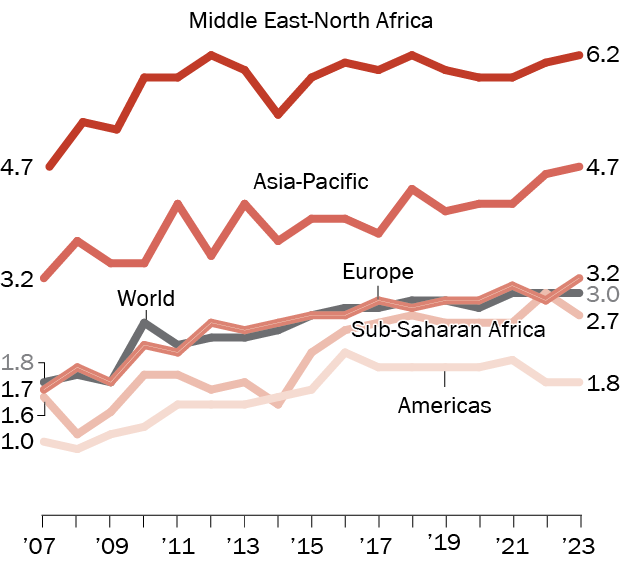
“More Countries Had Elevated Levels of Social Hostilities Involving Religion in 2023”
| Year | Americas | Asia-Pacific | Europe | Middle East-North Africa | Sub-Saharan Africa | World |
|---|---|---|---|---|---|---|
| 2007 | 1.0 | 3.2 | 1.7 | 4.7 | 1.6 | 1.8 |
| 2008 | 0.9 | 3.7 | 2.0 | 5.3 | 1.1 | 1.9 |
| 2009 | 1.1 | 3.4 | 1.8 | 5.2 | 1.4 | 1.8 |
| 2010 | 1.2 | 3.4 | 2.3 | 5.9 | 1.9 | 2.6 |
| 2011 | 1.5 | 4.2 | 2.2 | 5.9 | 1.9 | 2.3 |
| 2012 | 1.5 | 3.5 | 2.6 | 6.2 | 1.7 | 2.4 |
| 2013 | 1.5 | 4.2 | 2.5 | 6.0 | 1.8 | 2.4 |
| 2014 | 1.6 | 3.7 | 2.6 | 5.4 | 1.5 | 2.5 |
| 2015 | 1.7 | 4.0 | 2.7 | 5.9 | 2.2 | 2.7 |
| 2016 | 2.2 | 4.0 | 2.7 | 6.1 | 2.5 | 2.8 |
| 2017 | 2.0 | 3.8 | 2.9 | 6.0 | 2.6 | 2.8 |
| 2018 | 2.0 | 4.4 | 2.8 | 6.2 | 2.7 | 2.9 |
| 2019 | 2.0 | 4.1 | 2.9 | 6.0 | 2.6 | 2.9 |
| 2020 | 2.0 | 4.2 | 2.9 | 5.9 | 2.6 | 2.8 |
| 2021 | 2.1 | 4.2 | 3.1 | 5.9 | 2.6 | 3.0 |
| 2022 | 1.8 | 4.6 | 2.9 | 6.1 | 3.0 | 3.0 |
| 2023 | 1.8 | 4.7 | 3.2 | 6.2 | 2.7 | 3.0 |
“More Countries Had Elevated Levels of Social Hostilities Involving Religion in 2023”
In the Middle East and North Africa, the median GRI score rose from 6.1 in 2022 to 6.2 in 2023, tying with the region’s previous peak scores in 2012 and 2018. As in all previous years of the study, the Middle East and North Africa had the highest median GRI score of any region in the world.
Several factors contributed to the region’s high scores. All 20 countries in the Middle East and North Africa had at least one case of government harassment of religious groups (verbal and/or physical) reported in 2023 by the sources used in this study. For more details, refer to the Methodology and the report’s discussion of government harassment.
Half of the countries in the Middle East-North Africa region also had restrictions related to religious dress, an increase from eight countries with such cases in 2022 to 10 in 2023. In Jordan, for example, Jewish travelers reported facing hurdles at border crossings when they dressed in ways that revealed their religion. In April, one traveler said he was not allowed to cross the border because he did not agree to hide or cut his side curls (facial hair typically worn by ultra-Orthodox Jewish men). Jordanian authorities reportedly told other travelers it was not safe to “display characteristics that identified them as Jewish” such as a kippah, a traditional skullcap for men, according to the State Department.
Meanwhile, Morocco formally has maintained a ban on the import, production and sale of burqas – Islamic face coverings for women – since 2017. The government deemed the ban necessary for security reasons so officials could identify wearers. Additionally, burqas were forbidden for police officers, women in the Moroccan army and television news presenters, though private individuals were still able to wear them, according to the U.S. State Department’s annual report on international religious freedom.
The Asia-Pacific region’s median GRI score rose from 4.6 in 2022 to 4.7 in 2023, the highest it has been since the study began in 2007. This region contains 50 countries and territories, including places with some of the highest GRI scores in the world, such as China, Iran, Afghanistan and Indonesia.
In 2023, nine countries in Asia and the Pacific sought to eliminate the presence of a religious group, according to the sources used in this study. In Vietnam, authorities tried to force followers of Duong Van Minh (who are mainly from the ethnic Hmong community) to renounce their faith through repeated intimidation and physical harassment. Authorities broke into followers’ homes and destroyed their altars after the 2021 death and funeral of Duong Van Minh. In 2023, Vietnam’s government claimed to have eliminated “the Duong Van Minh evil-way religion’s influence” in several provinces.
Meanwhile, the military in nearby Myanmar (also called Burma) continued to target Rohingya Muslims in what several international organizations and foreign governments, including the U.S. State Department, previously described as a campaign of genocide and crimes against humanity.
In addition, the Asia-Pacific region had an uptick in the number of countries and territories (from 44 in 2022 to 46 in 2023) where government harassment of religious groups was reported. There also was a small rise in the number of Asia-Pacific countries whose governments used violence against religious minorities (from 26 to 28).
Europe’s median score on the GRI rose from 2.9 in 2022 to 3.2 in 2023, its highest median GRI score since the study began in 2007. The increase resulted in part from growth in the number of European countries whose governments reportedly failed to protect religious groups or provide redress for religious discrimination (up from 16 countries in 2022 to 24 in 2023).
For example, in Norway, Jewish community leaders expressed frustration that police did not respond adequately to cases of harassment and were reluctant to bring charges under antisemitism or hate crime statues, which can increase sentences. And in Germany, where Jehovah’s Witnesses experienced hostility over their proselytizing activities, authorities allegedly did not take hate crimes against the group seriously. Jehovah’s Witnesses said police did not show interest in investigating complaints they filed.
More than half of the countries in the region (25 out of 45) also had incidents of physical harassment by governments toward religious groups. This was up from 22 countries in 2022. (Refer to the report’s discussion of harassment of religious groups for more examples.)
On the other hand, sub-Saharan Africa’s median GRI score declined from 3.0 in 2022 to 2.7 in 2023. Fewer countries across the region had cases of physical harassment by governments against religious groups (26, down from 30 countries in 2022).
And in the Americas, the median GRI score remained the same between 2022 and 2023, at 1.8 out of 10. This was the lowest median score of all five regions studied.
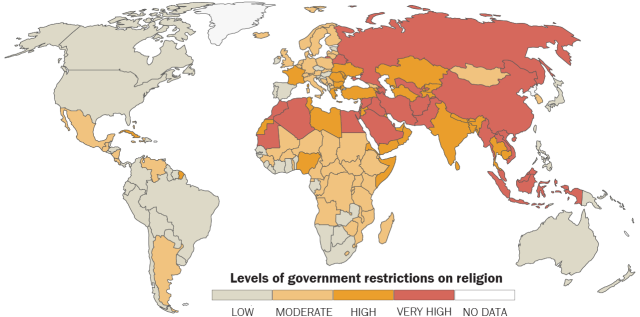
“More Countries Had Elevated Levels of Social Hostilities Involving Religion in 2023”
| Region | Country | GRI Category | 2023 GRI Score |
|---|---|---|---|
| Americas | Antigua and Barbuda | Low | 0.5 |
| Americas | Argentina | Moderate | 2.8 |
| Americas | Bahamas | Moderate | 2.9 |
| Americas | Barbados | Low | 1.7 |
| Americas | Belize | Low | 1.4 |
| Americas | Bolivia | Low | 0.8 |
| Americas | Brazil | Low | 2.3 |
| Americas | Canada | Low | 2.1 |
| Americas | Chile | Low | 1.6 |
| Americas | Colombia | Low | 1.4 |
| Americas | Costa Rica | Moderate | 2.6 |
| Americas | Cuba | High | 4.5 |
| Americas | Dominica | Low | 1.3 |
| Americas | Dominican Republic | Low | 1.5 |
| Americas | Ecuador | Low | 1.8 |
| Americas | El Salvador | Low | 1.8 |
| Americas | Grenada | Low | 1.8 |
| Americas | Guatemala | Moderate | 2.7 |
| Americas | Guyana | Low | 1.9 |
| Americas | Haiti | Moderate | 2.7 |
| Americas | Honduras | Low | 1.2 |
| Americas | Jamaica | Moderate | 2.5 |
| Americas | Mexico | Moderate | 4.4 |
| Americas | Nicaragua | Moderate | 4.2 |
| Americas | Panama | Low | 1.6 |
| Americas | Paraguay | Low | 1.9 |
| Americas | Peru | Low | 1.9 |
| Americas | St. Kitts and Nevis | Low | 1.1 |
| Americas | St. Lucia | Low | 1.7 |
| Americas | St. Vincent and the Grenadines | Low | 1.2 |
| Americas | Suriname | Low | 1.3 |
| Americas | Trinidad and Tobago | Low | 1.6 |
| Americas | United States | Low | 2.1 |
| Americas | Uruguay | Low | 1.6 |
| Americas | Venezuela | Moderate | 2.7 |
| Asia-Pacific | Afghanistan | Very high | 8.7 |
| Asia-Pacific | Armenia | High | 4.6 |
| Asia-Pacific | Australia | Low | 2.3 |
| Asia-Pacific | Azerbaijan | Very high | 7.3 |
| Asia-Pacific | Bangladesh | High | 5.5 |
| Asia-Pacific | Bhutan | High | 4.7 |
| Asia-Pacific | Brunei | Very high | 6.6 |
| Asia-Pacific | Cambodia | High | 5 |
| Asia-Pacific | China | Very high | 9.1 |
| Asia-Pacific | Cyprus | Moderate | 2.8 |
| Asia-Pacific | East Timor | Low | 1.1 |
| Asia-Pacific | Fiji | Moderate | 2.6 |
| Asia-Pacific | Hong Kong | Moderate | 3.6 |
| Asia-Pacific | India | High | 6.4 |
| Asia-Pacific | Indonesia | Very high | 7.9 |
| Asia-Pacific | Iran | Very high | 8.7 |
| Asia-Pacific | Japan | Low | 1.3 |
| Asia-Pacific | Kazakhstan | High | 6.5 |
| Asia-Pacific | Kiribati | Low | 1.4 |
| Asia-Pacific | Kyrgyzstan | High | 5.9 |
| Asia-Pacific | Laos | Very high | 6.7 |
| Asia-Pacific | Macao | Low | 1.2 |
| Asia-Pacific | Malaysia | Very high | 7.7 |
| Asia-Pacific | Maldives | Very high | 7.6 |
| Asia-Pacific | Marshall Islands | Low | 0.4 |
| Asia-Pacific | Micronesia, Federated States | Low | 0.4 |
| Asia-Pacific | Mongolia | Moderate | 3.1 |
| Asia-Pacific | Myanmar | Very high | 7.3 |
| Asia-Pacific | Nauru | Low | 1.8 |
| Asia-Pacific | Nepal | High | 5.4 |
| Asia-Pacific | New Zealand | Low | 0.9 |
| Asia-Pacific | Pakistan | Very high | 7.1 |
| Asia-Pacific | Palau | Low | 0.5 |
| Asia-Pacific | Papua New Guinea | Low | 1.4 |
| Asia-Pacific | Philippines | Low | 2 |
| Asia-Pacific | Samoa | Low | 1 |
| Asia-Pacific | Singapore | Very high | 6.7 |
| Asia-Pacific | Solomon Islands | Low | 0.9 |
| Asia-Pacific | South Korea | Moderate | 2.5 |
| Asia-Pacific | Sri Lanka | High | 5.9 |
| Asia-Pacific | Taiwan | Low | 1 |
| Asia-Pacific | Tajikistan | High | 6.4 |
| Asia-Pacific | Thailand | High | 4.6 |
| Asia-Pacific | Tonga | Low | 1.8 |
| Asia-Pacific | Turkey | High | 6.3 |
| Asia-Pacific | Turkmenistan | High | 6.5 |
| Asia-Pacific | Tuvalu | Moderate | 2.6 |
| Asia-Pacific | Uzbekistan | Very high | 7.8 |
| Asia-Pacific | Vanuatu | Low | 1.6 |
| Asia-Pacific | Vietnam | Very high | 7.3 |
| Europe | Albania | Low | 1.8 |
| Europe | Andorra | Moderate | 2.6 |
| Europe | Austria | Moderate | 3.8 |
| Europe | Belarus | Very high | 6.6 |
| Europe | Belgium | Moderate | 2.8 |
| Europe | Bosnia and Herzegovina | Moderate | 3.3 |
| Europe | Bulgaria | High | 5.5 |
| Europe | Croatia | Low | 2 |
| Europe | Czech Republic | Low | 2.2 |
| Europe | Denmark | Moderate | 4.2 |
| Europe | Estonia | Low | 1 |
| Europe | Finland | Moderate | 3.5 |
| Europe | France | High | 5.5 |
| Europe | Georgia | Moderate | 4.1 |
| Europe | Germany | Moderate | 4 |
| Europe | Greece | High | 4.7 |
| Europe | Hungary | Low | 2.2 |
| Europe | Iceland | Moderate | 3.6 |
| Europe | Ireland | Low | 1.1 |
| Europe | Italy | Moderate | 2.9 |
| Europe | Kosovo | Moderate | 3.4 |
| Europe | Latvia | Moderate | 2.9 |
| Europe | Liechtenstein | Low | 2 |
| Europe | Lithuania | Moderate | 3 |
| Europe | Luxembourg | Moderate | 2.4 |
| Europe | Malta | Low | 1.9 |
| Europe | Moldova | High | 5.4 |
| Europe | Monaco | Low | 1.4 |
| Europe | Montenegro | Moderate | 2.7 |
| Europe | Netherlands | Moderate | 3 |
| Europe | North Macedonia | Moderate | 3.5 |
| Europe | Norway | Moderate | 3.7 |
| Europe | Poland | Moderate | 3.2 |
| Europe | Portugal | Low | 0.6 |
| Europe | Romania | High | 4.8 |
| Europe | Russia | Very high | 7.7 |
| Europe | San Marino | Low | 0.6 |
| Europe | Serbia | Moderate | 3 |
| Europe | Slovakia | Moderate | 3.8 |
| Europe | Slovenia | Low | 2.3 |
| Europe | Spain | Low | 2 |
| Europe | Sweden | Moderate | 3.6 |
| Europe | Switzerland | Moderate | 4.1 |
| Europe | Ukraine | High | 6.1 |
| Europe | United Kingdom | Moderate | 3.2 |
| Middle East-North Africa | Algeria | Very high | 7 |
| Middle East-North Africa | Bahrain | High | 5.9 |
| Middle East-North Africa | Egypt | Very high | 7.7 |
| Middle East-North Africa | Iraq | Very high | 6.6 |
| Middle East-North Africa | Israel | Very high | 7.5 |
| Middle East-North Africa | Jordan | High | 6.4 |
| Middle East-North Africa | Kuwait | High | 6.2 |
| Middle East-North Africa | Lebanon | Moderate | 4.1 |
| Middle East-North Africa | Libya | High | 6.1 |
| Middle East-North Africa | Morocco | Very high | 7 |
| Middle East-North Africa | Oman | High | 5.1 |
| Middle East-North Africa | Palestinian territories | Moderate | 3.9 |
| Middle East-North Africa | Qatar | Very high | 6.6 |
| Middle East-North Africa | Saudi Arabia | Very high | 7.4 |
| Middle East-North Africa | Sudan | Moderate | 3.9 |
| Middle East-North Africa | Syria | Very high | 7.8 |
| Middle East-North Africa | Tunisia | High | 5.8 |
| Middle East-North Africa | United Arab Emirates | High | 6.3 |
| Middle East-North Africa | Western Sahara | High | 6.1 |
| Middle East-North Africa | Yemen | High | 6.2 |
| Sub-Saharan Africa | Angola | Moderate | 4.3 |
| Sub-Saharan Africa | Benin | Low | 1.8 |
| Sub-Saharan Africa | Botswana | Low | 1.6 |
| Sub-Saharan Africa | Burkina Faso | Moderate | 3.6 |
| Sub-Saharan Africa | Burundi | Moderate | 3.1 |
| Sub-Saharan Africa | Cameroon | Moderate | 3.9 |
| Sub-Saharan Africa | Cape Verde | Low | 1 |
| Sub-Saharan Africa | Central African Republic | Moderate | 4.3 |
| Sub-Saharan Africa | Chad | Moderate | 3.8 |
| Sub-Saharan Africa | Comoros | High | 4.6 |
| Sub-Saharan Africa | Congo, Dem. Rep. | Moderate | 3.2 |
| Sub-Saharan Africa | Congo, Rep. | Moderate | 2.7 |
| Sub-Saharan Africa | Djibouti | Moderate | 3.7 |
| Sub-Saharan Africa | Equatorial Guinea | Moderate | 4.3 |
| Sub-Saharan Africa | Eritrea | High | 5.7 |
| Sub-Saharan Africa | Eswatini | Moderate | 3.8 |
| Sub-Saharan Africa | Ethiopia | Moderate | 4.1 |
| Sub-Saharan Africa | Gabon | Low | 1 |
| Sub-Saharan Africa | Gambia | Low | 1 |
| Sub-Saharan Africa | Ghana | Low | 1.4 |
| Sub-Saharan Africa | Guinea | Moderate | 3.1 |
| Sub-Saharan Africa | Guinea-Bissau | Low | 1.3 |
| Sub-Saharan Africa | Ivory Coast | Low | 1.4 |
| Sub-Saharan Africa | Kenya | Moderate | 2.5 |
| Sub-Saharan Africa | Lesotho | Moderate | 2.5 |
| Sub-Saharan Africa | Liberia | Low | 2 |
| Sub-Saharan Africa | Madagascar | Moderate | 3.1 |
| Sub-Saharan Africa | Malawi | Moderate | 2.7 |
| Sub-Saharan Africa | Mali | Moderate | 3 |
| Sub-Saharan Africa | Mauritania | Very high | 6.7 |
| Sub-Saharan Africa | Mauritius | Low | 2 |
| Sub-Saharan Africa | Mozambique | Moderate | 2.5 |
| Sub-Saharan Africa | Namibia | Low | 1.3 |
| Sub-Saharan Africa | Niger | Moderate | 3.7 |
| Sub-Saharan Africa | Nigeria | High | 4.6 |
| Sub-Saharan Africa | Rwanda | Moderate | 4.2 |
| Sub-Saharan Africa | Sao Tome and Principe | Low | 1.3 |
| Sub-Saharan Africa | Senegal | Low | 1.3 |
| Sub-Saharan Africa | Seychelles | Moderate | 2.7 |
| Sub-Saharan Africa | Sierra Leone | Low | 2.2 |
| Sub-Saharan Africa | Somalia | High | 5.4 |
| Sub-Saharan Africa | South Africa | Low | 1.1 |
| Sub-Saharan Africa | South Sudan | Moderate | 2.5 |
| Sub-Saharan Africa | Tanzania | Moderate | 4.2 |
| Sub-Saharan Africa | Togo | Moderate | 2.6 |
| Sub-Saharan Africa | Uganda | Moderate | 3.6 |
| Sub-Saharan Africa | Zambia | Low | 2 |
| Sub-Saharan Africa | Zimbabwe | Moderate | 2.7 |
“More Countries Had Elevated Levels of Social Hostilities Involving Religion in 2023”
Social hostilities involving religion, by region
Four of the world’s five major geographic regions had overall increases on the Social Hostilities Index (SHI) in 2023: the Americas, the Asia-Pacific region, Europe and the Middle East-North Africa region. Sub-Saharan Africa was the only region to register a decrease.
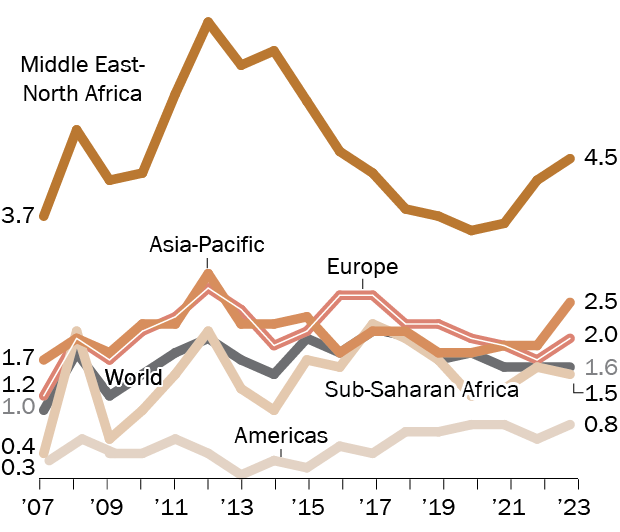
“More Countries Had Elevated Levels of Social Hostilities Involving Religion in 2023”
| Year | Americas | Asia-Pacific | Europe | Middle East-North Africa | Sub-Saharan Africa | World |
|---|---|---|---|---|---|---|
| 2007 | 0.3 | 1.7 | 1.2 | 3.7 | 0.4 | 1.0 |
| 2008 | 0.6 | 2.0 | 2.0 | 4.9 | 2.1 | 1.8 |
| 2009 | 0.4 | 1.8 | 1.7 | 4.2 | 0.6 | 1.2 |
| 2010 | 0.4 | 2.2 | 2.1 | 4.3 | 1.0 | 1.5 |
| 2011 | 0.6 | 2.2 | 2.3 | 5.4 | 1.5 | 1.8 |
| 2012 | 0.4 | 2.9 | 2.7 | 6.4 | 2.1 | 2.0 |
| 2013 | 0.1 | 2.2 | 2.4 | 5.8 | 1.3 | 1.7 |
| 2014 | 0.3 | 2.2 | 1.9 | 6.0 | 1.0 | 1.5 |
| 2015 | 0.2 | 2.3 | 2.1 | 5.3 | 1.7 | 2.0 |
| 2016 | 0.5 | 1.8 | 2.6 | 4.6 | 1.6 | 1.8 |
| 2017 | 0.4 | 2.1 | 2.6 | 4.3 | 2.2 | 2.1 |
| 2018 | 0.7 | 2.1 | 2.2 | 3.8 | 2.0 | 2.0 |
| 2019 | 0.7 | 1.8 | 2.2 | 3.7 | 1.7 | 1.7 |
| 2020 | 0.8 | 1.8 | 2.0 | 3.5 | 1.2 | 1.8 |
| 2021 | 0.8 | 1.9 | 1.9 | 3.6 | 1.3 | 1.6 |
| 2022 | 0.6 | 1.9 | 1.7 | 4.2 | 1.6 | 1.6 |
| 2023 | 0.8 | 2.5 | 2.0 | 4.5 | 1.5 | 1.6 |
“More Countries Had Elevated Levels of Social Hostilities Involving Religion in 2023”
The median SHI score in the Middle East-North Africa region went up to 4.5 in 2023 from 4.2 in 2022. The increase was partially driven by a rising number of countries (seven, up from two) that experienced religion-related mob violence.
For example, in the Palestinian territories in February, a Palestinian gunman killed two men from the Jewish settlement of Har Bracha, according to media reports. In retaliation, about 400 Israeli settlers attacked the Palestinian town of Huwara, resulting in one death, hundreds of injuries and destruction of property.9 (Both attacks counted as social hostilities in the Palestinian territories because they occurred in the West Bank.)
Meanwhile, in southern Tunisia, the historic El Hamma Synagogue, which includes the tomb of a 16th-century rabbi, was attacked in mid-October by hundreds of rioters. The attackers torched the building and defaced its walls with graffiti, reportedly to protest a hospital bombing in Gaza. At year’s end, Tunisian authorities had not arrested anyone for the attack.
The Asia-Pacific region’s median SHI score rose from 1.9 in 2022 to 2.5 in 2023, the second-highest score recorded for the region since 2007. (The peak was 2.9 in 2012.)
As in the Middle East-North Africa region, more Asia-Pacific countries had incidents of mob violence against religious groups in 2023 (eight) than in 2022 (three). In Buddhist-majority Sri Lanka, for example, violent clashes occurred at the disputed Kurunthoormalai archaeological site, which both Buddhists and Hindus claim as the location of ancient temples belonging to their respective faiths. In mid-July, about 100 Sinhalese protesters (members of a Sri Lankan ethno-religious group that is mostly Buddhist) along with Buddhist monks, police officers and other officials tried to stop a Hindu ceremony at the site on the grounds that fire used in the ceremony would cause damage. Police stopped the fire and removed people from the site.
In Armenia, which we include in Asia, there was mob violence against Jehovah’s Witnesses. In June, a large group of protesters attempted to interrupt a regional meeting of Jehovah’s Witnesses at a stadium by blasting noise through loudspeakers and throwing objects such as stones, firecrackers and food.
Europe’s median SHI score increased from 1.7 in 2022 to 2.0 in 2023, partly because five more countries had religion-related terrorist activity than in the previous year. (All of these cases involved three or fewer casualties.) In Belgium, a Tunisian man fatally shot two Swedish citizens and injured another at a soccer match. The attacker, who claimed membership in the Islamic State group (ISIS), shared a video saying he was seeking to avenge recent burnings of the Quran in Sweden.
In another incident, a French citizen of Iranian descent killed a German tourist and injured two others near the Eiffel Tower in Paris, later telling police he acted in revenge for events in Gaza and the killing of Muslims in Afghanistan. The attacker reportedly had pledged allegiance to the militant group ISIS in a prerecorded video, and after the attack he told police he was angry that France was an “accomplice to what Israel is doing” in Gaza. (This study categorizes an attack as religion-related if the perpetrators target a religious group or claim religious motivations. In determining whether the perpetrators belong to a terrorist group, the study relies primarily on the U.S. State Department’s list of foreign terrorist organizations.)
The median SHI score for the Americas increased from 0.6 to 0.8, matching the region’s previous peak scores recorded in 2020 and 2021 – although in 2023 the Americas continued to have the lowest median score among all five regions. The small year-over-year increase stemmed, in part, from a rise in the number of countries in which religious groups conducted or helped fund “conversion therapy” programs in which violence was used in an attempt to coerce people to become heterosexual.10
In Guatemala, for example, the U.S. State Department reported that conversion therapy centers in mostly rural parts of the country, partially funded and organized by evangelical churches, used tactics including electroshock therapy and coerced sex acts against lesbian, gay and transgender people. (The increase in SHI scores in the Americas reflects mentions of conversion therapy, since 2022, in the State Department Human Rights Reports.)
Meanwhile, sub-Saharan Africa’s median SHI score declined slightly from 1.6 to 1.5. This was the only region to experience declines in median levels on both the SHI and GRI in 2023. Still, the region contained the country with the world’s highest SHI score – Nigeria, whose score was 9.0, up from 8.7 the previous year.
Nigeria saw a rise in the number of deaths from attacks by the militant groups Boko Haram and ISIS-West Africa, who targeted both Christians and Muslims, according to the U.S. State Department. Multiple, violent clashes between mainly Muslim herders and Christian farmers over land and resources in Nigeria also had an ethno-religious component. Additionally, there were attacks on religious groups by Nigerian bandits and criminal gangs during the course of the year.
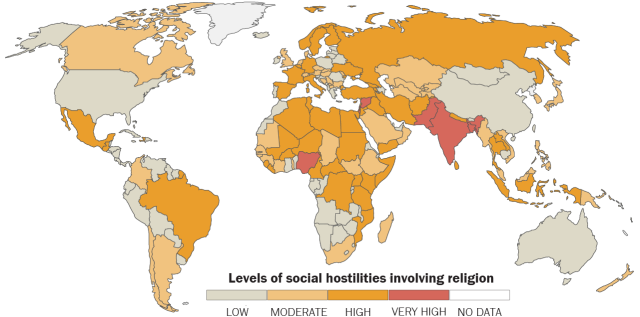
“More Countries Had Elevated Levels of Social Hostilities Involving Religion in 2023”
| Region | Country | SHI Category | 2023 SHI Score |
|---|---|---|---|
| Americas | Antigua and Barbuda | Low | 0 |
| Americas | Argentina | Moderate | 2.4 |
| Americas | Bahamas | Low | 0.1 |
| Americas | Barbados | Low | 0.1 |
| Americas | Belize | Low | 1.1 |
| Americas | Bolivia | Low | 0.8 |
| Americas | Brazil | High | 4.7 |
| Americas | Canada | Moderate | 3.3 |
| Americas | Chile | Moderate | 1.5 |
| Americas | Colombia | Moderate | 1.9 |
| Americas | Costa Rica | Low | 0.1 |
| Americas | Cuba | Low | 1 |
| Americas | Dominica | Low | 0 |
| Americas | Dominican Republic | Low | 0.8 |
| Americas | Ecuador | Low | 0.9 |
| Americas | El Salvador | Low | 1.1 |
| Americas | Grenada | Low | 0 |
| Americas | Guatemala | High | 3.8 |
| Americas | Guyana | Low | 0.1 |
| Americas | Haiti | High | 4.4 |
| Americas | Honduras | Low | 0.7 |
| Americas | Jamaica | Low | 0.8 |
| Americas | Mexico | High | 4.7 |
| Americas | Nicaragua | Low | 0.2 |
| Americas | Panama | Low | 0.8 |
| Americas | Paraguay | Low | 1 |
| Americas | Peru | Low | 0.4 |
| Americas | St. Kitts and Nevis | Low | 0.1 |
| Americas | St. Lucia | Low | 0.1 |
| Americas | St. Vincent and the Grenadines | Low | 0 |
| Americas | Suriname | Low | 0 |
| Americas | Trinidad and Tobago | Low | 1 |
| Americas | United States | Low | 1.3 |
| Americas | Uruguay | Low | 1.1 |
| Americas | Venezuela | Low | 0.7 |
| Asia-Pacific | Afghanistan | High | 7 |
| Asia-Pacific | Armenia | High | 4.5 |
| Asia-Pacific | Australia | Low | 1.2 |
| Asia-Pacific | Azerbaijan | Low | 0.8 |
| Asia-Pacific | Bangladesh | Very high | 7.8 |
| Asia-Pacific | Bhutan | Low | 1.1 |
| Asia-Pacific | Brunei | Moderate | 2 |
| Asia-Pacific | Cambodia | Low | 0.2 |
| Asia-Pacific | China | Low | 0.1 |
| Asia-Pacific | Cyprus | High | 5.4 |
| Asia-Pacific | East Timor | Low | 0.1 |
| Asia-Pacific | Fiji | Low | 0.4 |
| Asia-Pacific | Hong Kong | Low | 0.1 |
| Asia-Pacific | India | Very high | 8.8 |
| Asia-Pacific | Indonesia | High | 6 |
| Asia-Pacific | Iran | High | 5.8 |
| Asia-Pacific | Japan | Moderate | 2.6 |
| Asia-Pacific | Kazakhstan | Moderate | 2.8 |
| Asia-Pacific | Kiribati | Moderate | 1.5 |
| Asia-Pacific | Kyrgyzstan | Moderate | 2.6 |
| Asia-Pacific | Laos | High | 3.6 |
| Asia-Pacific | Macao | Low | 0.1 |
| Asia-Pacific | Malaysia | Moderate | 3.1 |
| Asia-Pacific | Maldives | High | 3.8 |
| Asia-Pacific | Marshall Islands | Low | 0.8 |
| Asia-Pacific | Micronesia, Federated States | Low | 0.2 |
| Asia-Pacific | Mongolia | Low | 0.8 |
| Asia-Pacific | Myanmar | Moderate | 3 |
| Asia-Pacific | Nauru | Low | 0 |
| Asia-Pacific | Nepal | High | 6.2 |
| Asia-Pacific | New Zealand | Moderate | 2.5 |
| Asia-Pacific | Pakistan | Very high | 7.5 |
| Asia-Pacific | Palau | Low | 0 |
| Asia-Pacific | Papua New Guinea | Moderate | 2.5 |
| Asia-Pacific | Philippines | Moderate | 2.9 |
| Asia-Pacific | Samoa | Low | 0.1 |
| Asia-Pacific | Singapore | Low | 1 |
| Asia-Pacific | Solomon Islands | Low | 0.3 |
| Asia-Pacific | South Korea | Moderate | 2.6 |
| Asia-Pacific | Sri Lanka | High | 6.3 |
| Asia-Pacific | Taiwan | Low | 0 |
| Asia-Pacific | Tajikistan | Moderate | 2 |
| Asia-Pacific | Thailand | High | 4.4 |
| Asia-Pacific | Tonga | Low | 0 |
| Asia-Pacific | Turkey | High | 4.3 |
| Asia-Pacific | Turkmenistan | Moderate | 3.5 |
| Asia-Pacific | Tuvalu | Moderate | 2.2 |
| Asia-Pacific | Uzbekistan | Moderate | 2.9 |
| Asia-Pacific | Vanuatu | Low | 0.3 |
| Asia-Pacific | Vietnam | Moderate | 2.6 |
| Europe | Albania | Low | 1.3 |
| Europe | Andorra | Low | 0 |
| Europe | Austria | Moderate | 3.4 |
| Europe | Belarus | Low | 0.2 |
| Europe | Belgium | High | 3.8 |
| Europe | Bosnia and Herzegovina | Moderate | 2.8 |
| Europe | Bulgaria | Moderate | 2.9 |
| Europe | Croatia | Low | 0.3 |
| Europe | Czech Republic | Moderate | 1.6 |
| Europe | Denmark | Moderate | 1.7 |
| Europe | Estonia | Low | 1.1 |
| Europe | Finland | High | 3.7 |
| Europe | France | High | 4.7 |
| Europe | Georgia | High | 4.4 |
| Europe | Germany | High | 4.4 |
| Europe | Greece | Low | 1.3 |
| Europe | Hungary | Moderate | 2 |
| Europe | Iceland | Low | 0.1 |
| Europe | Ireland | Low | 1.1 |
| Europe | Italy | High | 4 |
| Europe | Kosovo | Moderate | 3.5 |
| Europe | Latvia | Low | 0.7 |
| Europe | Liechtenstein | Low | 0.8 |
| Europe | Lithuania | Low | 1 |
| Europe | Luxembourg | Low | 0.1 |
| Europe | Malta | Low | 0 |
| Europe | Moldova | Moderate | 2.1 |
| Europe | Monaco | Low | 0 |
| Europe | Montenegro | Low | 1.4 |
| Europe | Netherlands | Moderate | 2.9 |
| Europe | North Macedonia | Moderate | 3.1 |
| Europe | Norway | High | 4.2 |
| Europe | Poland | Low | 1.4 |
| Europe | Portugal | Low | 0.2 |
| Europe | Romania | Low | 1.3 |
| Europe | Russia | High | 3.8 |
| Europe | San Marino | Low | 0 |
| Europe | Serbia | Moderate | 2.2 |
| Europe | Slovakia | Moderate | 2.3 |
| Europe | Slovenia | Low | 0.2 |
| Europe | Spain | High | 3.7 |
| Europe | Sweden | High | 4.5 |
| Europe | Switzerland | Moderate | 2.6 |
| Europe | Ukraine | High | 5.6 |
| Europe | United Kingdom | Moderate | 2.8 |
| Middle East-North Africa | Algeria | High | 3.9 |
| Middle East-North Africa | Bahrain | Low | 0.7 |
| Middle East-North Africa | Egypt | High | 7.1 |
| Middle East-North Africa | Iraq | High | 6.8 |
| Middle East-North Africa | Israel | Very high | 8.4 |
| Middle East-North Africa | Jordan | High | 4.9 |
| Middle East-North Africa | Kuwait | Moderate | 2.4 |
| Middle East-North Africa | Lebanon | High | 6.2 |
| Middle East-North Africa | Libya | High | 7.1 |
| Middle East-North Africa | Morocco | Low | 1 |
| Middle East-North Africa | Oman | Moderate | 2.1 |
| Middle East-North Africa | Palestinian territories | High | 6.7 |
| Middle East-North Africa | Qatar | Low | 1.2 |
| Middle East-North Africa | Saudi Arabia | Moderate | 2.9 |
| Middle East-North Africa | Sudan | High | 5.7 |
| Middle East-North Africa | Syria | Very high | 8.1 |
| Middle East-North Africa | Tunisia | High | 4.9 |
| Middle East-North Africa | United Arab Emirates | Low | 0.7 |
| Middle East-North Africa | Western Sahara | Low | 0 |
| Middle East-North Africa | Yemen | High | 4 |
| Sub-Saharan Africa | Angola | Low | 0.3 |
| Sub-Saharan Africa | Benin | Low | 0.8 |
| Sub-Saharan Africa | Botswana | Low | 0 |
| Sub-Saharan Africa | Burkina Faso | High | 6.7 |
| Sub-Saharan Africa | Burundi | Low | 0.2 |
| Sub-Saharan Africa | Cameroon | High | 6.5 |
| Sub-Saharan Africa | Cape Verde | Low | 0 |
| Sub-Saharan Africa | Central African Republic | High | 5.4 |
| Sub-Saharan Africa | Chad | Moderate | 2.8 |
| Sub-Saharan Africa | Comoros | Low | 0.5 |
| Sub-Saharan Africa | Congo, Democratic Republic | High | 4.9 |
| Sub-Saharan Africa | Congo, Republic | Low | 0.8 |
| Sub-Saharan Africa | Djibouti | Low | 0.4 |
| Sub-Saharan Africa | Equatorial Guinea | Low | 0.8 |
| Sub-Saharan Africa | Eritrea | Low | 0.1 |
| Sub-Saharan Africa | Eswatini | Low | 0.4 |
| Sub-Saharan Africa | Ethiopia | Moderate | 2.6 |
| Sub-Saharan Africa | Gabon | Low | 0.8 |
| Sub-Saharan Africa | Gambia | Moderate | 3.5 |
| Sub-Saharan Africa | Ghana | Low | 1.3 |
| Sub-Saharan Africa | Guinea | Moderate | 2.5 |
| Sub-Saharan Africa | Guinea-Bissau | Moderate | 1.6 |
| Sub-Saharan Africa | Ivory Coast | Moderate | 1.5 |
| Sub-Saharan Africa | Kenya | High | 4.6 |
| Sub-Saharan Africa | Lesotho | Low | 0.1 |
| Sub-Saharan Africa | Liberia | High | 5.1 |
| Sub-Saharan Africa | Madagascar | Moderate | 1.5 |
| Sub-Saharan Africa | Malawi | Low | 1.3 |
| Sub-Saharan Africa | Mali | High | 5.6 |
| Sub-Saharan Africa | Mauritania | Moderate | 1.7 |
| Sub-Saharan Africa | Mauritius | Low | 1.3 |
| Sub-Saharan Africa | Mozambique | High | 4 |
| Sub-Saharan Africa | Namibia | Low | 0.2 |
| Sub-Saharan Africa | Niger | High | 5.1 |
| Sub-Saharan Africa | Nigeria | Very high | 9 |
| Sub-Saharan Africa | Rwanda | Low | 0 |
| Sub-Saharan Africa | Sao Tome and Principe | Low | 0 |
| Sub-Saharan Africa | Senegal | Moderate | 2 |
| Sub-Saharan Africa | Seychelles | Low | 0 |
| Sub-Saharan Africa | Sierra Leone | High | 3.7 |
| Sub-Saharan Africa | Somalia | High | 4.5 |
| Sub-Saharan Africa | South Africa | Moderate | 1.8 |
| Sub-Saharan Africa | South Sudan | Moderate | 2.2 |
| Sub-Saharan Africa | Tanzania | High | 4.4 |
| Sub-Saharan Africa | Togo | Moderate | 1.7 |
| Sub-Saharan Africa | Uganda | High | 4.2 |
| Sub-Saharan Africa | Zambia | Low | 1.1 |
| Sub-Saharan Africa | Zimbabwe | Low | 0.8 |
“More Countries Had Elevated Levels of Social Hostilities Involving Religion in 2023”


