
Over the years, the number of countries where religious groups have faced harassment has increased from 152 in 2007 to 192 in 2023. That’s out of 198 countries and territories around the world.
The figure for 2023 matches the previous year’s total and remains the highest number of countries in which religion-related harassment has been reported in the 16 years since this study began.
In 2023, the latest year for which we have data:
- Governments harassed people for their religious beliefs and practices in 185 countries, down slightly from 186 countries in 2022.
- Private individuals, groups or organizations harassed people due to their religion in 175 countries, up from 164 in 2022, and at a peak level since this study began in 2007.
- Governments and/or private actors harassed religious groups in a total of 192 countries, including 168 countries where both governments and social actors engaged in harassment.
These figures capture two types of harassment: Physical harassment includes physical force used against religious individuals or groups, including damage to property, detentions, assaults, displacements and killings. Verbal and other nonphysical harassment includes insults or other hate-filled, biased remarks (either oral or written) that denigrate religious individuals or groups, as well as government policies that make religious practice more difficult.
We also count incidents of harassment in which nonbelievers or religiously unaffiliated people – atheists, agnostics and people who describe their religious identity as “nothing in particular” – were harassed, if the sources of information we rely on in this study indicate they were targeted because of their beliefs or nonbelief.7
A country is counted as having had religion-related harassment if the sources report that even a single incident of harassment took place in that country in the year under review. As a result, the summary statistics presented here should not be interpreted as determining which religious group faced the most persecution.
With the limited information available, we cannot claim to count every incident of religious harassment that takes place around the world in a given year, or to measure the severity of all incidents. The summary statistics presented here are best understood as indicators of whether various kinds of harassment are becoming more widespread or less widespread around the world over time. They are part of a wider Pew Research Center study of restrictions on religion around the world in 2023. Read the report overview for a broader understanding of the study’s key findings.
Physical harassment of religious groups in 2023
In this section we focus on the most serious harassment cases – physical harassment against religious groups, including damage to property, assaults, detentions, displacements and killings.8
According to the sources used in this study, religious groups faced at least one type of physical harassment in 151 countries and territories in 2023, an increase from 145 in 2022. This included physical harassment by governments in 110 countries in 2023, just one fewer than in 2022. It also included 115 countries where religious groups faced at least one type of physical harassment by nongovernmental actors, a slight uptick from 111 countries in 2022.

“More Countries Had Elevated Levels of Social Hostilities Involving Religion in 2023”
| 2023 | Americas | Americas % | Asia-Pacific | Asia-Pacific % | Europe | Europe % | Middle East-North Africa | Middle East-North Africa % | Sub-Saharan Africa | Sub-Saharan Africa % | Global | Global % |
|---|---|---|---|---|---|---|---|---|---|---|---|---|
| Property damage | 16 | 46% | 29 | 58% | 35 | 78% | 15 | 75% | 25 | 52% | 120 | 61% |
| Physical assaults | 11 | 31% | 25 | 50% | 25 | 56% | 13 | 65% | 22 | 46% | 96 | 48% |
| Detentions | 8 | 23% | 30 | 60% | 10 | 22% | 17 | 85% | 24 | 50% | 89 | 45% |
| Displacements | 7 | 20% | 22 | 44% | 6 | 13% | 12 | 60% | 11 | 23% | 58 | 29% |
| Killings | 5 | 14% | 11 | 22% | 5 | 11% | 9 | 45% | 18 | 38% | 48 | 24% |
| At least one form of harassment | 21 | 60% | 36 | 72% | 37 | 82% | 19 | 95% | 38 | 79% | 151 | 76% |
“More Countries Had Elevated Levels of Social Hostilities Involving Religion in 2023”
The most common type of physical harassment was property damage, with at least one incident of properties targeted in 120 countries (61% of the 198 countries and territories in the study) in 2023, the same number as in 2022. Physical assaults took place in 96 countries (48%), and detentions (including kidnappings and arrests) of people due to their religious affiliation, beliefs or practices were reported in 89 countries (45%). People were displaced from their homes because of their religion in 58 countries (29%), and religion-related killings happened in 48 countries (24%).
Property damage
Damage to property for religious reasons – including raids, closures and vandalism, as well as cases where restitution or compensation for property seized in the past was denied or stalled – took place in 120 countries. Governments damaged property in these ways in 74 countries, while nongovernmental actors (private individuals, groups or organizations) were responsible for religion-related property damage in 91 countries in 2023.
Incidents of property damage were most widely reported in Europe (in 35 of Europe’s 45 countries, or 78%). Targeting of property also occurred in 75% of the Middle East-North Africa region’s 20 countries and territories, 58% of the 50 countries and territories in Asia and the Pacific, 52% of sub-Saharan Africa’s 48 countries, and 46% of the 35 countries in the Americas.
In Europe, many incidents of property damage were reported in the conflict between Russia and Ukraine, where religious properties were attacked in warring or disputed areas. The U.S. State Department cited figures from a research consortium called the Conflict Observatory which said that Russian forces attacked hundreds of cemeteries and religious sites starting with its full-scale invasion of Ukraine in early 2022. In July 2023, a Russian missile damaged the largest Orthodox church in the Ukrainian city of Odessa, and in October another Russian missile hit a synagogue and rabbi’s house in the Ukrainian city of Kharkiv. In another October attack cited by the State Department, Russian shelling hit a cathedral in a monastery in the Ukrainian-controlled part of the disputed Donetsk region.
Elsewhere in Europe, repeated burnings of the Quran, a holy book for Muslims, were reported in Denmark, Norway, Sweden and Russia in 2023.
In several European countries, religious groups complained that property restitution cases were stalled through official channels. In Albania, for example, the U.S. State Department reported that religious groups said the government “lacked the will” to return properties seized from them by the Communist government in the 20th century.
Physical assaults
Physical assaults on people because of their religious identities, beliefs or practices happened in almost half the countries and territories studied in 2023 (96 out of 198, or 48%). Government officials or security forces took part in such assaults in 45 countries, and nongovernmental actors committed them in 77 countries, according to the sources used in the study.
Religion-related assaults occurred in 65% of countries in the Middle East-North Africa region, 56% of European countries, 50% of the countries in the Asia-Pacific region, 46% of countries in sub-Saharan Africa and 31% of countries in the Americas.
In Sudan, which we count as part of the Middle East-North Africa region, fighting between the Sudanese Armed Forces and the paramilitary group known as the Rapid Support Forces destroyed several religious sites and killed or injured worshippers. For instance, in a May aerial attack in the West Darfur region, a strike on a mosque killed 280 people and injured more than 160, according to the U.S. State Department, which did not make clear which of the warring parties was behind the attack.
And in Afghanistan (included in Asia in this analysis), government officials conducted hundreds of public floggings in 2023 to enforce their version of sharia. The lashings were punishments for crimes like theft and adultery. In November 2022, the ruling Taliban’s leadership had issued guidance to enforce penalties for these and other offenses under their interpretation of Islamic law.
In Ethiopia, the government and other armed groups attacked religious sites, resulting in deaths and injuries. In the Amhara region of the country, government forces targeted the Fano militia – an ethnonationalist group – in what the U.S. State Department said was a “crackdown” against the group. In May, almost all of 600 people sheltering in the monastery of an Orthodox church were killed, injured or displaced after the army launched an operation against the Fano militia there.
Detentions
Detentions (including arrests and kidnappings) related to religion occurred in 89 out of 198 countries (45% globally), including by governments in 85 countries and by private individuals or groups in 24 countries.
People were detained due to religion in 85% of the 20 countries in the Middle East-North Africa region, 60% of the 50 countries in the Asia-Pacific region, 50% of the 48 countries in sub-Saharan Africa, 23% of the 35 countries in the Americas and 22% of the 45 countries in Europe.
In Iran, which is grouped in Asia in this study, there were continued protests in 2023 after the September 2022 death in police custody of Mahsa Amini, a Kurdish woman who had been detained by the government’s morality police for how she wore her religious head covering. The U.S. State Department reported that at least 10 Kurdish Sunni clerics were sentenced to “imprisonment, exile, flogging, and revocation of clerical status” because they spoke in support of the protests. A Sunni prayer leader was sentenced to 17 years in prison after speaking at funerals for two protestors who were reportedly killed by government forces.
In Saudi Arabia, where the government in recent years instituted some legal reforms such as lifting a ban on women driving, women still faced “restrictions on their religious freedom,” according to the U.S. Commission on International Religious Freedom. In addition, activists who had called for some of the changes were still in prison or faced harassment from authorities.
Separately, detainees from the minority Shiite religious community in Saudi Arabia “faced a disproportionate level of scrutiny” and may have been given more severe legal charges than they deserved, according to the U.S. State Department. In 2023, nine individuals who were charged with crimes as minors were on death row; eight were Shiites.
Meanwhile, in the Americas, the Nicaraguan government increasingly targeted Roman Catholic and evangelical (Protestant) churches, with the president remarking that Catholic leaders were “bishops of Satan.” During the year, 27 Catholic priests and two seminarians were detained. In addition, a bishop named Rolando Alvarez who was arrested in 2022 received a 26-year sentence without a trial and had his citizenship revoked. (He was released from his sentence in 2024 and exiled to the Vatican.) The government in 2023 also stripped the citizenship of six Catholic priests, along with over 200 other political prisoners who went into exile in the United States.
Displacement
Displacements, which include people being deported or forced to flee due to religious tensions or violence, occurred in 58 countries around the world (29%) in 2023. Governments were responsible in 42 countries, and nongovernmental actors drove displacement in 28 countries. (These figures also count ongoing religion-related displacements from conflicts in previous years.)
In the Middle East-North Africa, 60% of the region’s 20 countries and territories had some type of religion-related displacement. Meanwhile 44% of the 50 Asia-Pacific countries, 23% of sub-Saharan Africa’s 48 countries, 20% of the 35 countries in the Americas and 13% of Europe’s 45 countries had at least one displacement due to religion in 2023.
In Turkey, the government deported noncitizen Christians in an attempt to curb the spread of Christianity, according to Christian advocacy groups cited by the U.S. State Department. The Turkish government’s national Presidency of Migration Management said it had deported 22 U.S. citizens due to national security concerns. Nineteen of these people were linked to one evangelical church community.
In India, more than 500 people, mostly Muslims, were forcibly evicted when the government demolished homes and buildings in the state of Haryana in August 2023, following communal violence over a Hindu procession through a predominantly Muslim area. The government claimed that the 1,208 structures destroyed were linked to people arrested during riots, were houses from which “rioters threw firebombs and rocks,” or were illegal structures on government land. Media reports and civic organizations said most of the demolitions and evictions targeted Muslims, including a Rohingya refugee camp. The state’s high court eventually ordered the demolitions to cease.
In addition, the northeastern Indian state of Manipur experienced large-scale ethnic violence in 2023 between the majority ethnic Meitei tribe, which is mostly Hindu, and the minority ethnic Kuki tribe, which is mostly Christian. The conflict stemmed from a court decision to recognize the Meitei as a “Scheduled Tribe,” giving them preferential access to land and government jobs. More than 250 churches were torched, over 200 people were killed and more than 60,000 people were displaced during the conflict. Media reports said both Hindu temples and Christian churches were attacked, though “more churches than Hindu temples were destroyed,” according to the U.S. State Department. In addition, a group of Meitei attacked members of Bnei Menashe, a small Jewish group composed of ethnic Kukis, “killing one community member, destroying two of their synagogues, and displacing more than 1,000 members of the community,” the State Department said.
In Myanmar (also known as Burma), large-scale, ongoing displacements of multiple groups continued in 2023. For example, 147,000 Rohingya Muslims were held in two dozen displacement camps, according to United Nations figures cited by the State Department. And Karenni Christians, a minority ethnic group, were the vast majority of over 280,000 people displaced between May 2021 and December 2023 due to conflict in the country, according to a civil society network of the Karenni that was cited by the State Department.
Killings
Religion-related killings took place in almost a quarter of countries (48 out of 198, or 24%), with governments carrying them out in 26 countries and nongovernmental actors behind them in 39 countries.
Killings occurred in 45% of the Middle East-North Africa region’s 20 countries, 38% of the 48 countries in sub-Saharan Africa, 22% of the 50 Asia-Pacific countries, 14% of the 35 countries in the Americas and 11% of the 45 countries in Europe.
In Kenya, authorities exhumed over 400 bodies following reports that members of a group called the Good News International Ministries, run by a pastor named Paul MacKenzie, had starved themselves to death after the pastor said that doing so would help them attain salvation. Kenyan authorities said some recovered bodies showed signs not only of starvation but also of “asphyxiation or blunt trauma.”
In Nigeria, there were numerous accounts of religion-related killings by nonstate actors throughout the year. In September, in Kaduna State, gunmen killed seven Muslims during Friday prayers, and in October bandits killed an imam and two worshippers at a mosque. Also, on Dec. 24, unidentified gunmen attacked more than a dozen villages in Plateau State, killing more than 150 people – mostly Christians – and displacing thousands, the U.S. State Department said. Authorities and people from the communities said the attacks were linked to conflicts over land and resources between farmers (most of whom were Christian) and herders (most of whom were Muslims). Christian leaders said the December attacks were aimed at pushing Christian farmers off their land, while the chief imam in the Plateau State capital said they were retribution for previous killings of herders and the theft of their animals.
Meanwhile, in China, the State Department reported that 188 Falun Gong practitioners died during the year “as a result of persecution,” according to an organization that represents the group. Twenty members of the Church of Almighty God (CAG) also died during the year due to persecution, the State Department said. Many of these deaths were attributed to torture in prison. The government characterizes both Falun Gong and the CAG as “cults.”
Which religious groups were harassed?
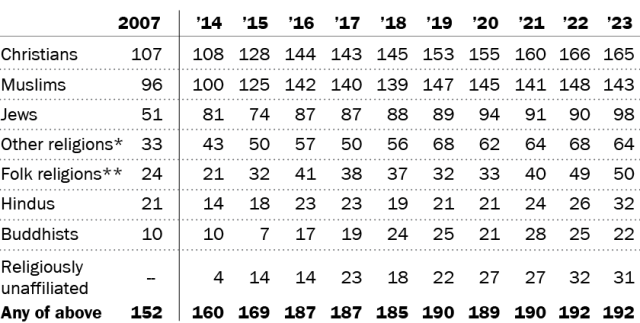
In 2023, Christians and Muslims, the two largest religious groups in the world, faced physical harassment as well as verbal and other nonphysical harassment in more countries than other groups.
Christians were harassed by government officials or nongovernmental actors in 165 countries in 2023, slightly down from 166 in 2022. Muslims were harassed in 143 countries, down from 148 in 2022.
Meanwhile, Jews – who make up less than 1% of the world’s population – were harassed in 98 countries, up from 90 in 2022. The increase was due in part to antisemitic statements from a variety of sources (including social media) after the attacks in Israel on Oct. 7, 2023, by the militant group Hamas and Israel’s ensuing military campaign in Gaza. This study counts hostile statements toward Jews (as opposed to criticism of Israel) as religion-related harassment. (Refer to the report overview for more information on these incidents.)
Harassment is counted as having occurred in a country if one or more incidents were reported by the sources used in this study. While the resulting data indicates whether any harassment by governments and private actors took place, it does not show which religious groups faced the most intense or severe harassment or which were the most persecuted.
** Includes, for example, followers of African traditional religions, Chinese folk religions, Native American religions and Australian Aboriginal religions.
Note: This measure looks at the number of countries in which groups were harassed, either by the government or by individuals/social groups. It does not assess the severity of the harassment. Numbers do not add to totals shown because multiple religious groups can be harassed in a country.
“More Countries Had Elevated Levels of Social Hostilities Involving Religion in 2023”
| Year | Christians | Muslims | Jews | Other religions* | Folk religions** | Hindus | Buddhists | Religiously unaffiliated | Any of above |
|---|---|---|---|---|---|---|---|---|---|
| 2007 | 107 | 96 | 51 | 33 | 24 | 21 | 10 | — | 152 |
| 2008 | 95 | 91 | 53 | 34 | 19 | 18 | 11 | — | 135 |
| 2009 | 96 | 82 | 63 | 39 | 24 | 11 | 7 | — | 147 |
| 2010 | 111 | 90 | 68 | 52 | 26 | 16 | 15 | — | 160 |
| 2011 | 105 | 101 | 69 | 42 | 23 | 12 | 9 | — | 161 |
| 2012 | 110 | 109 | 71 | 39 | 26 | 16 | 13 | 3 | 166 |
| 2013 | 102 | 99 | 77 | 38 | 34 | 9 | 12 | 5 | 164 |
| 2014 | 108 | 100 | 81 | 43 | 21 | 14 | 10 | 4 | 160 |
| 2015 | 128 | 125 | 74 | 50 | 32 | 18 | 7 | 14 | 169 |
| 2016 | 144 | 142 | 87 | 57 | 41 | 23 | 17 | 14 | 187 |
| 2017 | 143 | 140 | 87 | 50 | 38 | 23 | 19 | 23 | 187 |
| 2018 | 145 | 139 | 88 | 56 | 37 | 19 | 24 | 18 | 185 |
| 2019 | 153 | 147 | 89 | 68 | 32 | 21 | 25 | 22 | 190 |
| 2020 | 155 | 145 | 94 | 62 | 33 | 21 | 21 | 27 | 189 |
| 2021 | 160 | 141 | 91 | 64 | 40 | 24 | 28 | 27 | 190 |
| 2022 | 166 | 148 | 90 | 68 | 49 | 26 | 25 | 32 | 192 |
| 2023 | 165 | 143 | 98 | 64 | 50 | 32 | 22 | 31 | 192 |
** Includes, for example, followers of African traditional religions, Chinese folk religions, Native American religions and Australian Aboriginal religions.
Note: This measure looks at the number of countries in which groups were harassed, either by the government or by individuals/social groups. It does not assess the severity of the harassment. Numbers do not add to totals shown because multiple religious groups can be harassed in a country.
“More Countries Had Elevated Levels of Social Hostilities Involving Religion in 2023”
Most religious groups – except Jews, Hindus and adherents of folk religions – faced physical harassment as well as verbal and other nonphysical harassment in fewer countries in 2023 than in 2022. Adherents of folk religions were harassed in 50 countries, up from 49. And Hindus were harassed in 32 countries, up from 26. In Bulgaria, for example, a festival organized by the International Society for Krishna Consciousness was canceled by local authorities after a political party said it would disrupt the event and, on social media, called the group a “highly fanaticized sect” that opposes Christian values. According to the U.S. State Department, a Bulgarian Orthodox Church leader had said the event would promote “a destructive teaching [that is a] threat to society jeopardizing the social, psychological, and spiritual health of those who take part in it.”
With the exception of Jews, all religious groups analyzed in the study also faced harassment in more countries by governments than by private individuals or social groups. In 2023, Jews faced government harassment in 69 countries and faced harassment by private individuals, groups or organizations in 92 countries.


