
In 2023, fifty-five of the 198 countries and territories covered in a new Pew Research Center study had high or very high levels of social hostilities involving religion, such as harassment, assault or mob violence, by nongovernment actors. That was up from 45 in 2022.
The six countries with very high social hostilities involving religion in 2023 were Nigeria, India, Israel, Syria, Bangladesh and Pakistan. Both Israel and Bangladesh moved into the very high category partly because of large-scale violence, including the Hamas attacks on Oct. 7 in southern Israel and rioting against Ahmadi Muslims on March 3-4 in northern Bangladesh.
Meanwhile, 58 countries and territories had high or very high levels of government restrictions on religion in 2023, about the same number as in the previous year (59). Twenty-five countries had very high levels of government restrictions, including China, Iran, Afghanistan, Indonesia, Syria and Uzbekistan.
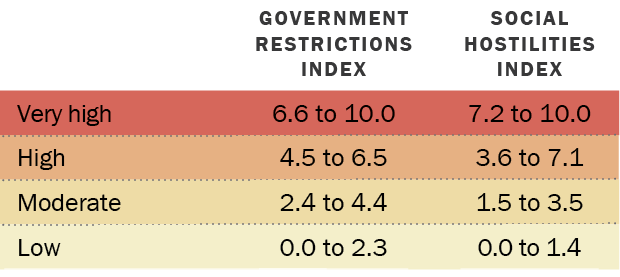
“More Countries Had Elevated Levels of Social Hostilities Involving Religion in 2023”
| Government Restrictions Index | Social Hostilities Index | |
|---|---|---|
| Very high | 6.6 to 10.0 | 7.2 to 10.0 |
| High | 4.5 to 6.5 | 3.6 to 7.1 |
| Moderate | 2.4 to 4.4 | 1.5 to 3.5 |
| Low | 0.0 to 2.3 | 0.0 to 1.4 |
“More Countries Had Elevated Levels of Social Hostilities Involving Religion in 2023”
Most countries around the world continued to have low or moderate social hostilities involving religion. Most also had low or moderate government restrictions on religion.
These findings are based on each country’s scores on two indexes.
The Social Hostilities Index (SHI) combines 13 indicators of religion-related hostilities by private individuals, groups and organizations, including terrorist groups. The Government Restrictions Index (GRI) includes 20 indicators of how government officials, laws and policies restrict religion. Scores on each index range from 0 to 10.
This part of the study focuses on countries that scored high or very high on either index. It also examines year-to-year changes, including how many countries moved up or down on each index. It is part of a wider Pew Research Center study of restrictions on religion around the world in 2023. Read the report overview for a broader understanding of the study’s key findings.
Social hostilities related to religion
On the SHI, a score of 7.2 to 10 is considered very high, while a score of 3.6 to 7.1 is considered high. (Refer to the chart and Methodology for more details on SHI categories.)
In 2023, six countries scored very high on the SHI, a slight decrease from seven in 2022. But 49 countries and territories scored high, up from 38 the previous year. In total, 55 scored either very high or high in 2023.
As in past years, most of the 198 countries and territories covered by the study had either low (94 countries) or moderate (49) levels of social hostilities in 2023.
Countries with the most extensive social hostilities
Each of the six countries with the highest levels of social hostilities in 2023 – Nigeria, India, Israel, Syria, Bangladesh and Pakistan – had an SHI score of at least 7.5 in 2023, placing them firmly in the very high category.
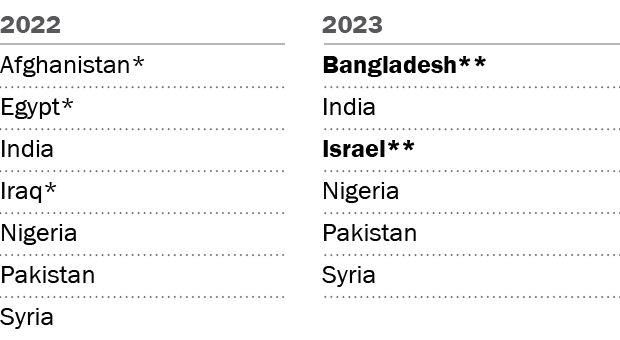
** (or bold) Country had “very high” social hostilities in 2023 but not in 2022.
“More Countries Had Elevated Levels of Social Hostilities Involving Religion in 2023”
| 2022 | 2023 |
|---|---|
| Afghanistan* | Bangladesh** |
| Egypt* | India |
| India | Israel** |
| Iraq* | Nigeria |
| Nigeria | Pakistan |
| Pakistan | Syria |
| Syria |
** (or bold) Country had “very high” social hostilities in 2023 but not in 2022.
“More Countries Had Elevated Levels of Social Hostilities Involving Religion in 2023”
The previous year, Israel and Bangladesh had been in the “high” category (rather than “very high”). Israel’s increase in score, from 7.1 points in 2022 to 8.4 points, reflected among other events a surprise attack by Hamas militants from the Gaza Strip on a music festival, kibbutzim and military bases in southern Israel on Oct. 7, 2023.2
The Hamas attack added to Israel’s SHI score because it was a terrorist attack on Israeli territory committed by an organization whose charter cites religious principles and objectives. Terrorism motivated by religion or targeting a religious group is counted in this study as a social hostility involving religion in the country where it occurs. Refer to the Methodology for more details.
Bangladesh’s increase (from 6.1 to 7.8 points on the SHI) also reflects, in part, deaths in 2023 from mob violence. On March 3-4, hundreds of people attacked the Ahmadi Muslim community at an annual gathering in the village of Ahmednagar, in the northern Panchagarh district. The attack resulted in two deaths, dozens of injuries, and the looting and destruction of many Ahmadi homes, an Ahmadi mosque, and a medical clinic, according to the U.S. State Department’s 2023 annual report on International Religious Freedom. Earlier in the year, a crowd of hundreds also attacked the house of a Hindu man in the village of Kotalipara (located in the Gopalganj district) in retaliation for a Facebook posting that allegedly denigrated the Prophet Muhammad.
Three countries – Afghanistan, Egypt and Iraq – had SHI levels that decreased from very high in 2022 to high in 2023. Although they shifted between categories, both Afghanistan and Egypt had fairly small numerical reductions in their SHI scores, going from 7.3 to 7.0 and 7.4 to 7.1, respectively. Iraq’s SHI score decreased by a full point, from 7.8 to 6.8.3
Changes in scores on the Social Hostilities Index
In 2023, 139 countries had changes in their SHI scores of at least 0.1 point, including 88 countries with increases and 51 with decreases. Fifty-nine countries had no change in their overall SHI scores. In 2023, the number of countries with a year-to-year decrease on the SHI (51) is the lowest in the 16-year history of our study.
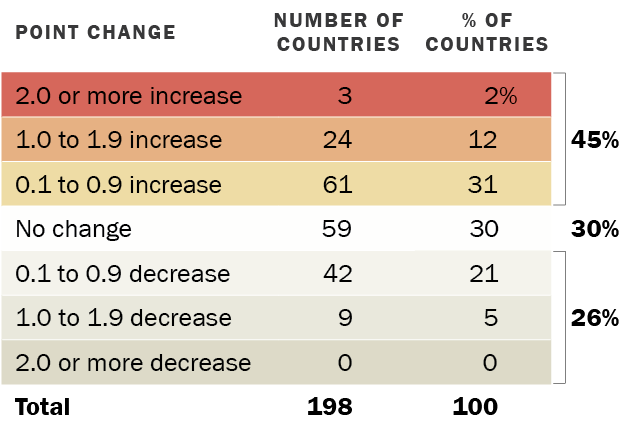
“More Countries Had Elevated Levels of Social Hostilities Involving Religion in 2023”
| Point change | Number of countries | % of countries |
|---|---|---|
| 2.0 or more increase | 3 | 2% |
| 1.0 to 1.9 increase | 24 | 12% |
| 0.1 to 0.9 increase | 61 | 31% |
| No change | 59 | 30% |
| 0.1 to 0.9 decrease | 42 | 21% |
| 1.0 to 1.9 decrease | 9 | 5% |
| 2.0 or more decrease | 0 | 0% |
| Total | 198 | 100% |
“More Countries Had Elevated Levels of Social Hostilities Involving Religion in 2023”
In just over half the countries analyzed (103 out of 198), the change in SHI scores was relatively small in 2023 (0.1 to 0.9 point), including 61 countries with increases and 42 with decreases. An additional 33 countries had modest SHI changes (1.0 to 1.9 points), including 24 increases and nine decreases.
No countries or territories had large SHI decreases in 2023, but three countries had large increases (2.0 points or more). One of those countries, Argentina, moved from the low category to moderate social hostilities as its SHI score rose from 0.2 in 2022 to 2.4 in 2023. Among the incidents reflected in Argentina’s higher score were the discovery by police of Nazi memorabilia and materials denying the Holocaust in a law firm’s “private museum” in Buenos Aires, and a bookstore in the city that sold and printed Nazi, antisemitic and Holocaust-denying texts.
The other countries that had large increases, Sudan and Sweden, moved from the moderate category to a high level of social hostilities.
Sudan’s SHI score rose from 3.5 to 5.7, which was mostly due to continued conflict between the Sudanese military and the paramilitary group known as the Rapid Support Forces (RSF). Amnesty International reported that the RSF targeted Coptic Christians, including in a May 13 attack on a church in Omdurman, where witnesses said RSF fighters shot several members of the clergy, stole money and took a gold cross. In that incident, and at other times during the year, the RSF reportedly pressured Coptic Christians to convert to Islam.
Additionally, the RSF seized religious buildings in Sudan – including mosques and Coptic churches – for use as military bases. In one example cited by the U.S. State Department, the RSF converted the Shambat Mosque in the city of Bahri (also known as Khartoum North) into a barracks and ammunition warehouse, blocking its use for worship for months.
Sweden’s rounded SHI score increased from 2.6 to 4.5 in 2023, reflecting – among other incidents – anti-Muslim demonstrations that included desecrations of the Quran.4 Over the course of the year, there were reports of individuals or small groups of protestors “burning the Quran, ripping pages out of the Quran, stomping on the pages of the Quran, and smearing bacon on the Quran,” according to the State Department. The Quran desecrations occurred outside the parliament, the embassies of Muslim-majority countries and the Stockholm Mosque during Eid al-Adha.
Government restrictions on religion
On the Government Restrictions Index (GRI), a score of 6.6 to 10 is considered very high, while scores between 4.5 and 6.5 points are considered high. (Refer to the chart above on how the index scores are classified and the report’s Methodology for more details on GRI categories.)
In 2023, 25 countries had very high levels of government restrictions on religion, up from 24 in 2022. An additional 33 countries and territories scored high, down from 35 in 2022. In total, 58 scored either very high or high in 2023.
As in past years, most of the 198 countries and territories covered by the study had either low (71 countries) or moderate (69) government restrictions on religion.
Countries with the most extensive government restrictions
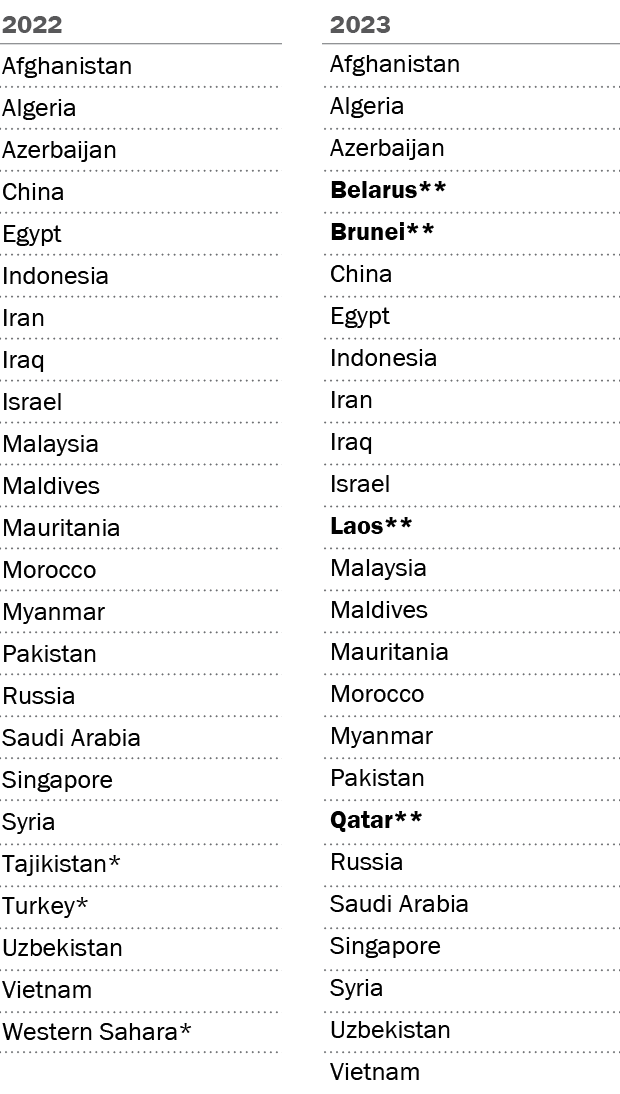
** (or bold) Country had “very high” government restrictions in 2023 but not in 2022.
Note: Myanmar is also called Burma.
“More Countries Had Elevated Levels of Social Hostilities Involving Religion in 2023”
| 2022 | 2023 |
|---|---|
| Afghanistan | Afghanistan |
| Algeria | Algeria |
| Azerbaijan | Azerbaijan |
| China | Belarus** |
| Egypt | Brunei** |
| Indonesia | China |
| Iran | Egypt |
| Iraq | Indonesia |
| Israel | Iran |
| Malaysia | Iraq |
| Maldives | Israel |
| Mauritania | Laos** |
| Morocco | Malaysia |
| Myanmar | Maldives |
| Pakistan | Mauritania |
| Russia | Morocco |
| Saudi Arabia | Myanmar |
| Singapore | Pakistan |
| Syria | Qatar** |
| Tajikistan* | Russia |
| Turkey* | Saudi Arabia |
| Uzbekistan | Singapore |
| Vietnam | Syria |
| Western Sahara* | Uzbekistan |
| Vietnam |
** (or bold) Country had “very high” government restrictions in 2023 but not in 2022.
Note: Myanmar is also called Burma.
“More Countries Had Elevated Levels of Social Hostilities Involving Religion in 2023”
Among the countries with very high GRI scores in 2023 were China, Iran, Afghanistan, Indonesia, Syria and Uzbekistan. Each of these six countries had a GRI score of at least 7.8, placing them firmly in the very high category.5
In 2023, four countries – Belarus, Brunei, Laos and Qatar – moved into the very high category from the high category in 2022. However, all four had GRI increases of less than 1 point.
In Laos, where Buddhism is the majority religion, the GRI score rose by 0.8 (from 5.9 to 6.7) in part due to reports that local authorities displaced or detained Christians who withstood pressure to renounce their faith and damaged their properties. In October, for example, authorities in the Sa Mouay district allegedly forced at least eight families from their villages and destroyed their homes after the families converted to Christianity.
Meanwhile, Qatar’s score increased from 6.1 to 6.6 partly because of government actions toward religious minorities. Members of the Baha’i community in the country reported that the government limited their economic opportunities and tried to intimidate them, causing some Baha’is to leave the country.
Three countries – Tajikistan, Turkey and Western Sahara – dropped from the very high category in 2022 into the high category in 2023. However, all had relatively small numerical decreases amounting to less than 1 point on the GRI.
Changes in scores on the Government Restrictions Index
“More Countries Had Elevated Levels of Social Hostilities Involving Religion in 2023”
| Point change | Number of countries | % of countries |
|---|---|---|
| 2.0 or more increase | 0 | 0% |
| 1.0 to 1.9 increase | 6 | 3% |
| 0.1 to 0.9 increase | 88 | 44% |
| No change | 36 | 18% |
| 0.1 to 0.9 decrease | 65 | 33% |
| 1.0 to 1.9 decrease | 3 | 2% |
| 2.0 or more decrease | 0 | 0% |
| Total | 198 | 100% |
“More Countries Had Elevated Levels of Social Hostilities Involving Religion in 2023”
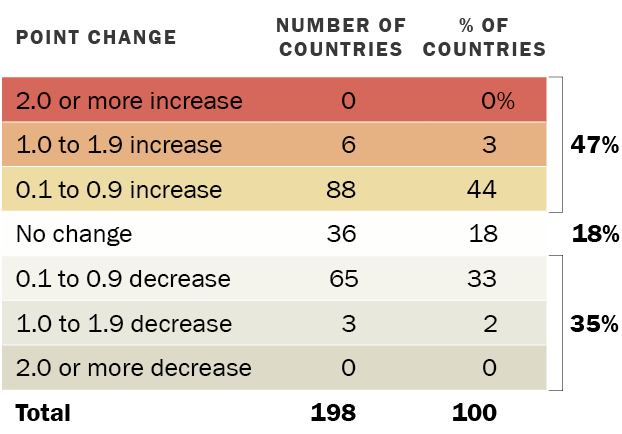
From 2022 to 2023, 162 countries and territories had changes in their GRI scores of at least 0.1 point, including 94 with increases and 68 with decreases. Thirty-six countries had no change in their overall scores.
However, more than three-quarters of countries – 153 out of 198 – had only small changes (0.1 to 0.9 points) on the GRI.
Nine countries had modest changes (1.0 to 1.9 points), including six with modest increases and three with modest decreases.
No country had a change of 2.0 points or more on the GRI in 2023.
Changes in combined scores on both indexes
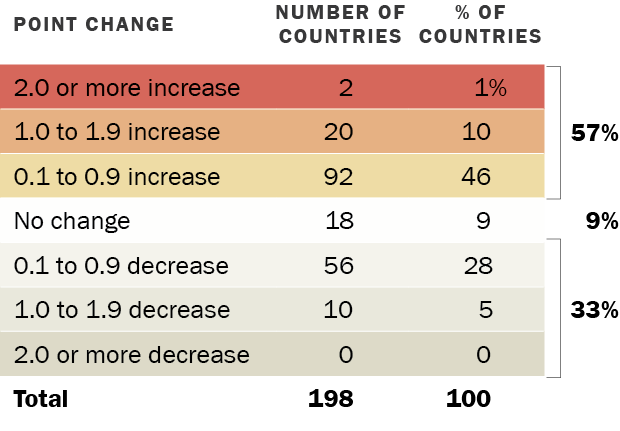
When the two indexes are combined by adding each country’s GRI score to its SHI score, 114 countries and territories show overall increases in their combined scores from 2022 to 2023, including 92 with small increases (between 0.1 and 0.9 points) and 20 countries with modest increases (1.0 to 1.9 points).
“More Countries Had Elevated Levels of Social Hostilities Involving Religion in 2023”
| Point change | Number of countries | % of countries |
|---|---|---|
| 2.0 or more increase | 2 | 1% |
| 1.0 to 1.9 increase | 20 | 10% |
| 0.1 to 0.9 increase | 92 | 46% |
| No change | 18 | 9% |
| 0.1 to 0.9 decrease | 56 | 28% |
| 1.0 to 1.9 decrease | 10 | 5% |
| 2.0 or more decrease | 0 | 0% |
| Total | 198 | 100% |
“More Countries Had Elevated Levels of Social Hostilities Involving Religion in 2023”
Only two countries – Argentina and Sweden – had large increases (2.0 points or more) in their combined scores.6
In Sweden, the increase stems in part from the repeated desecrations of the Quran that took place across Stockholm in 2023. Although Sweden’s Foreign Ministry condemned the burning of the Quran as Islamophobic and offensive, Swedish courts ruled that police attempts to “deny or relocate” the demonstrations were “unlawful limitations of free speech and assembly,” according to the U.S. State Department’s 2023 report on International Religious Freedom.
In this study, the anti-Muslim demonstrations in Sweden in 2023 are counted both as social hostilities involving religion and as government restrictions on religion, because Swedish authorities approved permits that mentioned the burning of religious books.
Argentina also had a large increase in its combined SHI and GRI score, in part due to incidents in which Muslims were verbally or physically harassed in public. For example, a Muslim woman was detained by airport officials for wearing a hijab and was required to undress in front of female officers. The airport security office later issued a formal apology, according to the U.S. State Department.
Meanwhile, 66 countries saw decreases in their combined SHI and GRI scores, including 56 with small decreases (0.1 to 0.9 points) and 10 with modest decreases (1.0 to 1.9 points). No country had a large decrease (2.0 points or more) in its combined score. A total of 18 countries had no changes in their combined scores.


