
Pew Research Center’s annual study of religious freedom shows that the number of countries with high or very high levels of social hostilities involving religion rose sharply in 2023. Among the reasons are increases in the harassment of religious minorities and worldwide reverberations of Hamas’ Oct. 7 attack on southern Israel and Israel’s military response in Gaza.
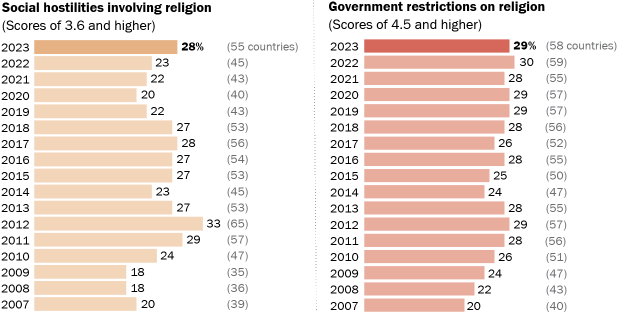
Fifty-five countries had elevated (high or very high) levels of social hostilities involving religion in 2023. This is up from 45 the previous year, though still below the highest number (65) recorded since the study began in 2007. The peak came in 2012 after the Arab Spring protests erupted across the Middle East and North Africa in 2010 and 2011.
“More Countries Had Elevated Levels of Social Hostilities Involving Religion in 2023”
| Year | % with very high/high Social Hostilities Index scores | Number of countries with very high/high SHI | % with very high/high Government Restrictions Index scores | Number of countries with very high/high GRI |
|---|---|---|---|---|
| 2023 | 28% | 55 | 29% | 58 |
| 2022 | 23% | 45 | 30% | 59 |
| 2021 | 22% | 43 | 28% | 55 |
| 2020 | 20% | 40 | 29% | 57 |
| 2019 | 22% | 43 | 29% | 57 |
| 2018 | 27% | 53 | 28% | 56 |
| 2017 | 28% | 56 | 26% | 52 |
| 2016 | 27% | 54 | 28% | 55 |
| 2015 | 27% | 53 | 25% | 50 |
| 2014 | 23% | 45 | 24% | 47 |
| 2013 | 27% | 53 | 28% | 55 |
| 2012 | 33% | 65 | 29% | 57 |
| 2011 | 29% | 57 | 28% | 56 |
| 2010 | 24% | 47 | 26% | 51 |
| 2009 | 18% | 35 | 24% | 47 |
| 2008 | 18% | 36 | 22% | 43 |
| 2007 | 20% | 39 | 20% | 40 |
“More Countries Had Elevated Levels of Social Hostilities Involving Religion in 2023”
The annual study covers a total of 198 countries and territories around the world; 2023 is the most recent year for which data is available. After categorizing incidents that have been publicly reported by the U.S. State Department, the United Nations and other international organizations, we rate each country on two scales, ranging from 0 to 10 points.
“More Countries Had Elevated Levels of Social Hostilities Involving Religion in 2023”
| Government Restrictions Index | Social Hostilities Index | |
|---|---|---|
| Very high | 6.6 to 10.0 | 7.2 to 10.0 |
| High | 4.5 to 6.5 | 3.6 to 7.1 |
| Moderate | 2.4 to 4.4 | 1.5 to 3.5 |
| Low | 0.0 to 2.3 | 0.0 to 1.4 |
“More Countries Had Elevated Levels of Social Hostilities Involving Religion in 2023”
The Government Restrictions Index (GRI) captures various ways that government officials, laws and policies can impinge on religious freedom. In 2023, 58 countries had high or very high levels of government restrictions on religion – just one fewer than the peak number, 59, recorded in 2022. Among the countries with very high GRI scores in 2023 were China, Iran, Afghanistan, Indonesia, Syria and Uzbekistan.
The Social Hostilities Index (SHI) captures various kinds of harassment and violence by private individuals and nongovernmental organizations (including terrorist groups) that are motivated by religion or that target religious communities. Among the countries with very high SHI scores in 2023 were Nigeria, India, Israel, Syria, Bangladesh and Pakistan.
What is a median?
In this analysis, medians are used to help readers see overall patterns in the data. A median is the middle number in a list of figures sorted in ascending or descending order.
In this report, within each geographic region (and for all 198 countries and territories we study overall), our researchers list the relevant countries from lowest to highest based on index scores. The median score is the score of the middle country on the list.
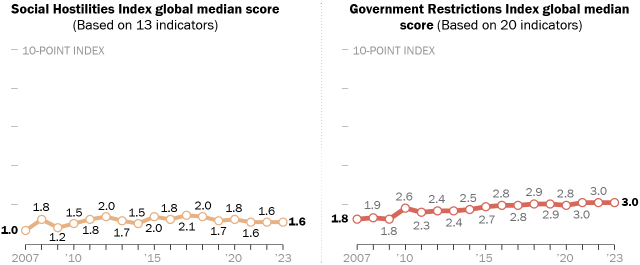
Despite the rise in the number of countries with high or very high SHI scores, the median SHI score of all 198 countries and territories in the study stayed the same in 2023 – 1.6 out of 10 – as in the previous two years. Most countries continued to have SHI scores that were either low (94 countries) or moderate (49 countries). The peak median score on the SHI over the course of the study has been 2.1, which was reached in 2017.
Globally, the median score on the Government Restrictions Index has been higher than on the Social Hostilities Index every year since the study began. In 2007, the median GRI score was 1.8. In 2023, it was 3.0, the same as in the previous two years and the highest it has been during the course of the study.
Over the years, the median GRI score has gone up fairly steadily, while the median SHI score has fluctuated. At a global level, this suggests that governments have been clamping down on religious beliefs and practices in more ways than they were in 2007, at the beginning of the study, while the number of countries with social hostilities has tended to rise and fall with events.
“More Countries Had Elevated Levels of Social Hostilities Involving Religion in 2023”
| Year | SHI Global Median | GRI Global Median |
|---|---|---|
| 2007 | 1 | 1.8 |
| 2008 | 1.8 | 1.9 |
| 2009 | 1.2 | 1.8 |
| 2010 | 1.5 | 2.6 |
| 2011 | 1.8 | 2.3 |
| 2012 | 2 | 2.4 |
| 2013 | 1.7 | 2.4 |
| 2014 | 1.5 | 2.5 |
| 2015 | 2 | 2.7 |
| 2016 | 1.8 | 2.8 |
| 2017 | 2.1 | 2.8 |
| 2018 | 2 | 2.9 |
| 2019 | 1.7 | 2.9 |
| 2020 | 1.8 | 2.8 |
| 2021 | 1.6 | 3 |
| 2022 | 1.6 | 3 |
| 2023 | 1.6 | 3 |
“More Countries Had Elevated Levels of Social Hostilities Involving Religion in 2023”
Countries that moved into the high SHI category in 2023
Most of the 55 countries in the high and very high SHI categories in 2023 were already at those levels in the previous year, but 12 of them had moderate SHI scores in 2022. (All 12 moved into the “high” category in 2023, not “very high.”) Meanwhile, two other countries, Ethiopia and the Philippines, moved out of the high category and into the moderate SHI category in 2023.
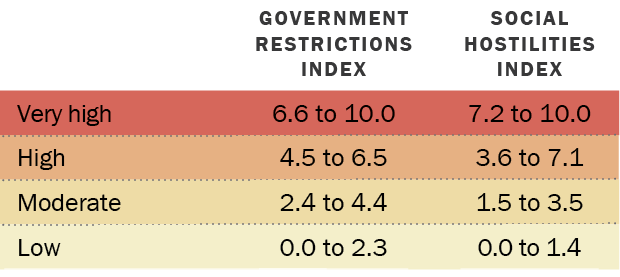
In this study, a “high” SHI score for a country is between 3.6 and 7.1 (out of 10) on the index, while a “moderate” score is 1.5 to 3.5. These categories were defined based on the distribution of scores in the first year of the study, which looked at data from 2007. (For more information, refer to the chart on how index scores are classified and the Methodology section of this report.)
Of the 12 countries that moved into the high category in 2023, five were in Europe (Belgium, Norway, Russia, Spain and Sweden); three were in sub-Saharan Africa (Democratic Republic of the Congo, Sierra Leone and Tanzania); two were in the Asia-Pacific region (Thailand and Turkey); one was in the Americas (Guatemala); and one was in the Middle East-North Africa region (Sudan).
In Spain, where the SHI score increased from 2.8 to 3.7, there were increased reports of attacks against Jehovah’s Witnesses in 2023. In March, the verbal harassment of two Jehovah’s Witnesses at an information booth in Valencia turned physical when the attackers assaulted one of the Witnesses who had tried to call the police. The resulting injury required surgery.
In another incident that raised Spain’s SHI score, a man of Moroccan origin killed one person and wounded another with a machete, at two churches in the city of Algeciras. The attacker was charged with “aggravated murder with terrorist intent,” although a psychiatric evaluation indicated the attacker’s actions may have stemmed from psychological problems, according to the U.S. State Department.
Harassment of Muslims and Jews also contributed to Spain’s SHI score. Muslim leaders in Spain reported a rise in “hate speech on social media platforms and discrimination” against Muslims in the wake of the Oct. 7 attack. At the same time, the Federation for Jewish Communities of Spain reported an increase in antisemitic incidents – including vandalism of synagogues, cemeteries and mailboxes at Jewish homes – after the Hamas attack.
In Norway, where the SHI score increased from 3.2 to 4.2 in 2023, there were cases of physical harassment of Jehovah’s Witnesses as well as Jews and Muslims. In September and October, Jehovah’s Witnesses were the targets of repeated attacks in Norway, including several committed by the same man over three days, according to the nongovernmental organization Human Rights Without Frontiers. (The man reportedly punched a male Jehovah’s Witness, verbally harangued other members of the religious group and overturned their literature carts.)
In addition, Jewish and Muslim groups in Norway reported an increase in hate speech after the Oct. 7 Hamas attack and Israel’s military response. The Jewish Community of Oslo voiced its “concern regarding increasing expressions of antisemitism in the country, and fear among the Jewish community at a level not experienced in decades,” according to the U.S. State Department. In one incident, a mezuzah (a scroll with religious text that Jews attach to doorposts) was torn off the front of a Jewish home.
Meanwhile, a group called “Stop the Islamization of Norway” (also known as SIAN) held rallies in which the Quran was burned. Also, SIAN and other like-minded organizations published anti-Muslim articles online and in print. The Muslim Dialogue Network, a group funded by the Norwegian government, reported that these anti-immigration sentiments contributed to hate speech and harassment and tended to increase “after major news events, particularly those involving the Middle East,” according to the State Department.
Among the countries that moved into the high SHI category, Sweden and Russia also had incidents of Quran burnings. (Refer to the section of this report on overall changes in restrictions on religion for more discussion of Sweden’s increased SHI score in 2023.)
Russia’s SHI score rose from 3.5 to 3.8 in 2023, due partly to newly reported mob violence. For example, in late October a mob breached security at an airport in the largely Muslim region of Dagestan “to protest the arrival of an Israeli El Al passenger flight, with some shouting antisemitic slogans,” according to the State Department, which said the protest was in reaction to Israel’s military campaign in Gaza after the Oct. 7 Hamas attack.
Also in Russia, in 2023, there were new reports of hostilities against women who were wearing religious clothing. On the outskirts of Moscow, multiple Russian women attacked a hijab-wearing Muslim woman and her children in a playground. The attackers allegedly set their dogs on the family and assaulted them. Additionally, women were required to conform to Islamic dress codes in the North Caucasus region of the country; this also had been reported in 2022.
Tanzania’s SHI score increased from 3.1 to 4.4, partly due to attacks on people accused of practicing witchcraft (which is counted in this study as a folk religion). In October, in the country’s Kigoma region, a mob assaulted and shaved the heads of several people who were accused of being witches, after having forced them to leave their homes. According to the U.S. State Department, accusations of witchcraft continue to occur in rural parts of Tanzania where traditional healing methods are used. (For more information on incidents in Tanzania in 2023, refer to the section of this report on the 25 most populous countries.)
Thailand’s index score rose from 3.5 to 4.4, partly due to increased reports of violence in a southern region of the Buddhist-majority country where the government is fighting Muslim separatists. In August 2023, in Narathiwat province, separatists set off a bomb at a Muslim family’s house where the Thai military was reportedly using the house for “humanitarian assistance” for people affected by the insurgency. The number of killings in the conflict increased in 2023, with Muslims accounting for most of the fatalities.
Meanwhile, Sudan’s score increased from 3.5 to 5.7, due in part to damage to houses of worship and other religious sites in the war between the Rapid Support Forces (a nongovernmental paramilitary group) and the Sudanese army. For more information on social hostilities in Sudan, refer to the sections of this report on large changes on the Social Hostilities Index and on physical assaults and harassment.
And in Guatemala, reports of conversion therapies for lesbian, gay and transgender people that were aided or funded by churches contributed to an increase in the country’s social hostilities score from 2.8 to 3.8. (Refer to the section on restrictions by geographic region to read more about these types of incidents.)
How many people live in countries with high or very high restrictions and hostilities?
In total, 58 countries (out of 198 analyzed) had high or very high levels of government restrictions involving religion in 2023, while 55 had high or very high levels of social hostilities. Accounting for some overlap, 86 countries had elevated levels either of government restrictions or of social hostilities, while 27 had elevated levels both of social hostilities and of government restrictions.
The 198 countries and territories analyzed in this report contain all but a tiny fraction of the global population.1
Of the people living in those 198 countries, about three-quarters (78%) live in places with high or very high levels of government restrictions and/or social hostilities.
At the same time, most countries have low or moderate levels of government restrictions and social hostilities.
This is possible because some of the countries with very high restrictions and/or hostilities are extremely populous, including China, India and Pakistan. Of course, not everyone living in countries with high levels of government restrictions or social hostilities is equally affected by them; in many cases, the brunt falls on religious minorities.
Government harassment of religious groups and interference in worship in 2023
To see other patterns in the data, we can look at subcategories of government restrictions.
“More Countries Had Elevated Levels of Social Hostilities Involving Religion in 2023”
| Total countries | Year | Government harassment of religious groups | Government interference in worship |
|---|---|---|---|
| 197 | 2007 | 118 | 112 |
| 197 | 2008 | 112 | 111 |
| 197 | 2009 | 103 | 107 |
| 197 | 2010 | 124 | 125 |
| 198 | 2011 | 129 | 136 |
| 198 | 2012 | 131 | 147 |
| 198 | 2013 | 133 | 135 |
| 198 | 2014 | 129 | 127 |
| 198 | 2015 | 157 | 146 |
| 198 | 2016 | 177 | 155 |
| 198 | 2017 | 175 | 155 |
| 198 | 2018 | 175 | 156 |
| 198 | 2019 | 180 | 163 |
| 198 | 2020 | 178 | 164 |
| 198 | 2021 | 183 | 163 |
| 198 | 2022 | 186 | 170 |
| 198 | 2023 | 185 | 175 |
“More Countries Had Elevated Levels of Social Hostilities Involving Religion in 2023”
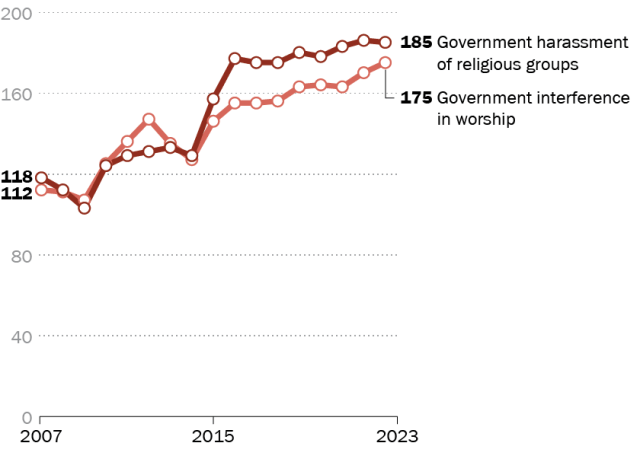
In 2023, as in most recent years of the study, government harassment of religious groups (either verbal or physical) was one of the most common types of restrictions on religion. According to the sources we analyzed, government harassment occurred in 185 countries (93% of the 198 countries and territories in the study), about the same as in 2022 (186).
At the same time, interference in worship also was a very common type of government restriction, occurring in 175 countries and territories (88%), up from 170 countries in 2022 and marking a new peak for the study. By interference in worship, we mean policies and actions that disrupt religious activities, like denying permits for houses of worship. It also includes interference against practices and rituals not explicitly linked to worship, such as burial rituals or conscientious objections to military service.
For more information on religion-related harassment by governments, refer to the section of the report on harassment of religious groups.


