


People who live in the American South continue to be more religious, on average, than residents of the Midwest, Northeast and West.
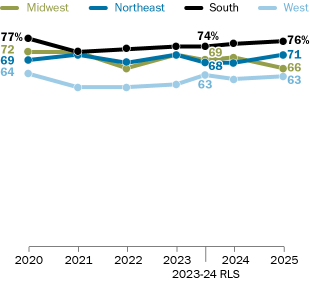
| South | Midwest | West | Northeast | |
|---|---|---|---|---|
| 2020 | 77 | 72 | 64 | 69 |
| 2021 | 72 | 72 | 59 | 71 |
| 2022 | 73 | 66 | 59 | 68 |
| 2023 | 74 | 71 | 60 | 71 |
| 2023-24 RLS | 74 | 69 | 68 | 63 |
| 2024 | 75 | 70 | 62 | 68 |
| 2025 | 76 | 66 | 63 | 71 |
Between 2020 and 2025, religiousness in the South and in the other regions generally has been stable, Pew Research Center surveys show.
But over the longer term, religiousness has declined markedly in each part of the country. The change is big enough that current levels of religiousness in the South resemble the 2007 levels of religiousness in the Northeast and West.
For example, 51% of Southerners pray daily, according to the 2023-24 Religious Landscape Study (RLS). That’s about the same as the 2007 levels of daily prayer in the West (53%) and Northeast (50%). And 74% of Southerners identify with a religion as of 2023-24, which is actually lower than the 2007 shares in the West (77%) and Northeast (83%).
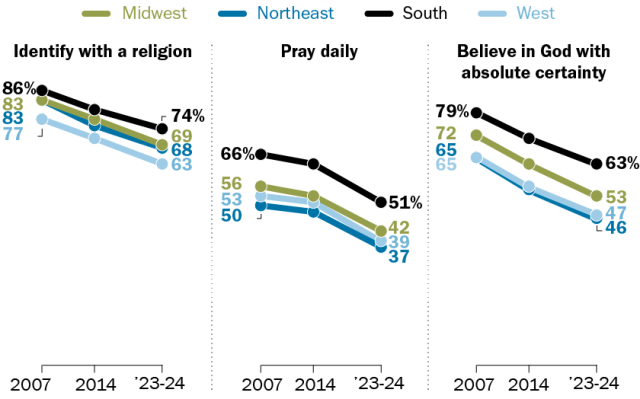
| Identify with a religion | Pray daily | Believe in God with absolute certainty | |||||||
|---|---|---|---|---|---|---|---|---|---|
| ’07 | ’14 | ’23-24 | ’07 | ’14 | ’23-24 | ’07 | ’14 | ’23-24 | |
| South | 86 | 80 | 74 | 66 | 63 | 51 | 79 | 71 | 63 |
| Midwest | 83 | 77 | 69 | 56 | 53 | 42 | 72 | 63 | 53 |
| West | 77 | 71 | 63 | 53 | 51 | 39 | 65 | 56 | 47 |
| Northeast | 83 | 75 | 68 | 50 | 48 | 37 | 65 | 55 | 46 |
Still, the South remains the most religious region by every measure included in this analysis, according to our 2023-24 RLS. The Midwest is generally the second-most religious region by these measures, while the Northeast and the West are less religious.
The Center has conducted the RLS three times (in 2007, 2014, and 2023-24), with more than 35,000 randomly sampled respondents each time. In the rest of this analysis, we take a closer look at RLS data within geographic regions.
How religiousness has changed by region
In each region, our surveys show long-term declines in religiousness on questions about religious affiliation, daily prayer and belief in God.
For example, the share of adults in the Midwest who identify with a religion dropped from 83% in 2007 to 69% in the 2023-24 RLS. In the South, that share declined from 86% to 74%. (For more details on religious affiliation over time in all four U.S. regions, refer to this detailed table from the Religious Landscape Study.)
In addition, 47% of adults in the West say they believe in God with absolute certainty as of 2023-24, down from 65% in 2007. In the South, the share who say this is 16 percentage points lower than in 2007 (63% vs. 79%).
Religious affiliation by region
Majorities of adults in each U.S. region identify as Christian, but those majorities have all gotten smaller since 2007. For example, 68% of Southerners are Christian as of 2023-24, down from 83% in 2007.
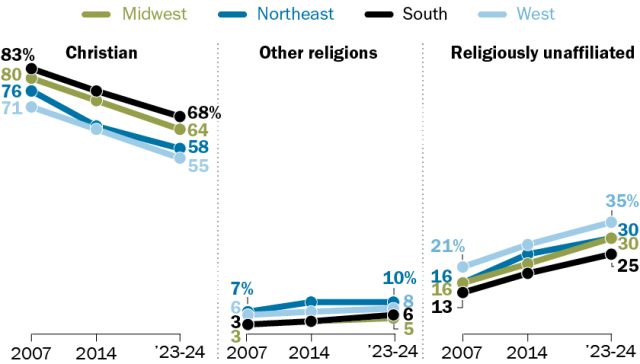
| Christian | Other religions | Religiously unaffiliated | |||||||
|---|---|---|---|---|---|---|---|---|---|
| ’07 | ’14 | ’23-24 | ’07 | ’14 | ’23-24 | ’07 | ’14 | ’23-24 | |
| South | 83 | 76 | 68 | 3 | 4 | 6 | 13 | 19 | 25 |
| Midwest | 80 | 73 | 64 | 3 | 4 | 5 | 16 | 22 | 30 |
| West | 71 | 64 | 55 | 6 | 7 | 8 | 21 | 28 | 35 |
| Northeast | 76 | 65 | 58 | 7 | 10 | 10 | 16 | 25 | 30 |
The shares identifying with each region’s largest Christian subgroup have also declined. In the South, for instance, 31% of all adults are evangelical Protestants, down from 37% in 2007. Similarly, the share of evangelicals in the Midwest has fallen from 26% to 23%.
Catholics are now 28% of the population in the Northeast, down from 37% in 2007. In the West, 20% of adults are Catholic, down from 25%.
Meanwhile, the share of religiously unaffiliated adults in each region has risen since 2007. For example, it has roughly doubled in the Northeast and the Midwest, from 16% to 30% in each.
The share of people who collectively identify with religions other than Christianity has increased slightly in each region. In the South, for instance, that share has grown from 3% in 2007 to 6% in 2023-24. In the Northeast, it has increased from 7% to 10%.
For more on recent trends in religiousness by region, refer to this detailed table from the Religious Landscape Study.
