How news is funded is central to the sustainability of journalism, yet most Americans do not see paying for it as their responsibility. This analysis explores how the public thinks about paying for news, the reasons behind their views, and who is most likely to pay.
“Americans’ Complicated Relationship With News”
| Group | group | Percent |
|---|---|---|
| All U.S. adults | Total | 8% |
| Rep/Lean Rep | Party | 5% |
| Dem/Lean Dem | Party | 11% |
| Ages 18-29 | age | 4% |
| 30-49 | age | 8% |
| 50-64 | age | 8% |
| 65+ | age | 10% |
| College grad+ | educ | 14% |
| Some college | educ | 5% |
| HS or less | educ | 5% |
| Upper income | inc | 14% |
| Middle income | inc | 8% |
| Lower income | inc | 5% |
“Americans’ Complicated Relationship With News”
Our findings reflect a recurring theme: Americans value being informed, but they feel a limited obligation to contribute financially to the system that produces the news.
These findings are based on a Pew Research Center survey of U.S. adults aimed at understanding how Americans are thinking about and experiencing news today. Read key findings from the full study.
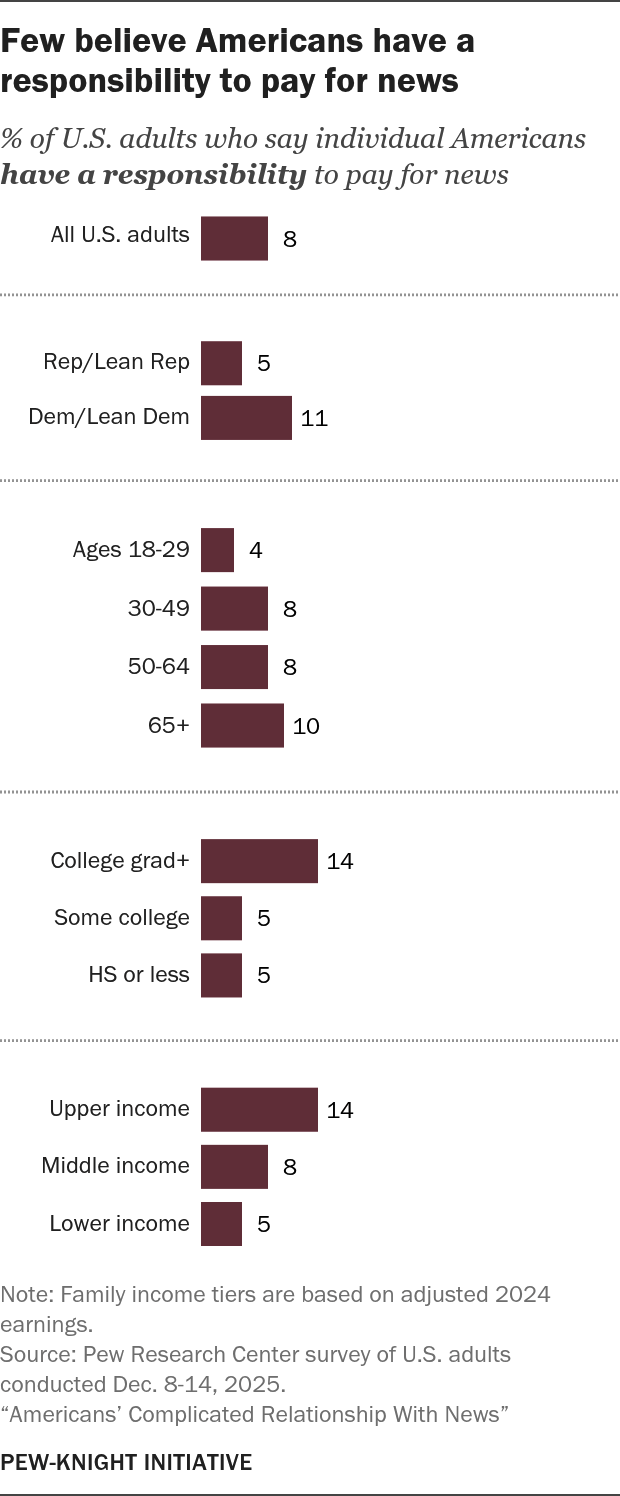
Just 8% of U.S. adults say individual Americans have a responsibility to pay for news. This may connect to the fact that many Americans think that news organizations should make most of their money from advertising, not subscriptions or government funding, and that most think news organizations are doing at least somewhat well financially.
In focus group discussions held as part of the study, some participants expressed a view that paying for news shouldn’t be a responsibility. “I don’t think that information should be a privilege,” one woman in her 20s said.
A woman in her 50s said, “I don’t pay to go to church, to get a spiritual message, you know? And if you’re true, and your mission is to relay facts that are fundamentally important for people’s well-being, do I need to pay you for that?”
Others observed that the money to pay for newsgathering has to come from somewhere. “I think somebody has to pay those journalists,” a man in his 60s said. “Somebody has to – it’s costly to travel around. It’s costly to report the news. And so I think it’s good for our society that we have reliable, objective journalism.”
Some groups are slightly more likely to see paying for news as a responsibility:
- Democrats and independents who lean Democratic are more likely than Republicans and GOP leaners to say Americans have a responsibility to pay (11% vs. 5%).
- People with high levels of education and adults with higher incomes are more likely to say people have this responsibility.
Few people pay for news themselves
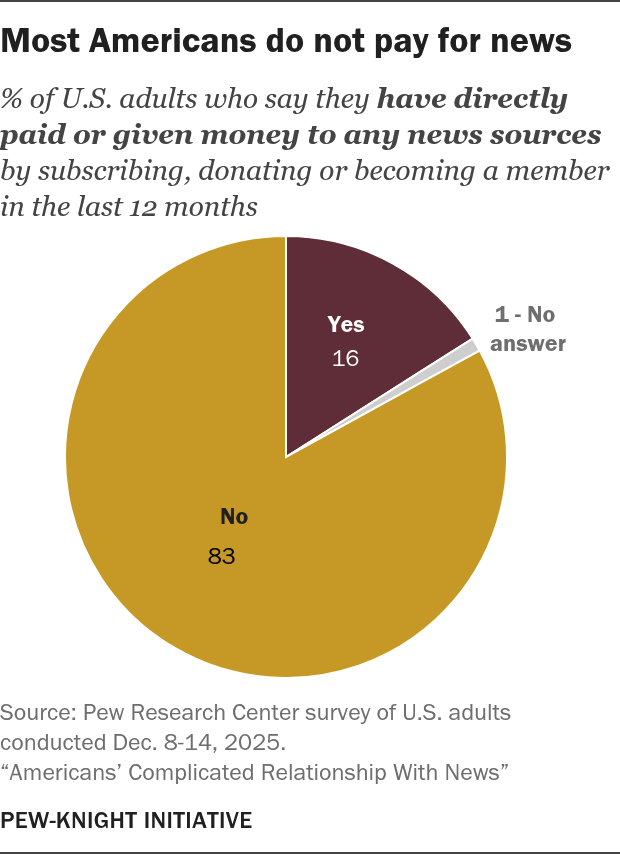
Consistent with attitudes about responsibility, relatively few Americans (16%) say they have paid for news in the past year – whether through subscriptions, memberships or donations.
“Americans’ Complicated Relationship With News”
| Percent | |
|---|---|
| Yes | 16% |
| No answer | 1% |
| No | 83% |
“Americans’ Complicated Relationship With News”
Again, the groups more likely to pay include:
- Upper-income Americans (30%)
- Those with a postgraduate degree (35%)
- Liberal Democrats (29%)
These patterns are similar to what we found in a March 2025 survey.
Why many Americans don’t pay for news
Focus group discussions highlight a few reasons many Americans don’t pay for news, including that plenty of it is available for free. One participant, a man in his 20s, said, “I feel like it’s a luxury to pay for news. … I think there’s still news accessible via free outlets, like just Googling something.”
“In some ways, I hate to pay for another subscription to another channel or subscribing to something,” a woman in her 50s explained. “I don’t want to give anybody that money. So I’m kind of like, if I can find a free news source, then I prefer that.”
Some said they support the concept of paying for news, including supporting independent journalists or creators through platforms like Substack, but felt subscription fatigue from being asked to pay for access to multiple news sources.
As a man in his 40s said, “You want to read different people’s articles, they want you to pay. And you like all these people, but … I can’t do $5 for 20 people. That’s a lot. It adds up.”
How do Americans think news organizations should make money?
When asked how U.S. news organizations should make most of their money, Americans are most likely to say advertising or sponsorships (45%). Much smaller shares say charging for subscriptions or memberships (11%), receiving government funding (10%), or receiving charitable donations (5%).

“Americans’ Complicated Relationship With News”
| Percent | |
|---|---|
| Selling ads or sponsorships | 45% |
| Charging for subscriptions or memberships | 11% |
| Receiving government funding | 10% |
| Receiving charitable donations | 5% |
| Some other way | 2% |
| Not sure | 25% |
“Americans’ Complicated Relationship With News”
A quarter of Americans say they are not sure how news outlets should make money.
Advertising revenue was the main source of revenue for daily newspapers, as well as most forms of television news, for much of the 20th century. But advertising revenue for the newspaper industry dropped dramatically in the last two decades and in recent years fell below circulation revenue for the first time in nearly 70 years of recorded data.
Both Republicans (51%) and Democrats (41%) are most likely to select advertising or sponsorships as the main way news organizations should make money. Democrats are modestly more likely than Republicans to say the main source of income should be government funding (14% vs. 7%).
Younger Americans also are more likely than their elders to say government funding is the main way news organizations should make money (15% of adults under 50 vs. 5% of those 50 and older). Still, selling advertising is the most common response even among young Americans.
Focus group conversations – particularly the following exchange among three participants in their 20s after they were asked about who should be responsible for ensuring people have access to news – revealed some people’s mixed feelings about the concept of government-funded journalism.
Participant 1: I’m thinking. My first thought was the government, but then I’m like, I don’t know if state-sanctioned journalism is a good idea.
Participant 2: Dangerous tightrope.
Participant 1: Yeah, because I’m like, well, it’s a public service, but then there’s a high risk there.
Moderator: [Participant], how do you feel about that? Who should do it?
Participant 3: I don’t know. … The only channel I trust is PBS. So I don’t know if there’s – we should never …
Participant 2: Isn’t that publicly funded?
Participant 3: Yeah. If Elmo could do it, sure. But I don’t think there is one person we can give the job. Because there’s always going to be someone that’s power hungry and trying to influence one idea.
Most Americans say news organizations are doing at least somewhat well financially
About a third of Americans (34%) say U.S. news organizations are doing extremely or very well financially, while 37% say news outlets are doing somewhat well. About a quarter (27%) say news organizations are doing not too well or not well at all financially.
“Americans’ Complicated Relationship With News”
| Somewhat well | Very well | Extremely well | Not well at all | Not too well | |
|---|---|---|---|---|---|
| All U.S. adults | 37% | 23% | 11% | 4% | 23% |
| Upper income | 33% | 18% | 8% | 4% | 36% |
| Middle income | 38% | 24% | 11% | 3% | 23% |
| Lower income | 38% | 23% | 13% | 5% | 19% |
“Americans’ Complicated Relationship With News”
These perceptions may help explain why relatively few people feel a responsibility to pay for news: Many believe news organizations are at least somewhat stable financially, despite well-documented revenue declines in some parts of the industry.
In the newspaper industry, for example, revenues have dropped dramatically, and many newspapers have closed or experienced layoffs as their business models ceased to be profitable.
Local TV and cable news businesses have not seen such drastic declines, with election advertising bolstering local television revenues. But cable news revenues have also begun to show signs of decline, particularly for CNN and MSNBC (now known as MS NOW).
Upper-income Americans are more likely than those with lower incomes to say news organizations are doing not too well or not at all well financially (40% say this). Liberal Democrats are also especially likely to say this: 38% say news organizations are not doing well.