Religious Groups Differ Widely in Their 2026 Midterm Preferences
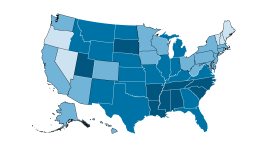
White evangelical Protestants and White Catholics favor Republicans in the midterms, while other religious groups split or lean Democratic.
Numbers, Facts and Trends Shaping Your World
Read our research on:

White evangelical Protestants and White Catholics favor Republicans in the midterms, while other religious groups split or lean Democratic.

Sent weekly on Wednesday
All
Publications
The Obama administration has submitted a “friend-of-the-court” brief on the legal challenge to California’s gay marriage ban, which will be argued before the U.S. Supreme Court on March 26.
As the pontificate of Benedict XVI winds down, three-quarters of American Catholics express a favorable view of the pontiff. Meanwhile, most U.S. Catholics say it would be good if the next pope allows priests to marry. And fully six-in-ten say it would be good if the next pope hails from a developing region like South America, Asia or Africa.
Updated Feb. 15, 2013 On Feb. 14, the Illinois Senate, as expected, approved a measure that would legalize same-sex marriage in the state. The bill will move next to the Illinois House of Representatives, which is more divided on the issue. Illinois Gov. Pat Quinn favors the legislation and has said he will sign it […]
Over the past century, the number of Catholics worldwide has more than tripled. But the world’s overall population also has risen rapidly from 1910 to 2010. As a result, Catholics have made up a remarkably stable share of all people on Earth, though their geographic distribution has changed substantially.
On Feb. 1, the U.S. Department of Health and Human Services released new rules for how the Patient Protection and Affordable Care Act’s contraception mandate applies to religious nonprofits, including houses of worship, schools and hospitals. Church-state law scholars Ira C. Lupu and Robert Tuttle explain the new rules and the legal arguments that religious groups might make.
Two years after Egyptians first poured into Cairo’s Tahrir Square chanting “Down with Mubarak” the legacy of the Arab Spring remains uncertain. Polling since the uprising shows that Egyptians want democratic rights and institutions, a major role for Islam in political life, and an improved economy – a challenging set of demands for the new cadre of Egyptian leaders.
Public Opinion on Abortion and Roe v. Wade 2013-01-18 Jan. 22, 2013, is the 40th anniversary of the Supreme Court’s Roe v. Wade decision legalizing abortion. A quarter of the U.S. public (25%) sees abortion as morally wrong and would like to have the decision completely overturned, according to a recent Pew Research Center survey.
During the past 35 years, federal courts, particularly the U.S. Supreme Court, have superseded states as the driving force in crafting abortion policy.
Across 25 countries, Americans are the most likely to see the morality and ethics of people in their country as somewhat or very bad.
Singapore is the world’s most religiously diverse country overall as of 2020, while Yemen is the least diverse. But the U.S. ranks first among nations with very large populations, followed by Nigeria and Russia.
The Christian share of the population, after years of decline, has been relatively stable since 2019. And the religiously unaffiliated population, after rising rapidly for decades, has leveled off – at least temporarily.
The Global Religious Futures (GRF) project is jointly funded by The Pew Charitable Trusts and The John Templeton Foundation. Here are some big-picture findings from the GRF, together with context from other Pew Research Center studies.