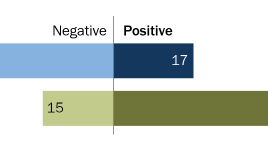
Just over half of U.S. teens say they’ve used chatbots for help with schoolwork, and 12% say they’ve gotten emotional support from these tools. Teens tend to view AI’s future impact on their lives more positively than negatively.
A majority of online adults can identify a strong password and know the risks of using public Wi-Fi. Yet, many struggle with more technical cybersecurity concepts.
India and China have long had a competitive relationship and have emerged as major economic powers. But in the digital space, China has a clear advantage.
More than a quarter of owners say they don’t use a screen lock or other security features to access their phone, but most are taking at least some steps for security.
Lee Rainie gave this speech about the new age of politics and media at Flagler College in St. Augustine, Florida on Feb. 16, 2017. He described what Donald Trump’s campaign and the dawn of the Trump presidency have taught us about the historic shifts in politics and media that have occurred in the last generation.
A unique study of Americans’ online news habits over the course of a week provides a detailed window into how Americans learn about current events in the digital age.
Lee Rainie, director of Internet, Science and Technology research at the Pew Research Center, discussed the Center’s latest findings on digital divides based a survey conducted from Sept. 29 to Nov. 6, 2016. The presentation was to the board of Feeding America. Rainie looked at differences tied to internet access, home broadband ownership, and smartphone ownership by several demographic measures, including household income, educational attainment, race and ethnicity, age, and community type. He also discussed the Center’s research related to “digital readiness gaps” among technology users.
Algorithms can save lives, make things easier and conquer chaos. But experts worry about governmental and corporate control of the data, and how algorithms can produce biased results and worsen digital divides.
Despite experiences and concerns involving digital privacy, many Americans are not following digital security best practices in their own personal lives.
Many Americans do not trust modern institutions to protect their personal data – even as they frequently neglect cybersecurity best practices in their own personal lives.
Most teens at least sometimes feel happy and peaceful when they don’t have their phone, but 44% say this makes them anxious. Half of parents say they have looked through their teen’s phone.
Most U.S. adults today say they use the internet (95%), have a smartphone (90%) or subscribe to high-speed internet at home (80%). About four-in-ten report being online almost constantly.