
As the U.S. population ages, the need for caregivers among older adults is on the rise. There’s growing evidence that family members are increasingly taking on these roles.
We surveyed 8,750 U.S. adults from Sept. 2-8, 2025, to learn about:
- The experiences of those who are caring for an aging parent
- The experiences of those who are caring for an aging spouse or partner
What we found is that the caregiving burden increases as aging family members get to be 75 and older. And, among Americans with an aging parent, spouse or partner, those with lower incomes are much more likely to be caregivers than those with middle and upper incomes.
In addition, providing regular care for an aging parent affects men and women differently, with women more likely to say it has a negative impact on their personal well-being.
This research is part of our ongoing effort to study how the U.S. is changing socially and demographically and how the public is reacting to these changes. It also builds on previous work we’ve done on older adults and aging.
Key takeaways
How many Americans are caring for an aging family member?
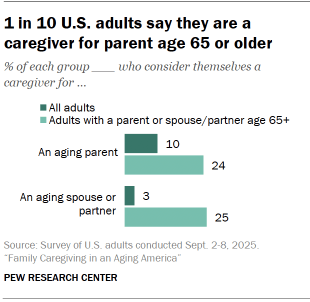
- 10% of all U.S. adults say they are a caregiver for a parent age 65 or older. Another 3% are caregivers for a spouse or partner age 65 or older. A very small share (less than 1%) say they care for an aging parent and an aging spouse or partner.
- The shares of Americans who see themselves as caregivers rise to 24% among those with a parent age 65 or older and 25% among those with an aging spouse or partner.
Who are the caregivers?
Among those with an aging parent, spouse or partner, some groups are more likely than others to be caregivers.
- Women: 28% of women who have an aging parent, spouse or partner consider themselves caregivers, compared with 23% of men.
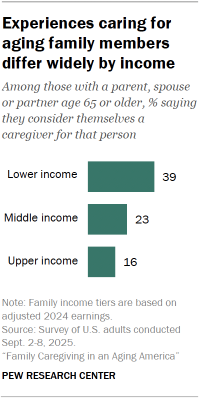
- Lower-income adults: 39% of lower-income adults with an aging parent, spouse or partner are caregivers, compared with 23% of middle-income adults and 16% of upper-income adults.
In addition, adults with a parent age 75 or older are more likely than those with a parent age 65 to 74 to be caregivers (31% vs. 16%). Similarly, 32% of those with spouse or partner age 75 or older are caregivers, compared with 21% of those with a spouse or partner age 65 to 74.
What do caregivers do for their aging family members?
Roughly two-thirds of adults who are caregivers for an aging parent (68%) and a similar share of those caring for an aging spouse or partner (66%) say they help that person with at least one of the following on a regular basis:
- Errands, housework or home repairs
- Managing their health care, such as medical appointments and medication
- Managing their finances, such as budgeting or paying bills on time
- Personal care, such as bathing or dressing
What’s the impact on caregivers?
The impact of caregiving differs depending on whether a person is providing support for an aging parent or for an aging spouse or partner.
Among those caring for an aging parent
Adults who are caring for an aging parent and regularly helping them with at least one of the tasks we asked about tend to report that this has had a more positive than negative impact on their relationship with their parent.
But, on balance, they say it’s had a more negative than positive impact on:
- Their emotional well-being
- Their physical health
- Their job or career (among those who have one)
- Their financial situation
- Their social life
Among those caring for an aging spouse or partner
Like their peers with aging parents, adults who are caring for an aging spouse or partner and regularly helping them with daily tasks report that this has had a more positive than negative impact on their relationship with their spouse or partner.
But views of the impact on their emotional well-being, physical health, financial situation and social life are more mixed, rather than mostly negative.
How do caregiving experiences differ for men and women?
Men and women who are caring for an aging parent are about equally likely to say helping them with daily tasks has had a positive impact on their relationship with their parent.
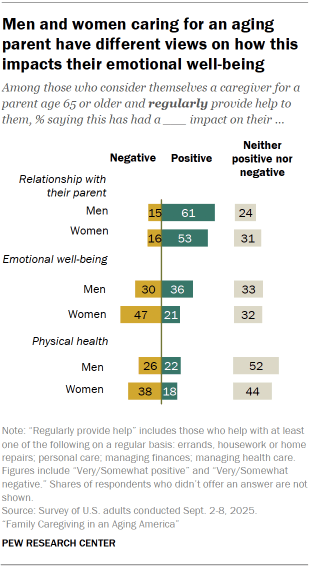
But women are more likely than men to say this has had a negative impact on their emotional well-being (47% vs. 30%) and their physical health (38% vs. 26%).1
Related: How Americans Are Thinking About Aging
Caring for an aging parent
We asked adults who consider themselves a caregiver for an aging parent how often they help their parent with various tasks.
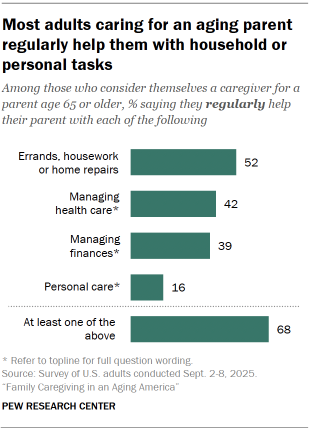
These caregivers most often help with errands, housework or home repairs. About half (52%) say they do this regularly.
Roughly four-in-ten say they regularly help their parent with:
- Managing their health care, such as scheduling medical appointments or helping manage medication (42%).
- Managing their finances, such as budgeting or paying bills on time (39%).
Some 16% say they regularly help their parent with personal care, such as bathing or dressing. An additional 15% say they do this from time to time.
About two-thirds (68%) say they help their parent with at least one of these things regularly.
How does this impact caregivers?
We asked adults who consider themselves a caregiver for an aging parent how this has impacted various aspects of their life.
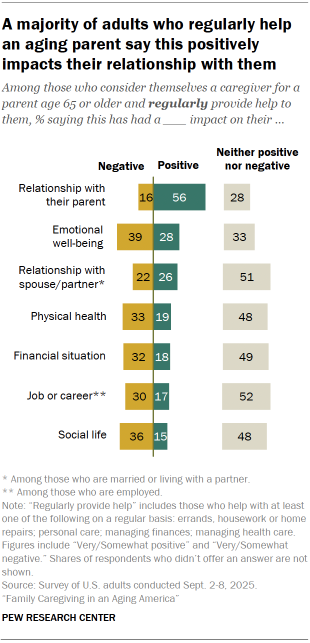
Among those who regularly help a parent with at least one of the tasks we asked about – errands or housework, personal care, managing finances, or managing health care – 56% say this has had a positive impact on their relationship with their parent. Some 16% say the impact has been negative, and 28% say it’s been neither positive nor negative.
Caregivers say helping their parent with these daily tasks has had a more negative than positive impact on:
- Their emotional well-being (39% negative vs. 28% positive)
- Their physical health (33% vs. 19%)
- Their financial situation (32% vs. 18%)
- Their job or career (30% vs. 17%, among those who are employed)
- Their social life (36% vs. 15%)
Caregivers have mixed views of the impact that helping their aging parent has had on their relationship with their spouse or partner (22% negative vs. 26% positive, among those who have a spouse or partner).
Differences by gender
Among caregivers who regularly provide help to an aging parent, men and women are about equally likely to say this has had a positive impact on their relationship with their parent.
But there are significant gender gaps when it comes to the impact on each of the following:
- Emotional well-being: 47% of women vs. 30% of men say caring for their parent has had a negative impact on their emotional well-being. Inversely, men are more likely than women to say the impact has been positive (36% vs. 21%).
- Physical health: 38% of women vs. 26% of men say the impact on their physical health has been negative.
Caring for an aging spouse or partner
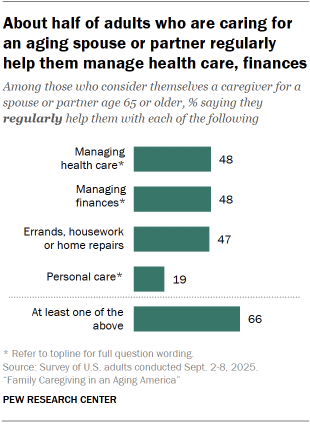
We asked adults who consider themselves a caregiver to an aging spouse or partner about the types of things they do to provide support.
- 48% regularly help their spouse or partner with managing health care.
- 48% help with managing finances.
- 47% help with errands, housework or home repairs.
- 19% help with personal care.
About two-thirds (66%) regularly help with at least one of these things.
How does this impact caregivers?
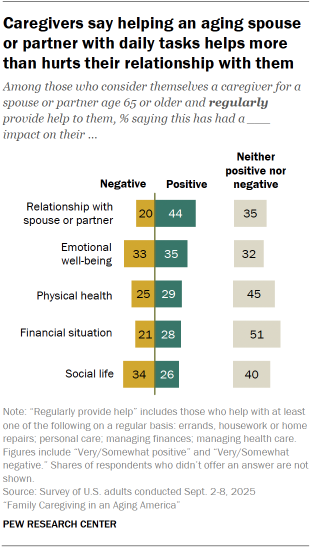
Among adults who are caring for an aging spouse or partner and regularly help with at least one of the tasks we asked about, 44% say this has had a positive impact on their relationship with their spouse or partner. Another 20% say the impact has been negative, and 35% say it’s been neither positive nor negative.
These caregivers are divided on the impact they feel in other aspects of their lives. Similar shares report positive and negative effects on:
- Their emotional well-being (35% positive and 33% negative)
- Their physical health (29% and 25%)
- Their financial situation (28% and 21%)
- Their social life (26% and 34%)


