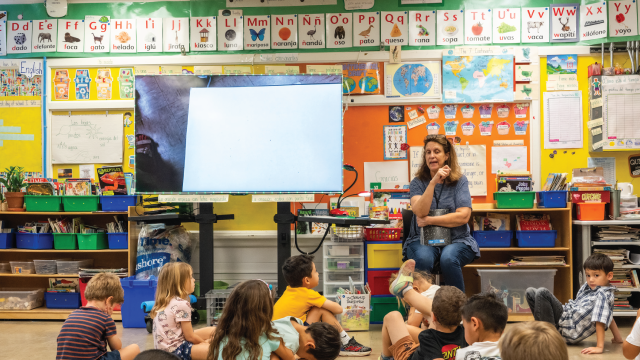
As children in the United States head back to school this fall, some of them will have world language classes on their schedules. More than four-in-ten K-12 public schools (43%) offer such language classes, according to a 2024 poll by the National Center for Education Statistics (NCES). That includes 20% of elementary schools and 82% of high schools.
In a Pew Research Center survey this spring, we asked 3,507 Americans about their attitudes toward language learning. Specifically, we asked whether it is important for children growing up in the U.S. to learn a language other than English, and which languages they think schools should offer.
Here are six findings about language learning in the U.S.:
Four-in-ten Americans say it is extremely or very important for children growing up in the U.S. to learn a language other than English. Another 38% say this is somewhat important, and 21% say it’s not too or not at all important.

| Response | % of U.S. adults |
|---|---|
| Extremely/Very important | 40 |
| Somewhat important | 38 |
| Not too/Not at all important | 21 |
| Don’t know/Refused | 1 |
Women are slightly more likely than men to say language learning is extremely or very important (42% vs. 38%). Adults with bachelor’s degrees are also more likely than adults with less education to say this (45% vs. 37%).
Additionally, U.S. adults who say they live in urban areas are particularly likely to say language learning is important (52%). Suburbanites (40%) are less likely to say this, and Americans who live in rural areas (28%) are the least likely.
More than half of Americans (53%) think it is highly important for U.S. schools to offer Spanish classes. That’s the highest share of any of the 10 languages we asked about.

| Extremely/Very | Somewhat | Not too/Not at all | |
|---|---|---|---|
| Spanish | 53 | 31 | 11 |
| Mandarin Chinese | 20 | 32 | 39 |
| Latin | 14 | 28 | 50 |
| French | 13 | 36 | 43 |
| Japanese | 11 | 32 | 49 |
| German | 10 | 33 | 48 |
| Arabic | 10 | 28 | 52 |
| Korean | 9 | 27 | 55 |
| Russian | 9 | 23 | 59 |
| Hindi | 7 | 22 | 61 |
Spanish is the second-most common language spoken at home in the U.S., after English. Among those ages 5 and older, 14% of the U.S. population speaks Spanish at home, according to the Census Bureau’s 2024 American Community Survey (ACS). Another 77% speak only English at home.
Mandarin (Chinese) comes up next in our survey. One-in-five Americans say it is important that U.S. schools offer it. But ACS estimates only around 1% of Americans speak Chinese languages, including Mandarin and Cantonese, at home.
Democrats are about twice as likely as Republicans to say learning a language other than English is extremely or very important. Among Democrats and independents who lean toward the Democratic Party, 52% say this, compared with 27% of Republicans and Republican leaners. This difference persists even when controlling for factors like age, gender, education, urbanicity, ethnicity and place of birth.
Democrats are also more likely than Republicans to say it is extremely or very important that U.S. schools offer each of the languages we asked about. The gap is the largest for Spanish.

| Rep/Lean Rep | Dem/Lean Dem | Dem-Rep diff | Grouping | |
|---|---|---|---|---|
| For U.S. children to learn a language other than English | 27 | 52 | 25 | Question |
| Spanish | 39 | 66 | 27 | Language |
| Mandarin Chinese | 12 | 28 | 16 | Language |
| French | 7 | 19 | 12 | Language |
| Arabic | 5 | 14 | 9 | Language |
| Japanese | 7 | 15 | 8 | Language |
| Hindi | 3 | 10 | 7 | Language |
| German | 7 | 13 | 6 | Language |
| Korean | 5 | 11 | 6 | Language |
| Latin | 11 | 16 | 5 | Language |
| Russian | 6 | 11 | 5 | Language |
There are some differences between the languages Americans think schools should teach and those that U.S. public schools offer. For example, 20% of U.S. adults in our survey say it’s important for schools to offer Mandarin Chinese as a language class, but only 3% of K-12 public schools offer Mandarin or Cantonese as an independent class, according to the 2024 NCES survey.
Meanwhile, Spanish is the world language that Americans think is most important for schools to offer, and it’s the most commonly taught. Four-in-ten K-12 public schools teach it as an independent class, including 79% of public high schools.
French is the second-most common language that U.S. public schools teach. But Americans say it’s less important to offer than Mandarin Chinese and about as important to offer as Latin.
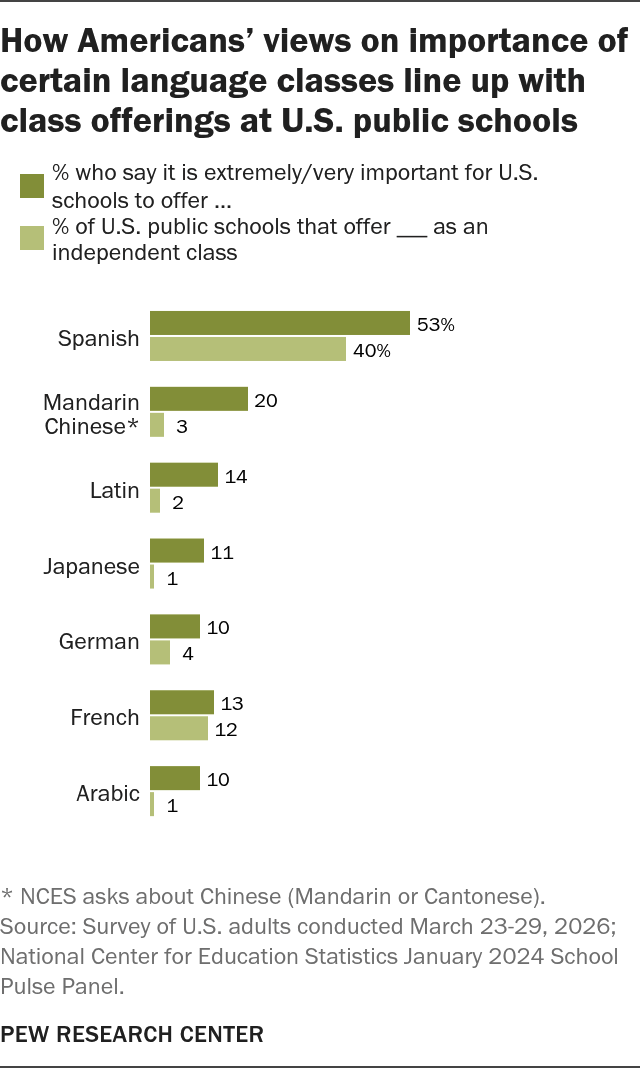
| % who say it is extremely/very important for U.S. schools to offer … | % of U.S. public schools that offer __ as an independent class | |
|---|---|---|
| Spanish | 53 | 40 |
| Mandarin Chinese* | 20 | 3 |
| Latin | 14 | 2 |
| French | 13 | 12 |
| Japanese | 11 | 1 |
| German | 10 | 4 |
| Arabic | 10 | 1 |
Immigrants and Americans born in Puerto Rico are nearly twice as likely as those born elsewhere in the U.S. to say children learning a language other than English is extremely or very important (60% vs. 36%). There is a similar pattern when it comes to learning some specific languages, such as Spanish and Mandarin Chinese.
Among U.S.-born adults, second-generation Americans are more likely than third- or higher-generation Americans to say learning a language other than English is important (49% vs. 33%).

| Extremely/Very | Somewhat | Not too/Not at all | Grouping | |
|---|---|---|---|---|
| Immigrant | 60 | 27 | 12 | Birth |
| U.S. born | 36 | 40 | 24 | Birth |
| 2nd generation | 49 | 34 | 15 | Gen |
| 3rd or higher gen. | 33 | 41 | 25 | Gen |
People’s opinions of the importance of learning a language other than English vary by how they see the United States’ global power and influence. In general, those who see the U.S. as less powerful tend to say learning another language is more important.
We asked U.S. adults an open-ended question: “What country or countries are global superpowers, where ‘superpower’ means a country that is both militarily and economically dominant?”
- 27% of Americans who see the U.S. as the sole global superpower say learning a language other than English is extremely or very important.
- 43% of people who see the U.S. as one of several global superpowers say learning another language is important.
- 51% of people who do not name the U.S. as a superpower say learning another language is important.
Related: Which countries do Americans consider global ‘superpowers,’ and how many are there?
Along the same lines, Americans who think their country’s influence in the world is waning (51%) are more likely than those who think U.S. influence is getting stronger (31%) or staying the same (34%) to say U.S. children should learn a language other than English.
Similarly, 23% of people who say China’s influence is growing say it’s important for U.S. schools to offer Mandarin Chinese, compared with 18% of those who say China is getting weaker and 12% who say China’s influence is staying the same.
Note: Here are the survey questions used for this analysis, the detailed responses and the survey methodology.