As we do every year, we’ve gathered data around some of the most pivotal news stories of 2025, including President Donald Trump’s return to the White House, the changing U.S. immigration landscape and the rapid rise of artificial intelligence worldwide.
Here’s a look back at 2025 through 12 of Pew Research Center’s most striking research findings. This is just a small slice of the Center’s research publications this year.
Related: Our favorite data visualizations of 2025
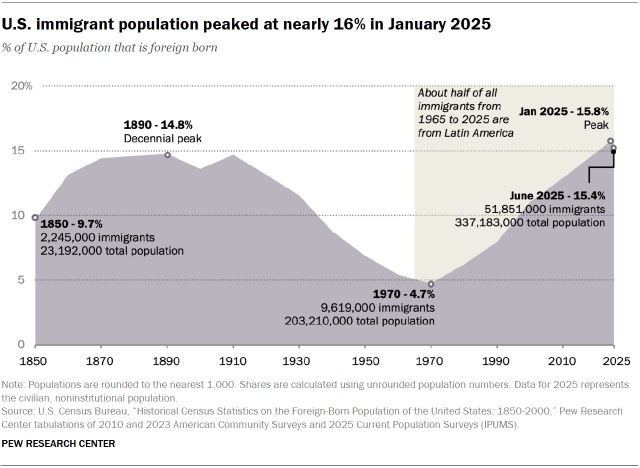
After more than 50 years of rapid growth, the number of immigrants living in the United States is on the decline. In January 2025, there were 53.3 million immigrants in the U.S., making up close to 16% of the country’s population. Both the number and the share were record highs. But by June 2025, the nation’s immigrant population decreased by more than a million, to 51.9 million. That decline has likely continued since, due to deportations, voluntary departures and fewer new arrivals.
Most immigrants are in the U.S. legally. As of 2023, 73% were either naturalized American citizens, lawful permanent residents or temporary lawful residents. The remaining 27% were unauthorized immigrants.
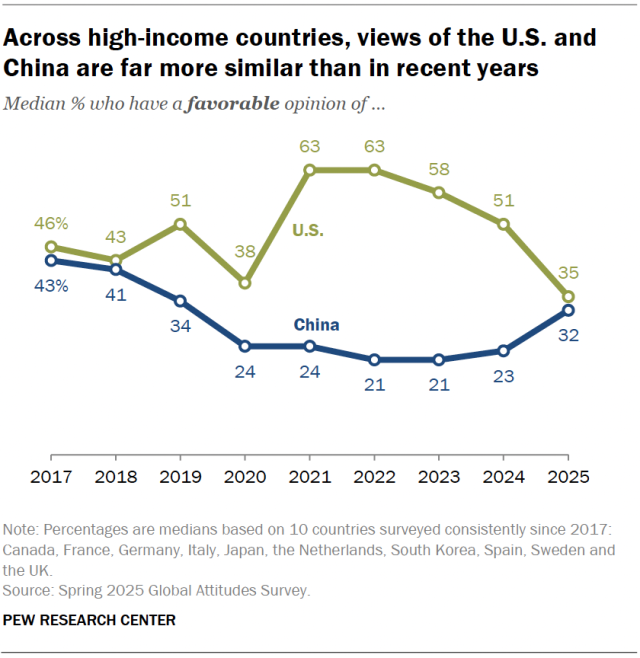
Views of the U.S. have worsened – and views of China have improved – across many of the 10 high-income countries we surveyed this year. Across these countries, a median of 35% of adults now say they have a favorable opinion of the U.S., while 32% say the same about China. These shares are the closest they’ve been since 2018.
There is a similar pattern when it comes to confidence in U.S. and Chinese leaders to do the right thing regarding world affairs. A median of 22% of adults in the 10 high-income countries surveyed have confidence in Trump, while 24% express confidence in Chinese President Xi Jinping. Their median confidence in former U.S. President Joe Biden was consistently higher than their confidence in Xi.
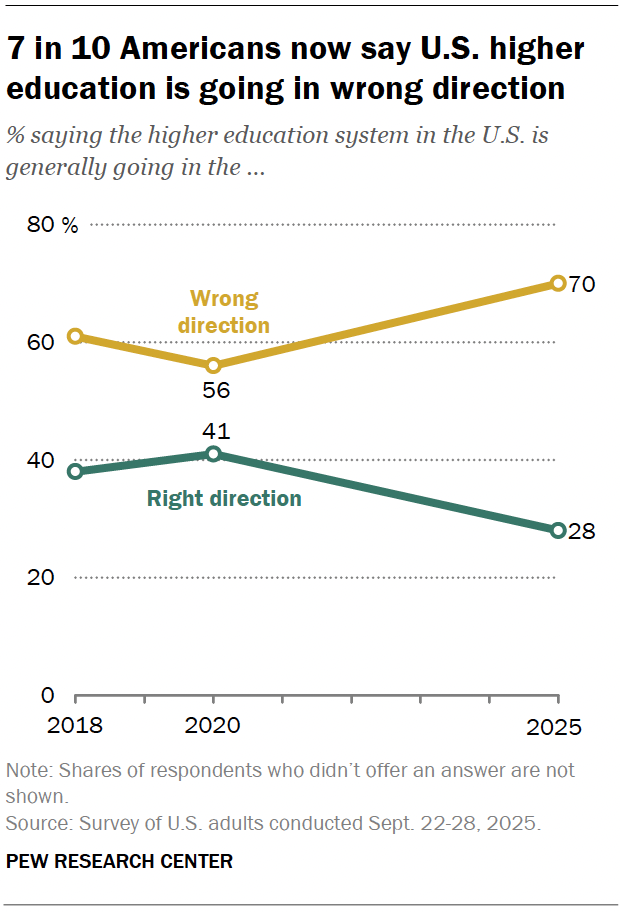
Seven-in-ten Americans now say the U.S. higher education system is generally going in the wrong direction – up from 56% in 2020. Views of the nation’s colleges and universities have turned more negative among Republicans and Democrats alike. (In this analysis, Republicans and Democrats include independents who lean toward each party.)
Many Americans give these institutions broadly negative ratings in specific areas. For example, 79% of U.S. adults say colleges are doing an only fair or poor job of keeping tuition costs affordable, and 55% say this about preparing students for jobs in today’s economy.
Americans have grown more critical of the widespread legalization of sports betting, and this is especially the case among young men.
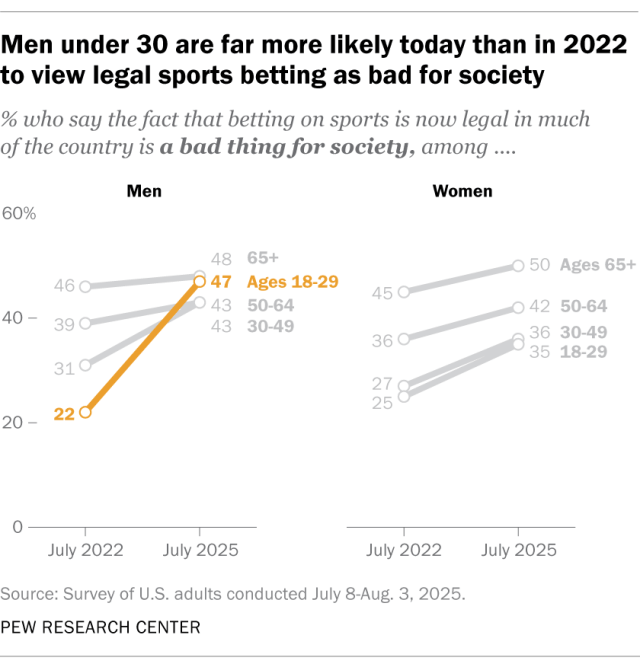
Overall, 43% of U.S. adults say the fact that sports betting is now legal in much of the country is a bad thing for society, up from 34% in 2022. And 40% say it’s a bad thing for sports, up from 33%.
One of the biggest shifts in attitudes has occurred among men under 30. In this group, 47% say legal sports betting is a bad thing for society, an increase from 22% in 2022. For women under 30, the shift is smaller: 35% now see legal sports betting as bad for society, up from 25%.
A substantial share of men under 30 (36%) also say they have personally placed a sports bet in the past year.
Around seven-in-ten Americans (69%) say Trump is trying to exert more power than his predecessors, according to a Center survey from September.
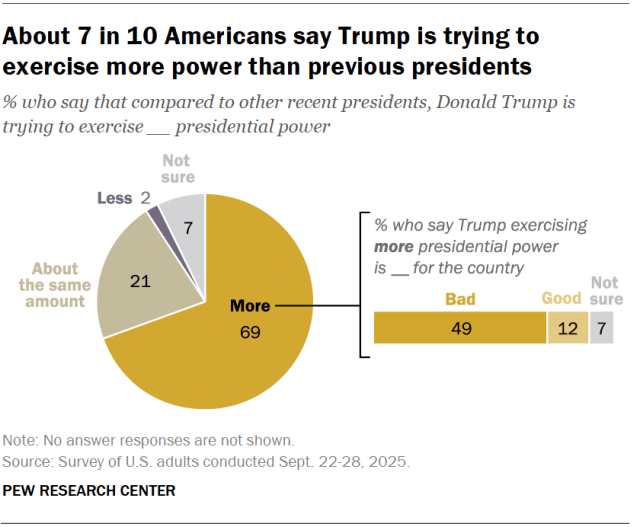
Most of those who say this view it as a bad thing for the country. Overall, 49% of U.S. adults say Trump is trying to exercise more presidential power than previous presidents and that this is bad for the country.
Democrats overwhelmingly say Trump is trying to exert more executive power and that this is bad (83%). Republicans are more divided: About half (49%) say Trump is trying to exert more power, and among those who say this, more say it’s good for the country than say it’s bad.
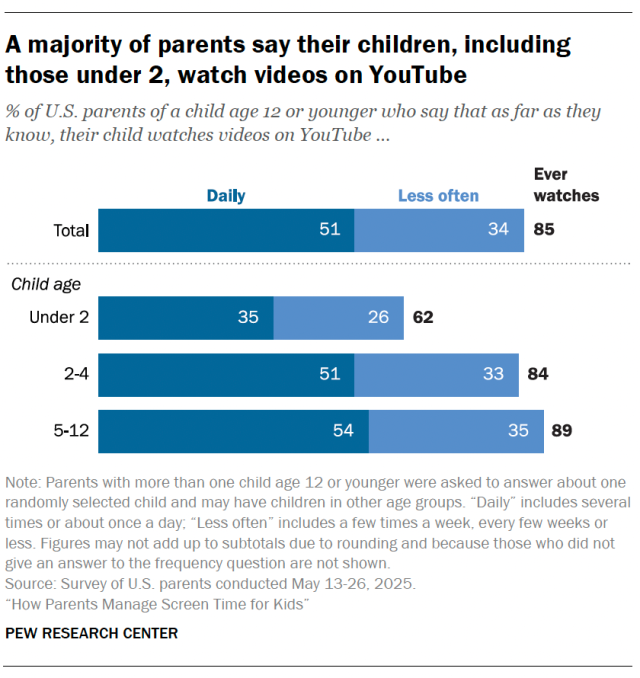
A majority of parents with a child under 2 say their child watches videos on YouTube. Some 62% of parents with a child under 2 say their child ever does this, up from 45% in 2020.
A growing share of parents with a child under 2 also say their child watches YouTube videos daily: 35% say this, up from 24% five years ago. Daily use is also up among kids ages 2 to 4, according to their parents (51%, up from 38%). But it’s stable among children in other age groups.
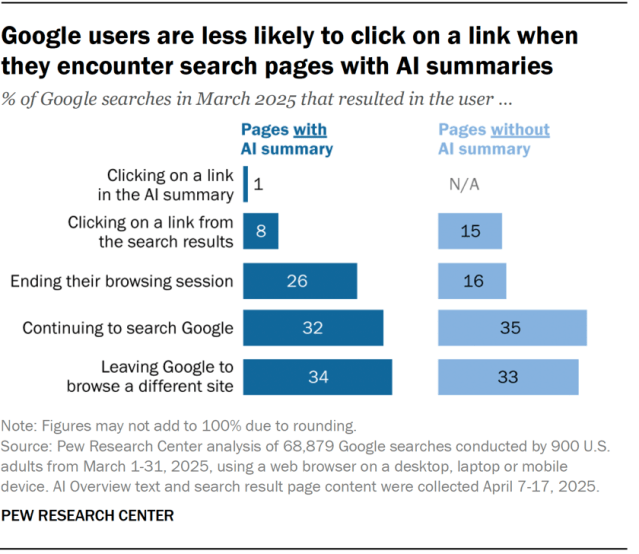
Google users who encounter a Google AI Overview are about half as likely as users who don’t to click on search results. Users who landed on a Google search page with an AI summary clicked on a search result 8% of the time. Those who did not encounter an AI summary clicked on a search result 15% of the time, according to our analysis of data from U.S. adults who agreed to share their March 2025 web browsing activity.
People who encountered the summaries – which Google introduced in 2024 – very rarely clicked on the sources cited, and they were more likely than those who didn’t see summaries to end their browsing session entirely.
Republicans have become much less likely to say healthy children should be required to get the measles, mumps and rubella (MMR) vaccine to attend public school. Around half of Republicans (52%) now hold this view, down significantly from 79% in 2019. The share of Democrats who support school MMR requirements (86%) has not changed.
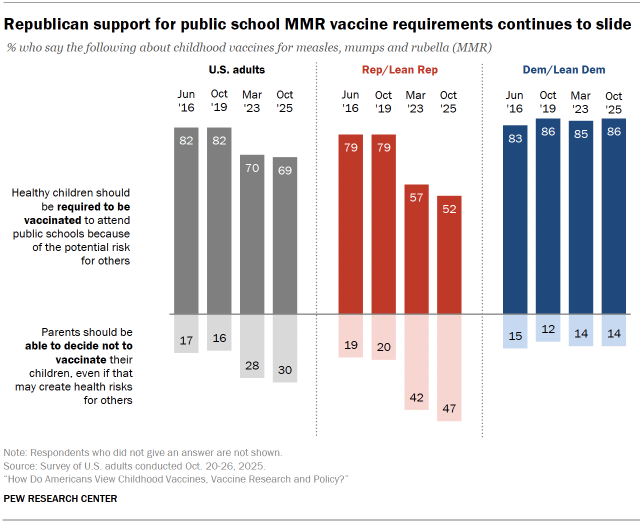
Our broader survey on childhood vaccines found that Republicans are divided over some aspects of vaccine safety. For instance, 32% of Republicans are highly confident that the childhood vaccine schedule is safe, while 31% are not too or not at all confident. A 71% majority of Democrats are highly confident.
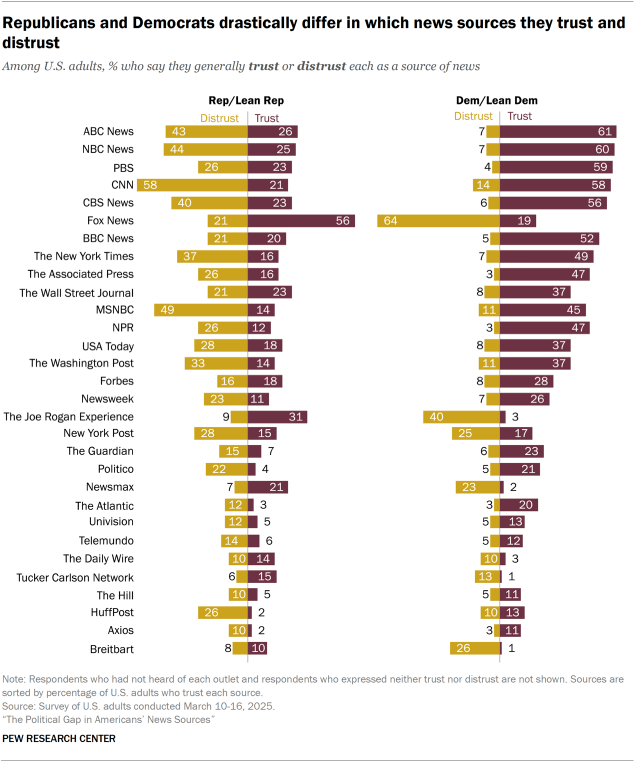
Partisans differ sharply on which news sources they trust, especially when it comes to Fox News and CNN. More than half of Republicans (56%) say they trust Fox News, but 64% of Democrats say they distrust it. The reverse is true for CNN: 58% of Democrats trust it, while the same share of Republicans distrust it.
Fox News stands out among the 30 news sources we asked about because it is the only one that a majority of Republicans trust. Democrats tend to trust a much broader range of sources.
For the first time in nearly two decades of our national surveys of U.S. Hispanics, most say Hispanics’ situation in the country has worsened over the past year. About seven-in-ten Latinos (68%) now express this view, up sharply from 26% in 2021 during the Biden administration and 39% in 2019 during the first Trump administration. In the most recent survey, 9% of Latinos say their group’s situation is better than it was a year ago, and 22% say it’s about the same.
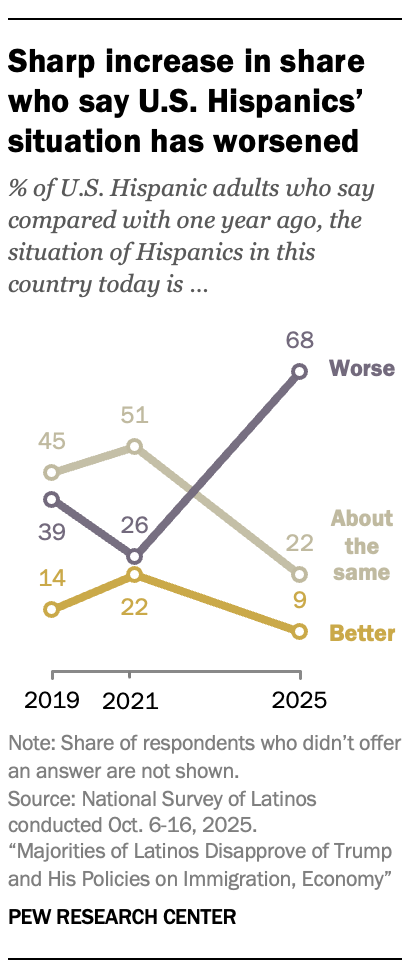
About a third of Latinos (32%) also say they’ve recently thought about moving to another country. Among those who have considered this, the most commonly cited reason is the political situation in the U.S.
Sub-Saharan Africa is now home to more Christians than any other world region, surpassing Europe. As of 2020, about 31% of the world’s Christians live in sub-Saharan Africa, while 22% live in Europe. This change has been fueled by Africa’s much higher fertility rates, but also by widespread disaffiliation from Christianity in Western Europe.
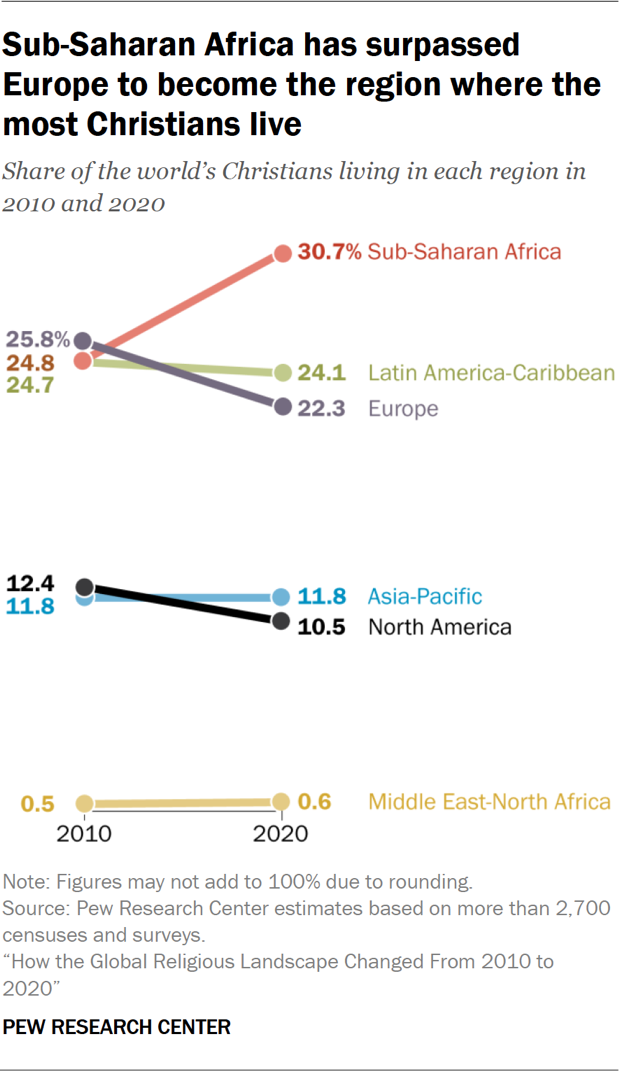
Christianity remains the world’s largest religion. But Islam was the fastest-growing religion between 2010 and 2020, among the seven groups Pew Research Center has measured globally over time. The global Muslim population increased by 347 million people during that span (to 2.0 billion), while the Christian population grew by 122 million (to 2.3 billion).
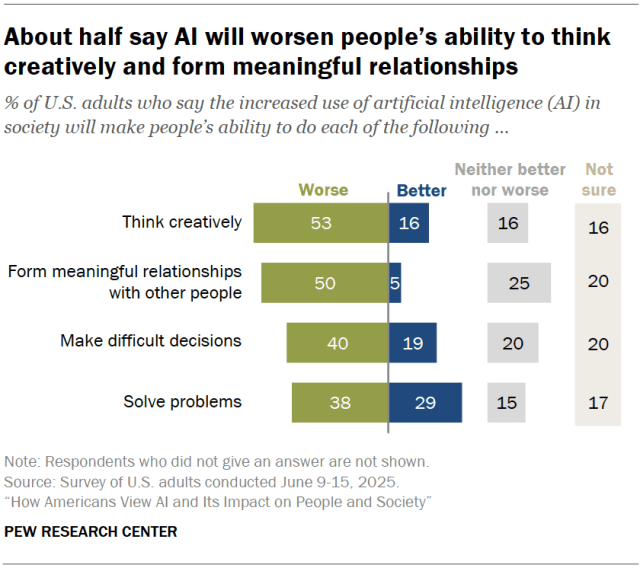
Americans are far more pessimistic than optimistic about the effect AI will have on human creativity and connection. About half (53%) say AI will worsen people’s ability to think creatively, while 16% say it will improve this. And 50% say it will worsen people’s ability to form meaningful relationships with others, while only 5% say it will make this better.
As generative AI technology continues to improve, most Americans (76%) say it’s extremely or very important for them to be able to distinguish between content made by AI and by people. But 53% are not too or not at all confident that they can personally tell the difference; just 12% are highly confident.