
Key takeaways:
- Health care providers are a key source for health information: 85% of Americans say they get health information from health care providers at least sometimes, making them the most common of seven sources we asked about. And a majority see them as providing information that is highly accurate.
- Many Americans also want to hear people’s real-life stories. About two-thirds (66%) say they get health information at least sometimes from people experiencing a similar health issue as them.
- Smaller shares are getting health information at least sometimes from newer sources like social media (36%) and artificial intelligence (AI) chatbots (22%).
- Half of Americans struggle to determine the accuracy of health information: 12% say it is extremely or very difficult to know if the health information they come across is accurate, and 38% say it is somewhat difficult.
- Most Americans say they come across conflicting health information. And when they do, 54% say it is at least somewhat difficult to know which information to trust.
In an era with unprecedented access to health information, the vast majority of Americans still turn to health care providers for health information, according to a new Pew Research Center study. Many also look to major health websites such as WebMD.
But Americans’ health sources aren’t limited to medical experts. Many Americans (66%) also learn from others going through similar health experiences. And some get health information from social media (36%) or AI chatbots (22%) at least sometimes.
Within this landscape, Americans don’t always find it easy to determine what information is trustworthy. Half of Americans say it is at least somewhat difficult to judge if health information is accurate, and a similar share (54%) has a hard time knowing what to trust when they come across conflicting health information.
Overall, however, Americans are more likely to have confidence in the accuracy of the health information they get from health care providers and major health websites compared with other sources.
These findings are from a survey of 5,111 U.S. adults conducted from Oct. 20 to 26, 2025. Building on our body of work around Americans’ views of medicine and health, we did this study to understand how Americans make sense of today’s crowded health information environment in a moment in which the number of potential sources of health information are expanding. The study explores what Americans want from their health sources and how Americans view their own health, including challenges to their health.
This study covers Americans’ views on the following topics:
- What do Americans want from their health information sources?
- Users of social media and AI chatbots for health information are more likely to say they are convenient than accurate
- Americans value their health – but many face challenges in taking care of it
- Roughly a third of young adults have negative views of their mental health
Americans’ sources of health information
Americans hear about health from a wide array of people, platforms and institutions, some beyond the medical establishment. But when asked how often they get health information from each of the seven sources we asked about, health care providers are at the top of the list.
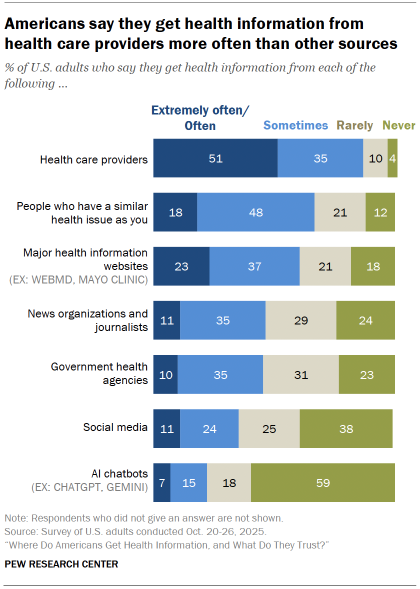
The vast majority of Americans (85%) say they at least sometimes get health information from health care providers, including 51% who say they often or extremely often turn to doctors and other medical workers.
A majority of Americans (60%) also say they turn to major health websites, such as WebMD or Mayo Clinic at least sometimes.
But in addition to these medical sources, many Americans also learn from other people who share their health experiences. Roughly two-thirds (66%) of Americans say they at least sometimes get health information from people who are facing health issues that are similar to their own.
Just under half of Americans get health information at least sometimes from journalists and news organizations (46%) and government health agencies (45%). Meanwhile, social media and AI chatbots — two newer digital information sources – are the least common sources of health information we asked about. Still, 36% of Americans say they at least sometimes get health information from social media, and 22% say the same about AI chatbots.
For a detailed analysis of Americans’ views of the health information they get from these sources, refer to “Users of social media and AI chatbots for health information are more likely to say they are convenient than accurate.”
Overall, getting health information from multiple sources is the norm: Most Americans (73%) say they get health information at least sometimes from three or more of the seven sources we asked about.
Differences by health insurance coverage, education and age
Health insurance coverage: While large shares of Americans regardless of health insurance status say they get health information from health care providers, those with health insurance coverage are more likely to do so. But people without coverage are more likely than those with coverage to turn to social media and AI chatbots, although at much lower rates overall.
Education: Americans with more formal education are more likely than those with less formal education to get health information at least sometimes from most of the sources we asked about. These differences are widest on major health information websites. However, there are no education differences on the frequency of getting information from people with a similar health issue and from social media.
Age: Older adults are more likely than younger Americans to say they at least sometimes get health information from health care providers (though providers are the most common source across age groups). Younger adults are more likely than their older peers to turn to social media and AI chatbots at least sometimes.
Further demographic details on Americans’ health information sources are in the appendix.
How Americans view the accuracy of health information sources they use
The sheer volume of health information can be overwhelming, and it’s not always easy to decide which sources get the facts right. To get a sense of how Americans navigate this environment, we asked them to rate the accuracy of the information they get from each source.
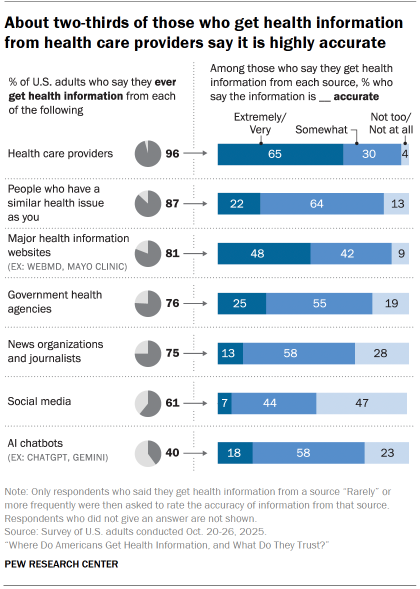
Nearly all Americans get health information from health care providers, and a majority find this information highly accurate – much more than any other source.
About two-thirds (65%) of those who ever get health information from providers say the information is extremely or very accurate. Very few (4%) say it is not too or not at all accurate.
Views of the accuracy of information on websites such as WebMD or Mayo Clinic are also generally positive. About half (48%) of those who get health information from these websites say they’re highly accurate, far more than the 9% who say the information is not too or not at all accurate.
Social media stands out for the lowest ratings of accuracy. Roughly half (47%) of Americans who get health information from social media say that information is not too or not at all accurate, while just 7% say it is highly accurate. Views of health information from AI chatbots are more mixed, with a majority of those who turn to them saying the information is somewhat accurate.
Here’s our in-depth look at views of social media and AI chatbots as health information sources.
Notably, for each of the seven sources we asked about, sizable shares give mixed ratings saying the information is somewhat accurate.
Differences by education, income, party and health insurance coverage
Education and income: Americans with more education or higher incomes are more likely to say information they get from health care providers and major health websites is highly accurate.
Party: Three-quarters of Democrats and Democratic-leaning independents rate the information they get from health care providers as highly accurate. This is more than the share of Republicans and leaners who say the same (58%). This pattern of Democrats having more confidence than Republicans in the accuracy of the sources they use extends to major health websites (55% vs. 42%), government health agencies (29% vs. 20%) and news organizations and journalists (19% vs. 6%).
Health insurance coverage: Those with health insurance are more likely than those without insurance to say the information they get from health care providers is highly accurate (67% vs. 47%). They are also more likely to say the same about information they get from major health websites (50% vs. 31%).
For more detailed demographic breakdowns, refer to the appendix.
Do Americans have difficulty determining if health information is accurate?
Americans have mixed experiences judging the accuracy of health information they get in general – regardless of the source.
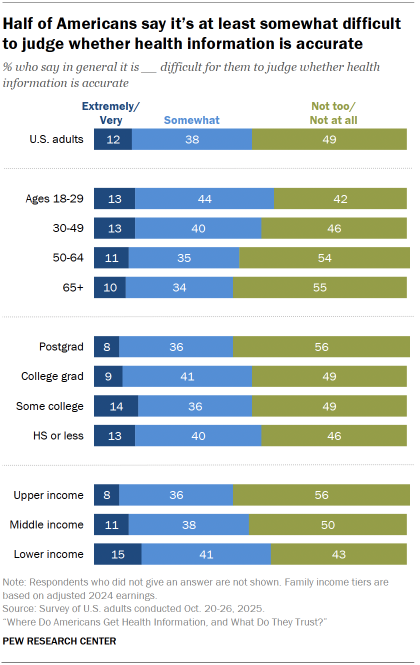
Half of Americans say it is at least somewhat difficult to judge the accuracy of health information, including 12% who say this is extremely or very difficult. On the other hand, 49% say it is not too or not at all difficult to make this judgment.
These challenges are reported across demographic groups, with at least four-in-ten adults in each age, education and income group saying judging health information accuracy is at least somewhat difficult. Still, some key differences emerge:
Younger adults are somewhat more likely than their older counterparts to have at least some difficulty evaluating accuracy. For example, 57% of adults under 30 say this, compared with 44% of those ages 65 and older.
Americans with lower incomes are also more likely to report at least some difficulty judging the accuracy of health information. And while education differences are modest, Americans with a postgraduate degree are less likely than those with lower education levels to say they find judging the accuracy of health information at least somewhat difficult.
Coming across conflicting health information
When Americans get health information, they sometimes have to weigh it against something they’ve already heard that seems contradictory. Is chocolate good or bad for you? Will a health product cure an ailment or make it worse?
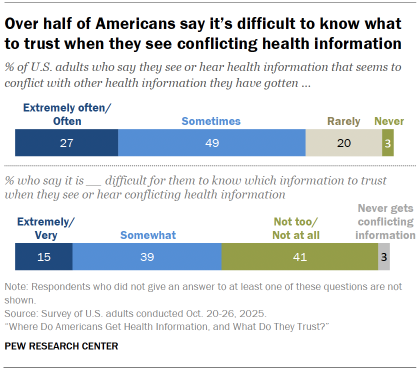
A large majority of Americans (76%) say they see this kind of conflicting health information at least sometimes, including about a quarter (27%) who see it often or extremely often.
When Americans do encounter conflicting health information, just over half (54%) say they have at least some difficulty knowing which information to trust. This share is larger than the 41% of Americans who say knowing which information to trust is not too or not at all difficult.
As with judging the accuracy of health information they come across in general, older Americans and those with more income or education report fewer difficulties. For more demographic details, refer to the appendix.
Americans who see conflicting health information more frequently have more difficulty knowing which source to trust. Those who come across conflicting health information often or extremely often (71%) are more likely than those who come across it sometimes (58%) or rarely (32%) to say it is at least somewhat difficult for them to know which information to trust.


