
Key takeaways:
- Three-quarters of Americans say it’s highly important that their health information sources have medical training. Similar shares say the same for being transparent about potential conflicts of interest (73%) and being easy to understand (72%).
- When asked to rate sources of health information, health care providers get the best ratings overall. Roughly half or more of Americans who get health information from health care providers say it is extremely or very easy to understand (55%), personalized (52%) and convenient to get (49%).
- Beyond health care providers, a few sources stand out as being extremely or very easy to understand: Roughly four-in-ten or more Americans who get health information from people facing similar health issues as them (44%), major health information websites (42%) and artificial intelligence (AI) chatbots (41%) say this.
- For many of the sources we asked about, such as social media, news organizations and government health agencies, far more say the information they get is not personalized to them than say it is highly personalized.
Americans have choices for where they get their health information, but what qualities are they looking for in those sources? A Pew Research Center survey finds that most say having medical training, being transparent and easy to understand are highly important.
We also asked Americans to rate the information they get from seven common sources of health information by how understandable, personalized and convenient they are to access. Health care providers receive positive ratings on each of these qualities, consistent with Americans saying they highly value medical training. And Americans give similarly high marks to AI chatbots, major health websites and peers with similar health issues on at least one of these measures.
This is not the case when it comes to accuracy. Health care provider information consumers rate the information they get as highly accurate, but users of other sources are less likely to rate the information they get as highly accurate.
For more details about how Americans rate each source on accuracy, refer to our analysis of where Americans get health information and what they trust.
This study is part of a larger survey on Americans’ health information sources and views on their personal health, conducted Oct. 20-26, 2025, among 5,111 U.S. adults.
The characteristics Americans look for in sources of health information
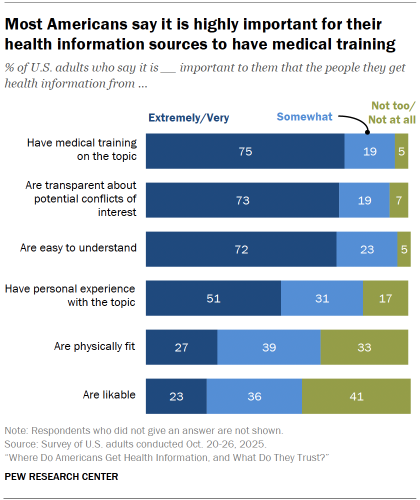
Most Americans are generally looking for expertise, transparency and clarity when they get health information. Roughly three-quarters say it is extremely or very important that the people they get health information from have relevant medical training (75%), are transparent about any conflicts of interest (73%) and are easy to understand (72%).
About half (51%) of U.S. adults place high value on their sources having personal experience with the health issue they are giving information about.
Smaller shares say these people’s physical fitness (27%) and likability (23%) are extremely or very important, while at least a third say these characteristics are not too or not at all important.
Differences by age, education, income and party
Age: Older adults are more likely than younger adults to say being easy to understand is extremely or very important in their health information sources. For example, adults ages 65 and older are more likely than those under 30 to say this is highly important (82% vs. 59%). Age differences between older and younger adults are more modest for all other characteristics we asked about.
Education and income: Adults with higher levels of formal education or income are especially likely to value transparency and medical training in their health information sources. Conversely, those with less formal education or lower incomes are more likely to say likability is extremely or very important compared with those with higher education or income.
Party: Majorities of both Republicans and Democrats say it is highly important for their sources to have medical training, but more Democrats than Republicans say this (82% vs. 71%). And while far smaller shares say it is highly important for those sources to be physically fit, more Republicans than Democrats hold this view (33% vs. 21%). For all other characteristics we asked about, there are no differences between Republicans and Democrats.
For more details on each of these differences, refer to the appendix.
Rating health information sources on ease of understanding, convenience and personalization
In addition to asking Americans about the characteristics they value in their health information sources, we also asked how often they get health information from seven sources. Each source’s health information consumers were asked to rate how easy to understand, convenient to get and personalized the information is. We also asked Americans to rate the accuracy of the sources they use for health information. (For more about ratings of accuracy, read “Where do Americans get health information, and what do they trust?”)
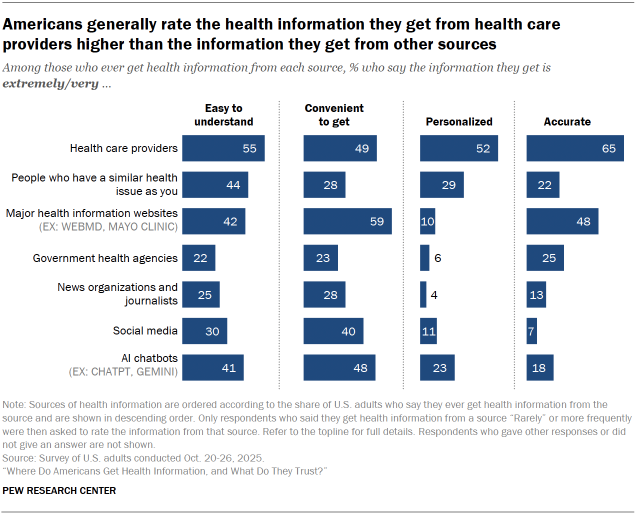
Roughly half or more of adults who get health information from health care providers say it is highly easy to understand, convenient to get, personalized and accurate. In general, no other sources gets as high marks across the board. And aside from health care providers, views are particularly negative when it comes to ratings of how personalized the information is.
How easy to understand are common health information sources?
Americans rate health care providers ahead of other health information sources when it comes to how easy they are to understand. A slim majority (55%) of Americans who get health information from health care providers say it is extremely or very easy to understand.
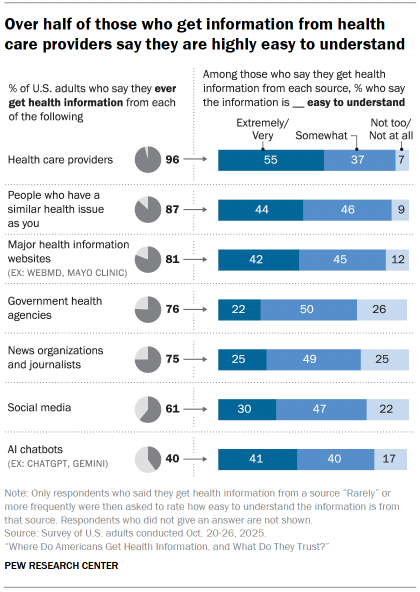
But at least four-in-ten also think the information they get from several other sources is easy to understand, including people with similar health issues (44%), major health websites (42%), and AI chatbots (41%). And for each of these sources, the share who say this is more than double the share who say the information is not too or not at all easy to understand.
Smaller shares of adults who get health information from social media, news organizations and journalists or government health agencies say the health information from those sources is extremely or very easy to understand. In the cases of news organizations and government health agencies, similar shares say the information is not too or not at all easy to understand.
And overall, sizable shares express mixed views on each source. Roughly four-in-ten or more health information consumers say this information is somewhat easy to understand.
Differences by age
- Among those who get health information from AI chatbots and social media, adults under 50 are more likely than those 50 and older to say the information they get from these sources is easy to understand (47% vs. 31% for AI chatbots and 35% vs. 21% for social media).
- Among those who get health information from health care providers, adults ages 50 and older are more likely than those under 50 to say the information is extremely or very easy to understand (60% vs. 50%).
Differences by education
- For each source that we asked about, adults with at least a four-year college degree are more likely than those without a four-year degree to say the information they get is extremely or very easy to understand.
- For example, there are education gaps in ratings of understandability among those who get information from AI chatbots (52% vs. 35%) and major health information websites (50% vs. 36%).
For additional demographic details, refer to the appendix.
How convenient is it to get health information from each source?
More users of major health websites find them highly convenient than any other source we asked about. A majority (59%) of Americans who get health information from this source say it is extremely or very convenient to get.
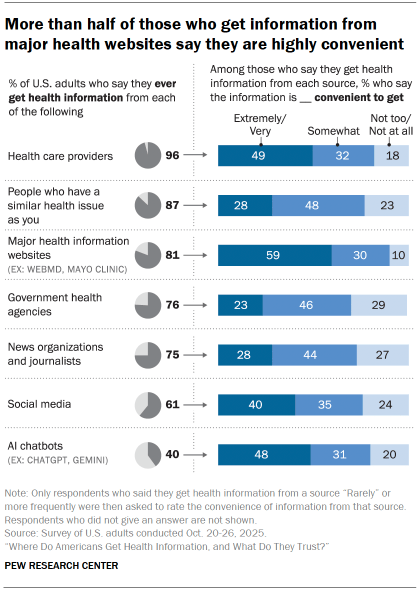
Roughly half of those who get health information from health care providers (49%) and AI chatbots (48%) say it is highly convenient to get, though far more Americans get this kind of information from health care providers than chatbots.
A slightly smaller share of Americans who get health information on social media (40%) say it is highly convenient to do so.
And for each of these four sources, larger shares say the information they get is extremely or very convenient to get than say it is not too or not at all convenient.
Fewer say that news organizations (28%), people with similar health conditions (28%) and government health agencies (23%) offer health information in a highly convenient way. For these sources, similar shares say the information they get is not too or not at all convenient.
And similar to ratings of understandability, sizable shares have mixed views of each source’s convenience. At least three-in-ten say the information they get from each of these sources is somewhat convenient to get.
Differences by age
- Among those who get health information from health care providers, adults ages 50 and older are more likely than those under 50 to say the information is extremely or very convenient to get (59% vs. 40%).
- Among those who get health information from social media, adults under 50 are more likely than those 50 and older to say the information is highly convenient to get (45% vs. 33%).
Differences by education
Those who have a four-year college degree are more likely than those who do not to say the information they get from major health websites is highly convenient (69% vs. 54%). There’s a similar pattern for other sources we asked about:
- AI chatbots (61% vs. 40%)
- Social media (49% vs. 36%)
- News organizations (33% vs. 25%)
These differences are largely driven by those with a high school degree or less education giving low ratings.
Differences by health insurance coverage
- Adults who are covered by health insurance are more likely than those who are not covered to say the health information they get from health care providers is extremely or very convenient to get (51% vs. 31%).
- Those without health insurance coverage are more likely than those with coverage to say the information they get from people facing a similar health issue is extremely or very convenient to get (36% vs. 27%).
For additional demographic details, refer to the appendix.
How personalized is the information from each source?
While Americans generally give more positive than negative ratings to many of the sources we asked about, this is not the case on the question of whether this information is personalized.
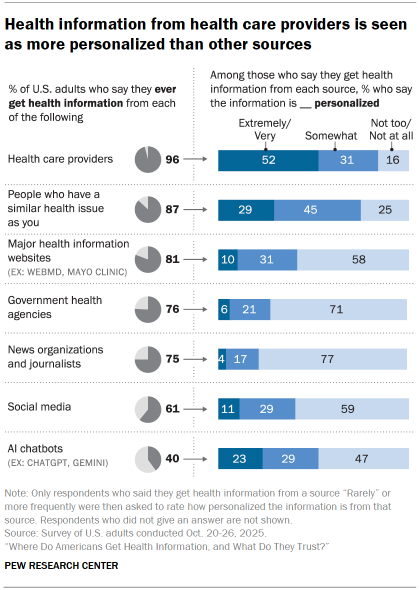
When it comes to news organizations, government health agencies, social media and major health websites, majorities say the health information they get is not too or not at all personalized. About one-in-ten or fewer in each case say the information is highly personalized.
AI chatbots generate unique messages in each conversation, and 23% of those who get health information this way say it is extremely or very personalized. Still, roughly half (47%) say health information they get from chatbots is not too or not at all personalized. For more on views of AI chatbots as a source of health information, refer to “Users of social media and AI chatbots for health information are more likely to say they are convenient than accurate.”
Americans view information from health care providers as much more personalized. About half (52%) of those who get information from providers say it is highly personalized, and far fewer (16%) say it is not too or not at all personalized.
Differences by age
- Among those who get health information from health care providers, those ages 65 and older are more likely than all younger age groups to say the information they get is highly personalized (61% of those 65 and older, compared with no more than 53% of any other age group).
- Among adults who get health information from others who are facing a similar health issue, adults under 30 (37%) are more likely than those in older age groups (e.g. 24% of those in the 65 and older group) to say the information they get is highly personalized.
- And among those who get health information from social media and AI chatbots, adults ages 50 and older are more likely than younger adults to say the information is not too or not at all personalized.
- For social media, 69% of those 50 and older say this compared with 58% of those 30 to 49 and 45% of those under 30.
- For AI chatbots, 63% of those ages 50 and older say this while 47% of those 30 to 49 and 27% of those under 30 say the same.
Differences by education
- Majorities of adults who get health information from news organizations, government health agencies, major health websites and social media say the information is not too or not at all personalized. But those with a high school degree or less education are less likely than those with at least a four-year college degree to say this.
- Adults with a four-year degree are more likely than those with less education to say the information they get from health care providers is highly personalized (58% vs. 49%).


