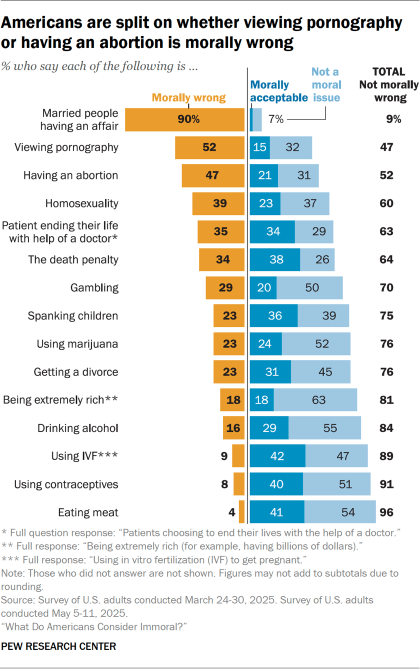
Across a wide range of issues, Americans express morally permissive views. Nearly all U.S. adults (96%) say that eating meat is either morally acceptable or not a moral issue, and 91% take similar positions on using contraceptives to prevent pregnancy.
Also:
- 75% express no moral objection to spanking children.
- 63% have no moral problem with patients choosing to end their lives with the help of a doctor.
- 60% have no moral qualms about homosexuality.
These are key new findings from two Pew Research Center surveys in spring 2025 about the morality of 15 behaviors.
We asked about behaviors that are, at least in part, morally debated in society today. We did not focus on behaviors that nearly everyone would likely say are morally wrong (like murder or stealing) or that everyone presumably would find acceptable (like asking for directions or picking up litter).
Consequently, the finding that Americans think many things are morally permissible doesn’t mean the public thinks everything is morally permissible.
Indeed, there is one item on our list that most Americans do find immoral: having an extramarital affair. Nine-in-ten U.S. adults say that married people having an affair is morally wrong.
For comparisons with what people in two dozen other countries consider moral and immoral, including Europeans’ views on extramarital affairs, read our international report on morality.
The American public is almost evenly split on two topics we asked about: pornography and abortion.
About half of U.S. adults say viewing pornography is morally wrong (52%), while nearly half feel it is not a moral issue (32%) or is morally acceptable (15%).
Likewise, 47% of Americans say having an abortion is morally wrong, while about half say an abortion is not a moral issue (31%) or is morally acceptable (21%).
Jump to: How men and women differ on these questions.
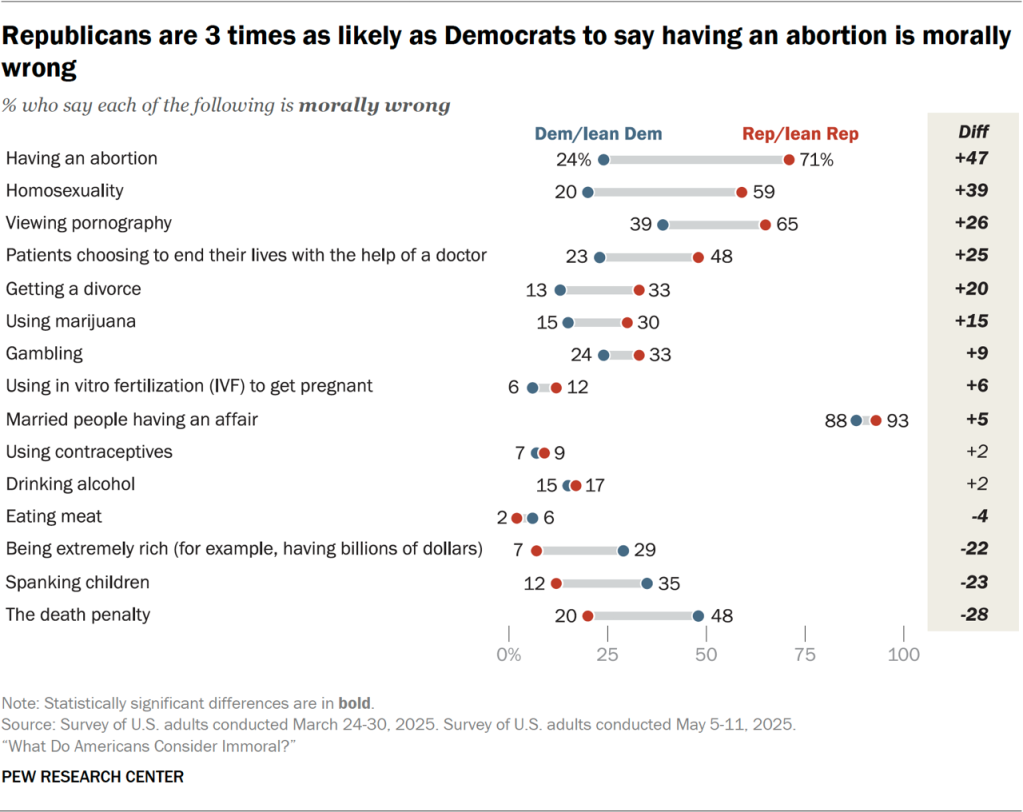
There has long been a partisan divide in the United States on whether abortion should be legal. Today, Republicans and Republican-leaning independents are much more likely than Democrats and those who lean toward the Democratic Party to say that having an abortion is morally wrong(71% vs. 24%).
The new surveys also show that Republicans are more likely than Democrats to view several other behaviors relating to sex and family life as morally wrong:
- Homosexuality (59% of Republicans vs. 20% of Democrats say it is wrong, including leaners to each party)
- Viewing pornography (65% vs. 39%)
- Getting a divorce (33% vs. 13%)
On the other hand, Democrats are significantly more likely than Republicans to view each of the following as morally wrong:
- The death penalty (48% of Democrats vs. 20% of Republicans say it is wrong)
- Spanking children (35% vs. 12%)
- Being extremely rich (29% vs. 7%)
Jump to the appendix of this report for detailed tables showing the percentages of adults in each political party who say these behaviors are morally wrong, morally acceptable or not a moral issue.
There also is a divide between the two partisan camps on whether Americans, as a whole, are morally good. At present, 54% of Republicans and Republican-leaning independents rate the morality and ethics of Americans as very or somewhat good, compared with 40% of Democrats and Democratic leaners who share that assessment.
Overall, 47% of Americans see other Americans as morally good, while 53% say the morality and ethics of their fellow Americans are somewhat or very bad. (By contrast, in nearly all the other countries where we asked this question in 2025, more people view their fellow citizens as morally and ethically good than as bad.)
Read further in this report for more about:
- How people’s religious identity is connected with their views on morality
- Differences between younger and older people on moral issues
- Differences between men and women
These findings come from two nationally representative Pew Research Center surveys: a survey of 3,605 U.S. adults conducted March 24-30, 2025, and a survey of 8,937 U.S. adults conducted May 5-11, 2025.
For analysis of how attitudes about morality differ around the world, as well as how some of these attitudes have changed over time, read “In 25-Country Survey, Americans Especially Likely To View Fellow Citizens as Morally Bad.”
Related: In the U.S. and other countries, fewer people now say it’s necessary to believe in God to be moral
Related: Majority of Americans Continue to Say Abortion Should Be Legal in All or Most Cases
Evangelicals often diverge from other Americans on issues of morality
White evangelical Protestants are more likely than people in other religious groups to express traditionally conservative moral positions on several of the 15 issues we asked about.
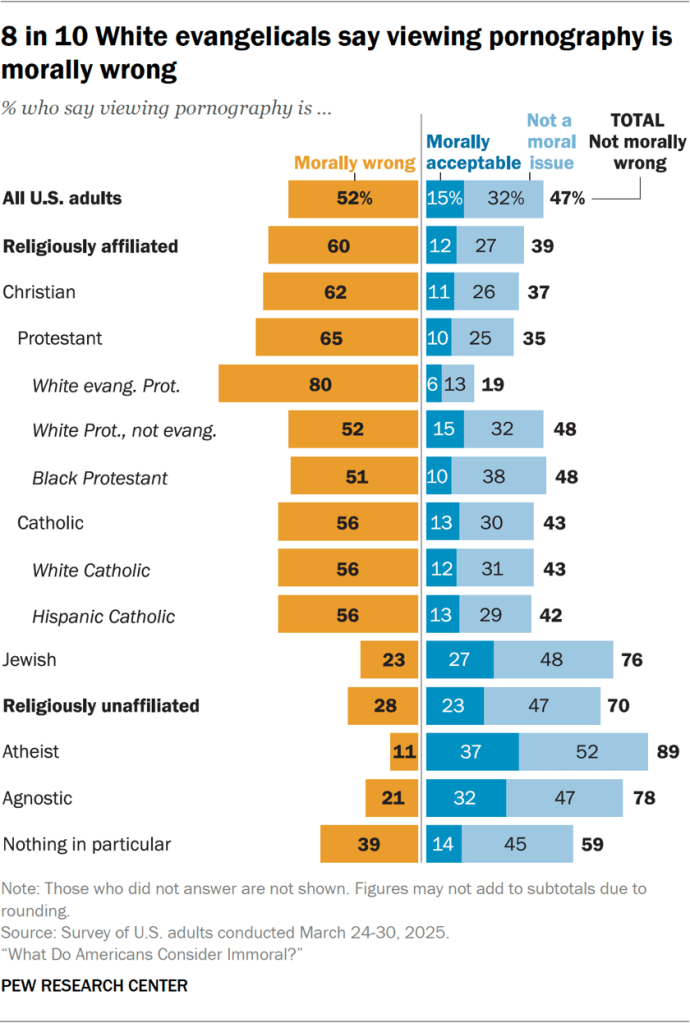
For example, 80% of White evangelicals say viewing pornography is wrong, while about one-in-five say it is not a moral issue (13%) or that it’s morally acceptable (6%). By comparison, about half of other Protestants say viewing pornography is wrong, as do 56% of all Catholics.
Jewish adults (23%) and the religiously unaffiliated (28%) are much less likely than evangelicals to say that viewing pornography is morally wrong. Indeed, about half of Jewish and religiously unaffiliated adults say it’s not a moral issue.
There is also a big divide between White evangelicals and other groups on the morality of homosexuality: 72% of White evangelicals say homosexuality is wrong, compared with 34% of all Catholics and 13% of religiously unaffiliated adults.
In addition, White evangelicals are more likely than Americans who belong to most other religious groups – including those who describe themselves as atheist, agnostic or “nothing in particular” – to take the position that it’s morally wrong to have an abortion or to choose to end one’s life with the help of a doctor.
And White evangelical Protestants are the least likely of the religious groups studied to say the death penalty is morally wrong (20%). By contrast, 48% of atheists, 46% of Black Protestants and 42% of Jews consider the death penalty immoral.
Jump to the appendix of this report for detailed tables showing the percentages of adults in each religious group who say these behaviors are morally wrong, morally acceptable or not a moral issue.
How younger and older Americans differ on morality
On many of these moral issues, there are substantial differences between younger and older Americans. But whether younger or older adults are most likely to consider each behavior morally wrong is highly dependent on the question asked.
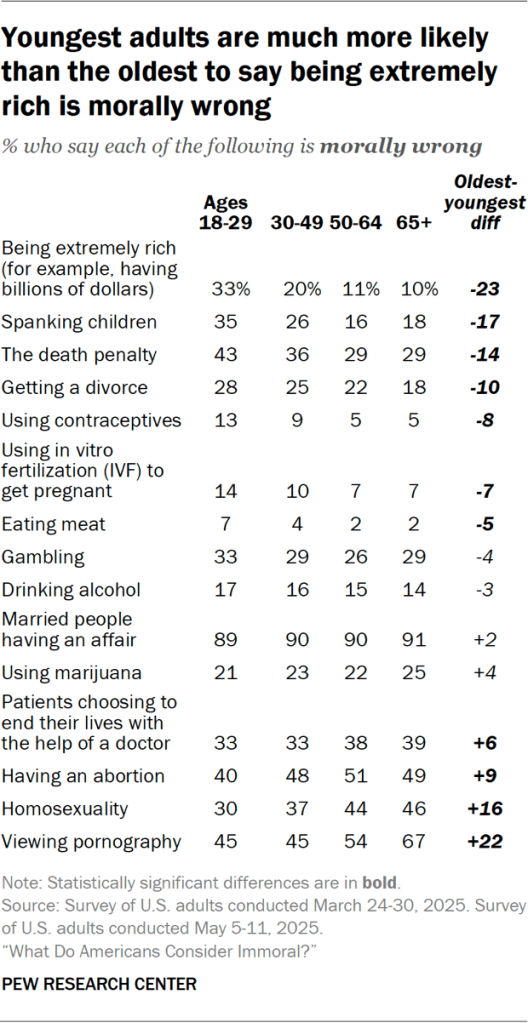
For example, adults ages 18 to 29 are much more inclined than older groups to see “being extremely rich” and spanking children as morally wrong. Still, only about one-third of the youngest American adults say it’s immoral to be extremely rich (33%) or to spank children (35%).
At the same time, there are some behaviors that younger adults are less likely than older adults to consider immoral. For example, 30% of Americans ages 18 to 29 say homosexuality is morally wrong, compared with 37% of adults 30 to 49 and even higher shares of older adults.
The biggest age-related differences persist even within political parties.
Take attitudes toward the morality of being extremely rich: Young American adults are much more likely than older adults to say that being extremely rich is morally wrong. For instance, one-third of adults ages 18 to 29 take this stance, compared with 10% of adults ages 65 and older.
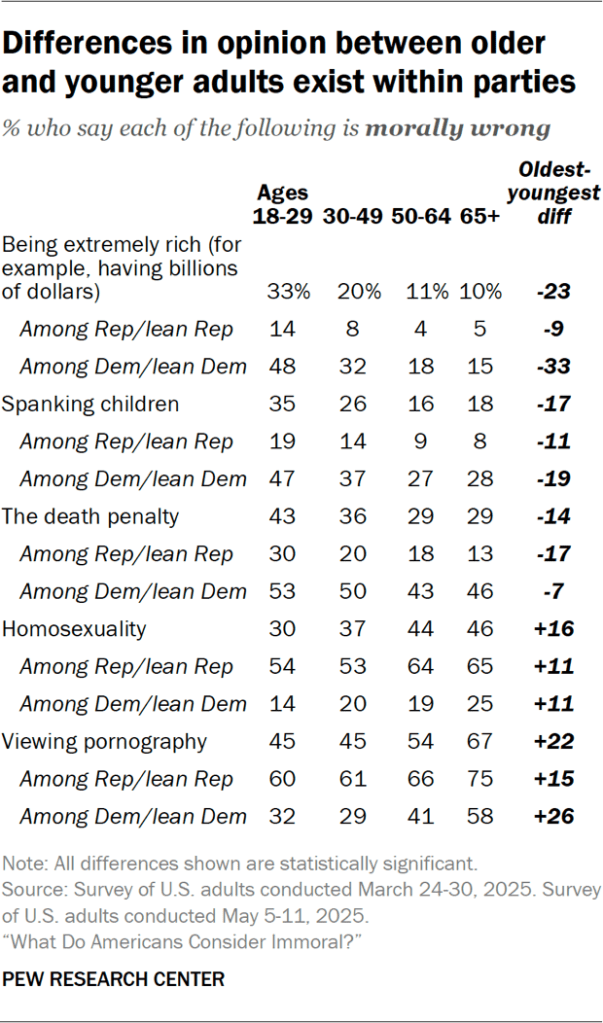
Among Republicans, too, there is a 9 percentage point age gap between the youngest and oldest adults (14% vs. 5%) – though this divide is even larger among Democrats (48% vs. 15%).
Jump to the appendix of this report for detailed tables showing the percentages of adults in each age group who say these behaviors are morally wrong, morally acceptable or not a moral issue.
How American women and men differ in their moral views
Similar shares of men and women say that many of the 15 behaviors we asked about are morally wrong. Only on a handful of the behaviors do men and women notably differ in their opinions.
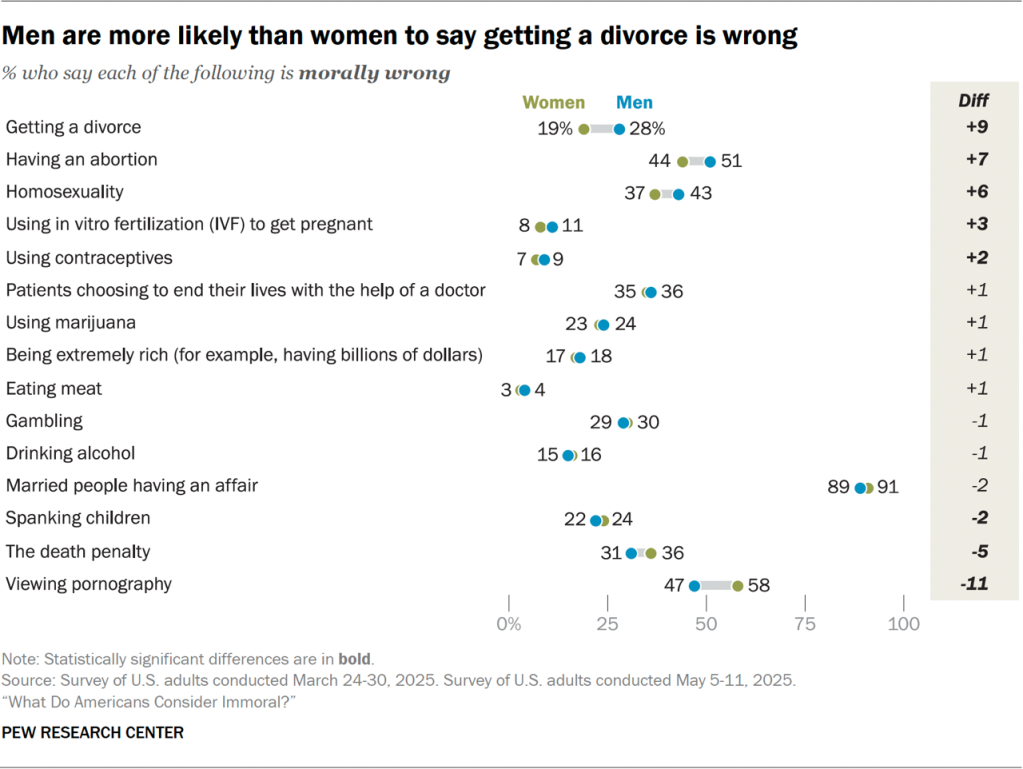
Men are somewhat more likely than women to take the position that getting a divorce (28% vs. 19%), having an abortion (51% vs. 44%) and homosexuality (43% vs. 37%) are morally wrong.
However, women are more likely than men to say that viewing pornography is morally wrong (58% vs. 47%).
Jump to the appendix of this report for detailed tables showing the percentages of men and women who say these behaviors are morally wrong, morally acceptable or not a moral issue.