The Catholic share of the population in several Latin American countries has shrunk over the last 10 years, while a growing percentage of Latin American adults are religiously unaffiliated, describing themselves as atheist, agnostic or “nothing in particular.”
Catholicism still appears to be Latin America’s largest religion, according to Pew Research Center surveys in six of the region’s most populous countries: Argentina, Brazil, Chile, Colombia, Mexico and Peru.
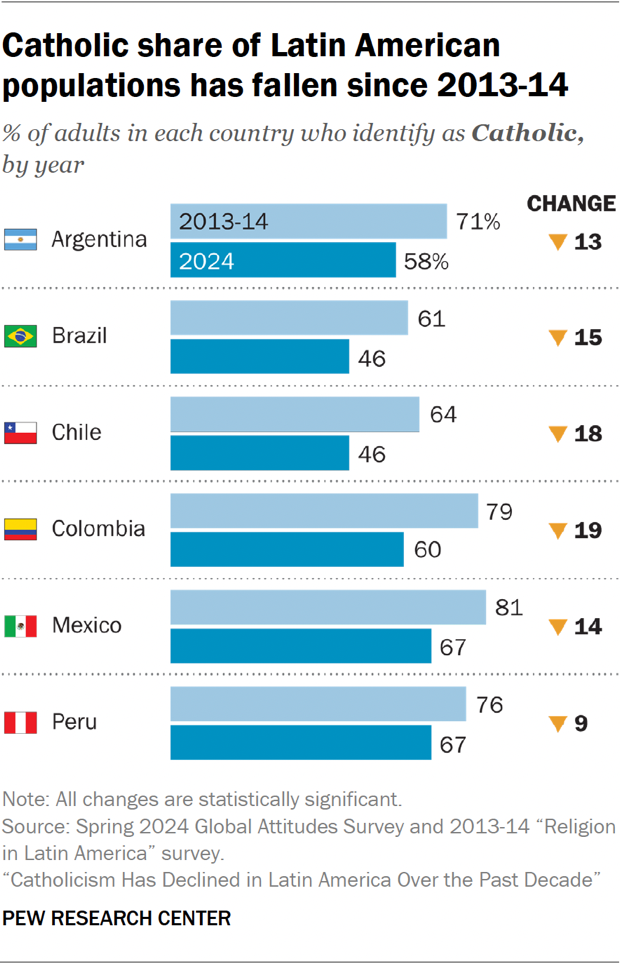
Today, Catholics make up 46% to 67% of the adult population in each of these countries, while the share of adults who are religiously unaffiliated ranges from 12% to 33%.
But the Catholic shares have dropped by 9 percentage points or more in all six countries over the past decade, while the percentages of adults who are unaffiliated have risen by 7 points or more. In several countries, unaffiliated adults – sometimes called religious “nones” – now outnumber Protestants.
Despite these shifts, Latin Americans remain quite religious, on average. For instance:
- Belief in God is widespread, with around nine-in-ten or more adults surveyed in each country saying they believe in God.
- Religion matters deeply to many people in the region, with about half or more of adults surveyed in Brazil, Colombia, Mexico and Peru saying religion is very important in their lives.
- Prayer is fairly common, with majorities of Brazilian, Colombian and Peruvian adults saying they pray at least once a day.
By these measures, Latin Americans are more religious than adults in many other countries the Center has surveyed in recent years, especially in Europe, where many adults have left Christianity since childhood.
Moreover, Latin Americans are about as likely to believe in God as they were a decade ago. Even among religiously unaffiliated adults surveyed across the region, majorities say they believe in God.
These are among the key findings of Pew Research Center surveys, conducted in spring 2024, that included more than 6,200 adults in Argentina, Brazil, Chile, Colombia, Mexico and Peru.
Why these countries?
This report focuses on six Latin American nations that were included in a 2024 survey of 36 countries around the world. Together, the six countries contain about 495 million people, or roughly three-quarters of the entire population of Latin America and the Caribbean.
The responses Latin Americans gave to questions about their religious affiliation and belief in God can be compared with results of another survey we conducted across Latin America in 2013-14, providing insights into how the region has changed religiously over the past decade.
But the results of most other questions in the 2024 survey cannot be directly compared with the earlier survey, either because the questions are new or because their wording has changed.
The rest of this overview explores the following questions:
- How has the religious affiliation of Latin Americans changed?
- What do former Catholics in Latin America identify as now?
- How religious are Latin Americans today?
- How different are Catholics, Protestants and “nones” in Latin America?
- Who is more religious: “Nones” in Latin America or Christians in Europe?
How has the religious affiliation of Latin Americans changed?
A decade ago, Argentina, Brazil, Chile, Colombia, Mexico and Peru all had Catholic majorities, with roughly six-in-ten or more adults in each country identifying as Catholic.
Today, roughly half of Brazilians and Chileans identify as Catholic (46% each in 2024), while Argentina (58%), Colombia (60%), Mexico (67%) and Peru (67%) have much smaller Catholic majorities than they did in 2013-14.
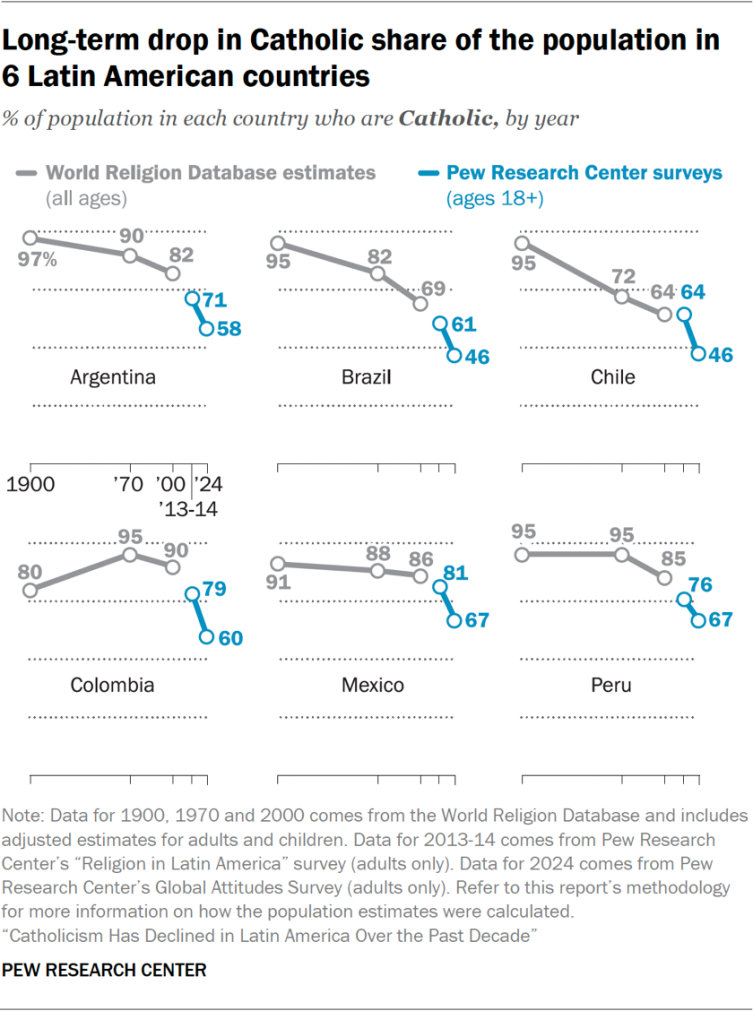
Catholicism has been declining in all these countries at least since the 1970s, according to estimates from the World Religion Database.
How the share of Catholics in Latin America has changed since 1900
In 1900, the vast majority of Latin Americans were Catholic. But by the end of the 20th century, Catholicism was declining in most Latin American countries, according to estimates from the World Religion Database.
For instance, in Argentina, the share of Catholics in the general population (which includes children) fell from 97% in 1900 to 82% in 2000. More recently, Pew Research Center surveys (which do not include children) have found the share of Catholics in Argentina declining from 71% in 2013-14 to 58% in 2024.
Refer to the “Factors driving religious change” section for details about the drivers behind this shift.
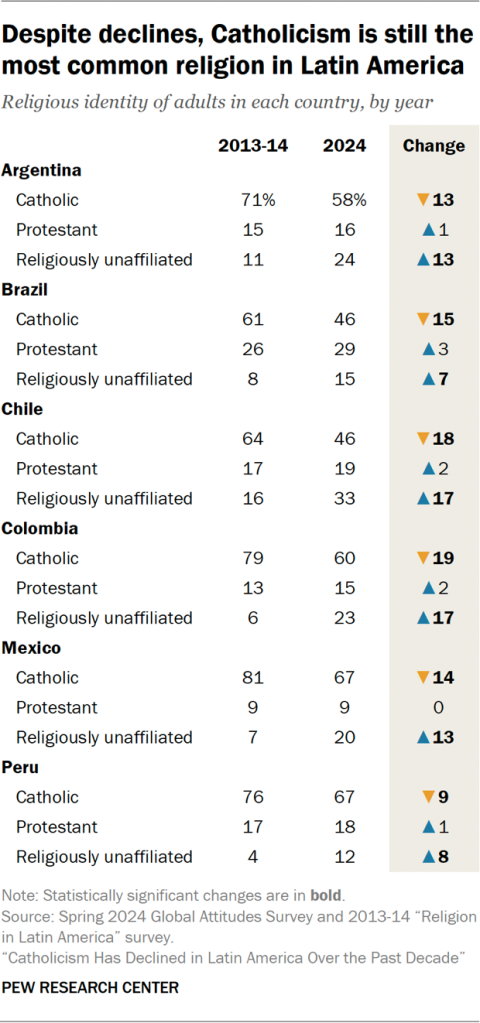
Meanwhile, the share of adults who are religiously unaffiliated has roughly doubled in Argentina (to 24% in 2024), Brazil (15%) and Chile (33%); tripled in Mexico (20%) and Peru (12%); and nearly quadrupled in Colombia (23%).
There are now more religiously unaffiliated adults than Protestants in Argentina, Chile, Colombia and Mexico. When asked about their current religion, for example, two-in-ten Mexican adults identify as atheist, agnostic or “nothing in particular” – compared with about one-in-ten Mexicans who identify with any branch of Protestantism.
Protestantism has remained relatively stable across the region. For instance, in Brazil – which has the largest percentage of Protestants of the six countries surveyed – 29% of adults now identify as any kind of Protestant, compared with 26% in 2013-14.
And while Pentecostal Protestantism continues to be widespread across the region, the percentage of Protestants who are Pentecostal has declined over the past decade as other traditions have grown.1
Jump to a later section for more information on religious affiliation in Latin America, including how the Pentecostal share of the population has changed in each country since 2013-14.
Catholic decline among Hispanics in the United States
The U.S. Hispanic population reached 68 million in 2024. The number of Hispanics living in the United States exceeds the number of all people who live in any Latin American country, except Brazil and Mexico.
In a trend similar to the religious changes in Latin America, fewer Hispanics in the U.S. identify as Catholic now (42%) than did so a decade ago (58%), according to Pew Research Center’s 2023-24 Religious Landscape Study (RLS).
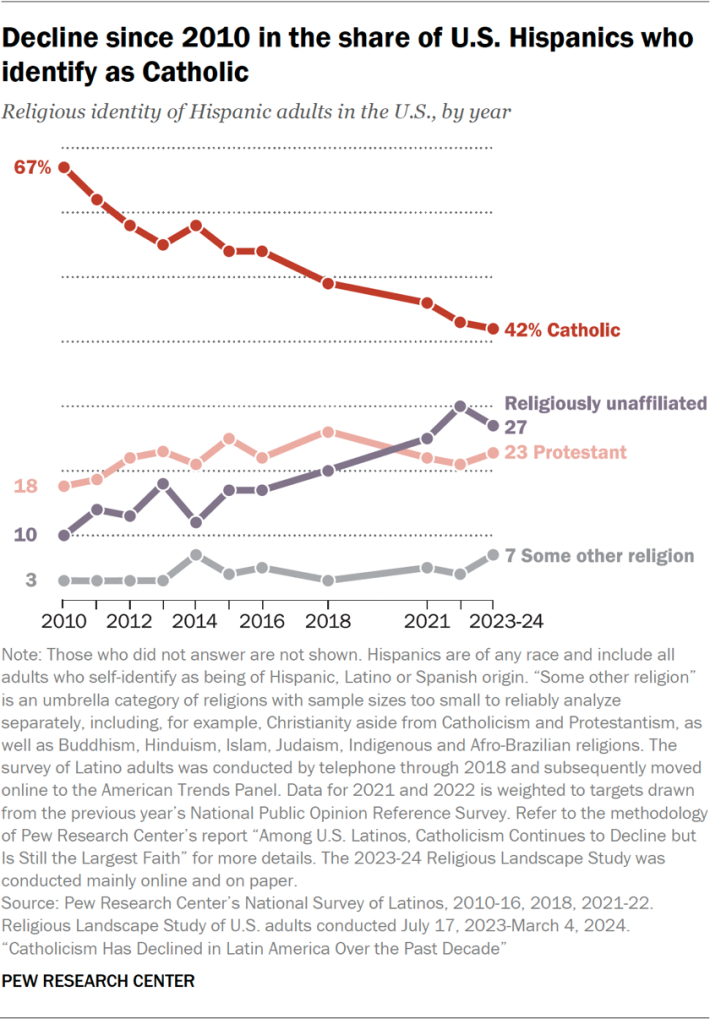
Meanwhile, the share of U.S. Hispanics who are religiously unaffiliated has increased since 2014, with about a quarter now describing their religious identity as atheist, agnostic or “nothing in particular.”
(In the Center’s U.S. surveys, people who self-identify as being of Hispanic, Latino or Spanish origin are considered Hispanic. They can be of any race. Adults in Latin America may or may not identify as Hispanic, Latino or Spanish.)
Additionally, 40% of U.S. Hispanics say religion is very important in their life, and 47% say they pray at least daily. A large majority of U.S. Hispanics (83%) say they believe in God, according to a separate 2023 Center survey.
For more information about religious and spiritual beliefs and practices among U.S. Hispanics, refer to our recent report and the RLS interactive database.
What do former Catholics in Latin America identify as now?
One reason for the decline of Catholicism and growth of religiously unaffiliated populations in Latin America is religious switching: a flow out of Catholicism by adults who were raised in the religion but no longer identify with it.
Across the six Latin American countries surveyed, around two-in-ten or more adults say they were raised Catholic but have since left Catholicism.2
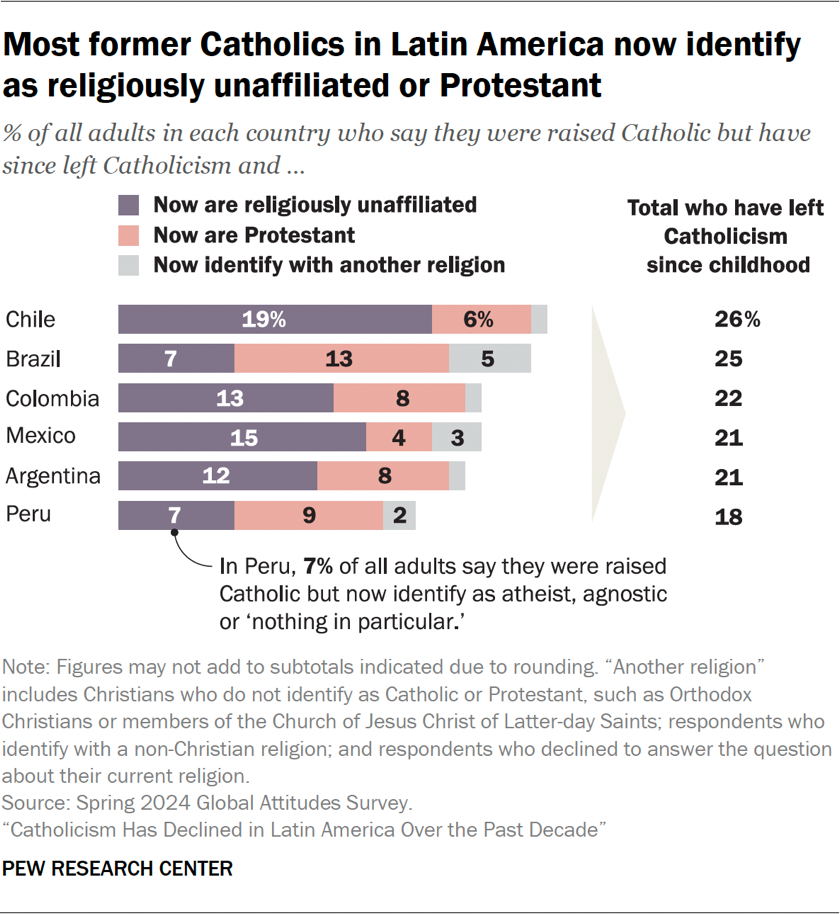
Many Latin American adults who have left Catholicism since childhood have become religiously unaffiliated, with smaller shares in some countries now identifying as Protestant.
For example, 22% of adults in Colombia say they were raised Catholic but no longer identify that way. This includes 13% of all Colombian adults who were raised Catholic but now identify as atheist, agnostic or “nothing in particular,” 8% who were raised Catholic and now identify as Protestant, and 1% who were raised Catholic and now identify with another religious group.
Brazil is the only country surveyed where former Catholics are more likely to now be Protestant (13% of all adults) than to be religiously unaffiliated (7%).
In Peru, roughly equal shares of former Catholics have become Protestants (9% of all adults) and “nones” (7%).
Jump to a later section for more information on religious affiliation and religious switching in Latin America.
How religious are Latin Americans today?
Even though Catholics are shrinking and “nones” are growing as a share of the population in every Latin American country surveyed, most adults across the region are religious, to some degree, by a variety of measures.
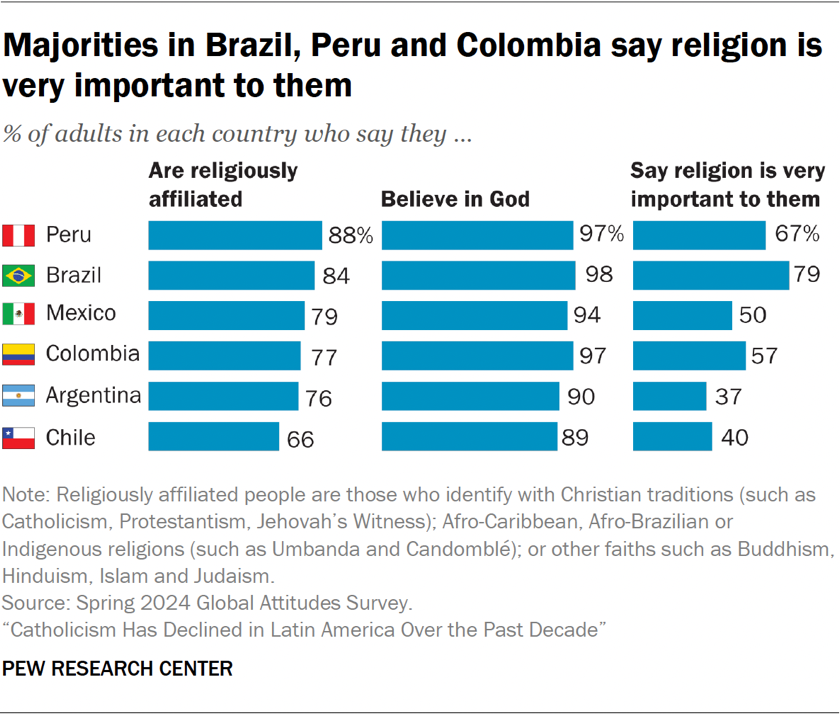
To begin with, in all six countries, most adults identify with a religion. The shares who are religiously affiliated range from 66% in Chile to 88% in Peru. These figures include people who identify with Christian traditions (such as Catholics, Protestants and Jehovah’s Witnesses); Afro-Caribbean, Afro-Brazilian and Indigenous religions (such as Umbanda and Candomblé); and other faiths (such as Buddhism, Hinduism, Islam and Judaism).
Also, the vast majority of adults in every Latin American country surveyed say they believe in God – with percentages ranging from 89% in Chile to 98% in Brazil. Even among religiously unaffiliated adults, majorities say they believe in God. For example, about three-quarters of “nones” in Mexico say they believe in God.
Fewer Latin Americans describe religion as very important to them personally. Yet in four of the six countries surveyed, half or more of adults say religion is very important in their lives. For instance, 57% of Colombians say this, as do 79% of Brazilians. In Chile and Argentina, fewer adults say religion is very important to them (40% and 37%, respectively).
Jump to later sections for more information on religious affiliation and belief in God in Latin America.
In addition, many Latin Americans regularly engage in religious or spiritual practices. For example, about four-in-ten or more adults in each country surveyed say they pray at least once a day; these shares range from 39% of adults in Argentina to 76% in Brazil.
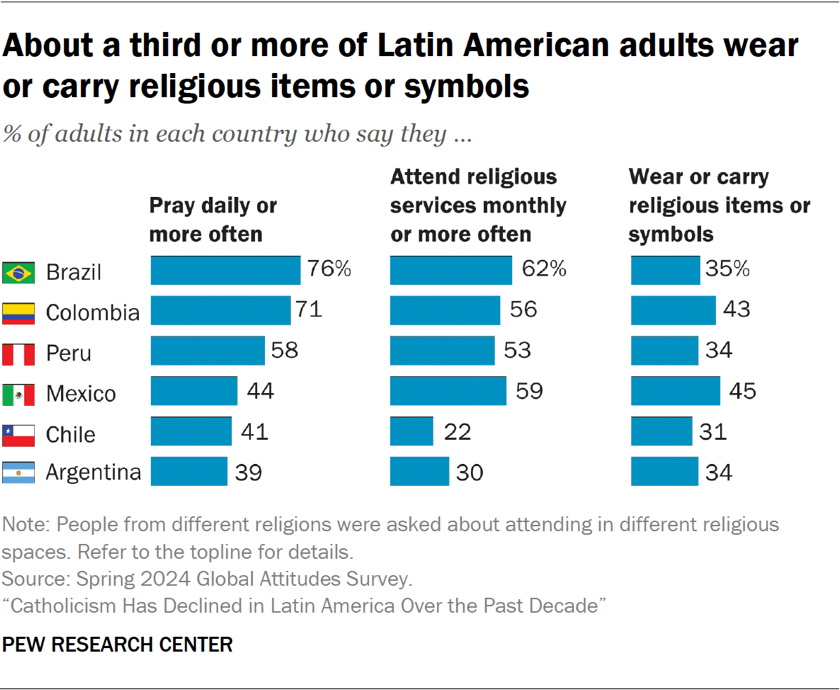
In four countries – Brazil, Colombia, Mexico and Peru – about half or more of adults say they attend religious services monthly or more often. For example, 59% of Mexicans surveyed say they attend religious services at least monthly.
Substantial numbers of adults across the region also say they wear or carry religious items or symbols, ranging from 31% in Chile to 45% in Mexico.
Jump to a later section for more on religious practices in Latin America.
How different are Catholics, Protestants and ‘nones’ in Latin America?
Levels of religious engagement vary widely among Catholics, Protestants and religiously unaffiliated people in Latin America. Across the six countries surveyed, Protestants are more likely than Catholics to hold some religious beliefs and engage in some religious practices, but the reverse is true on other measures. Religious “nones” are usually – but not always – less religiously engaged than either Catholics or Protestants in the same country.
Religious and spiritual beliefs
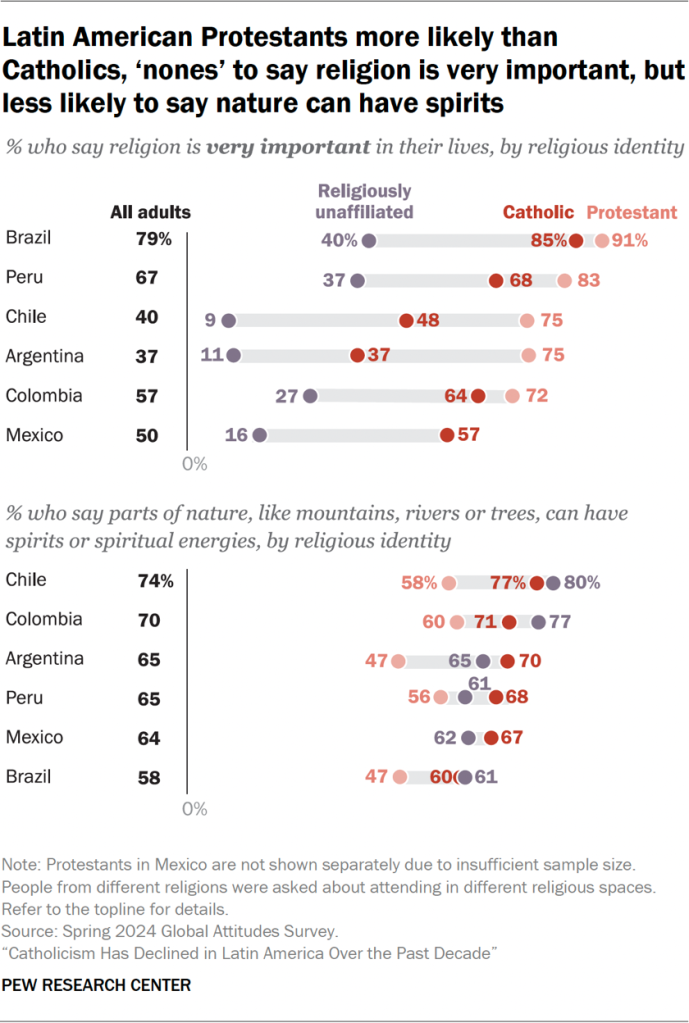
Generally, Protestants are more likely than Catholics and “nones” to say religion is very important in their lives. For instance, in Chile, 75% of Protestants say this, compared with 48% of Catholics and 9% of religiously unaffiliated adults.
Catholics and religiously unaffiliated adults in Latin America are generally more likely than Protestants to believe that parts of nature – such as mountains, rivers or trees – can have spirits or spiritual energies. For example, in Brazil, roughly six-in-ten Catholics and “nones” believe that spirits can inhabit parts of nature, while about half of Protestants say the same.
Jump to a later section for more on beliefs among Catholics, Protestants and religiously unaffiliated people in Latin America.
Religious and spiritual practices
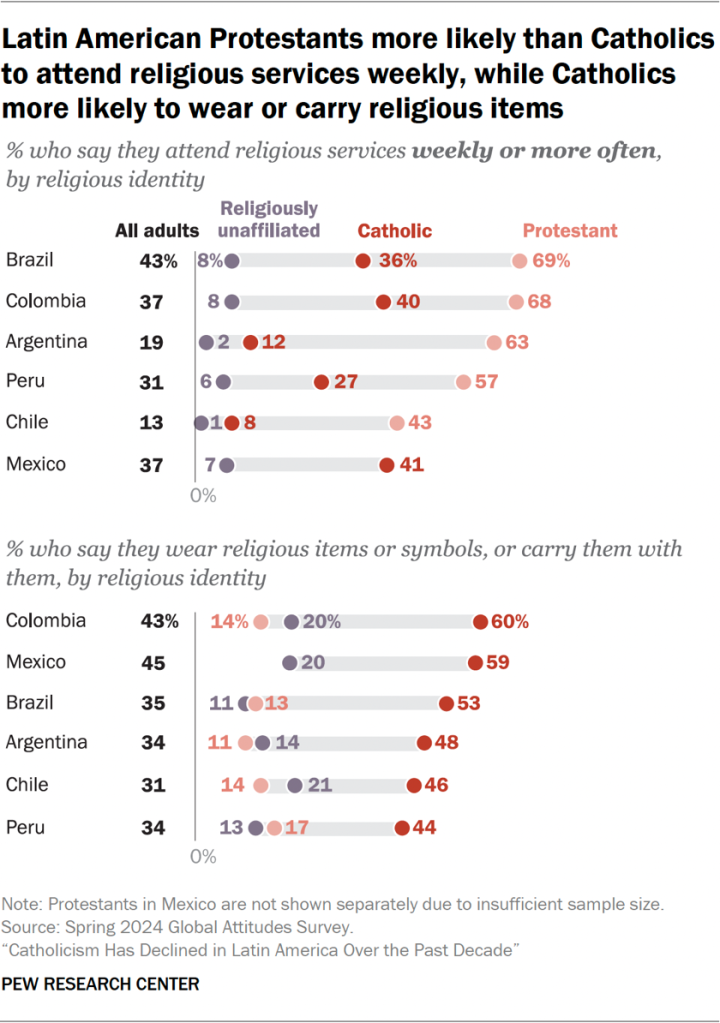
Protestants in the region are more likely than Catholics and “nones” to report attending religious services weekly or more often.
In Argentina, for example, 63% of Protestants say they attend religious services at least weekly, while 12% of Catholics and just 2% of “nones” say they attend that often.
On the other hand, Catholics are much more likely than Protestants and religiously unaffiliated adults to say they wear or carry religious items or symbols. For instance, six-in-ten Catholics in Colombia say they wear or carry religious items or symbols, while two-in-ten or fewer Colombian “nones” and Protestants say they do this.
Jump to a later section for more on practices among Catholics, Protestants and religiously unaffiliated people in Latin America.
Who is more religious: ‘Nones’ in Latin America or Christians in Europe?
Another way of looking at a society’s religiousness is by examining the religious engagement of its “nones” – people who say they are atheist, agnostic or “nothing in particular.”
We compared religiously unaffiliated people in Latin America with Christians in Europe on three measures: belief in God, frequency of prayer and whether people consider religion to be very important in their lives.
By these measure,“nones” in Latin America are about as religious as Christians in Europe, on average.3
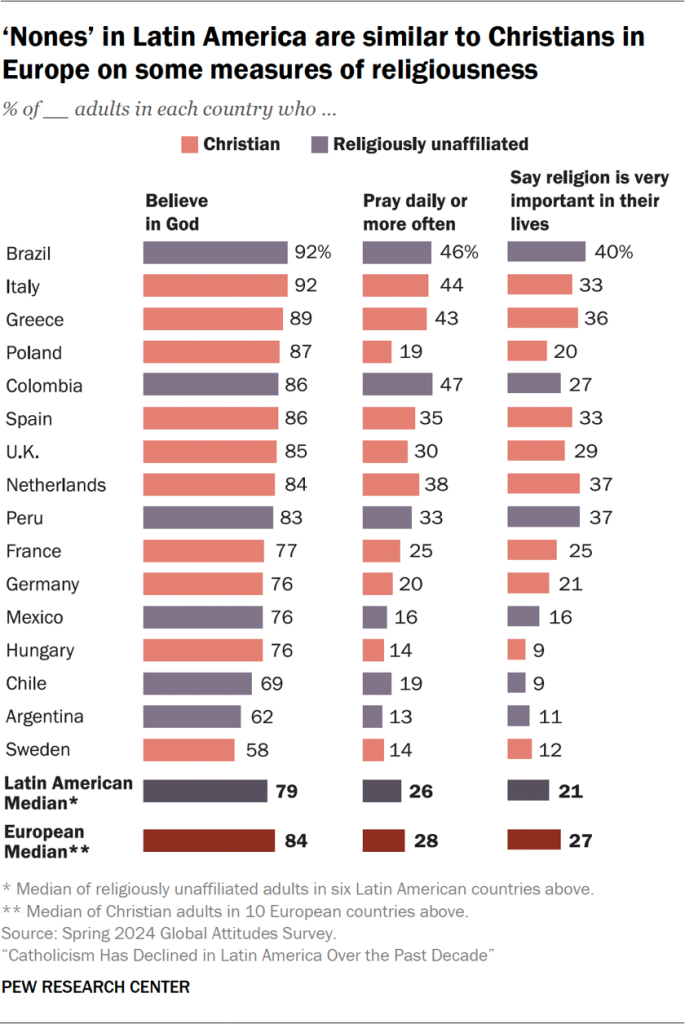
For instance, anywhere from 58% of Swedish Christians to 92% of Italian Christians say they believe in God. This is similar to the shares of “nones” surveyed in Latin America who believe in God, which range from 62% in Argentina to 92% in Brazil.
When it comes to prayer, a third or more of “nones” surveyed in Brazil, Colombia and Peru pray at least once a day – comparable to the shares of Christians who say they pray daily or more often in several European countries.
And around four-in-ten religiously unaffiliated adults in Brazil and Peru say religion is very important in their lives – similar to the shares of Christians in Greece (36%) and the Netherlands (37%) who express the same view.