
Fifty years ago, Congress passed a law to improve data collection on people in the United States who have roots in Spanish-speaking countries – a group that came to be labeled “Hispanics” and “Latinos” in federal surveys and publications. The law was meant to help decision makers better understand the fast-growing Hispanic population, but it also grouped a diverse people under a single umbrella.
Today, Hispanics in the U.S. use a variety of labels to describe their identity, from pan-ethnic ones such as Hispanic and Latino to ancestry-based ones like Cuban American or Mexican. Some Hispanics use “American” on its own. Importantly, many Hispanics have used each of these terms at least once in their lives to describe themselves, highlighting the layers of U.S. Hispanic identity. At the same time, some terms are used more than others, reflecting the ways Hispanics understand and express who they are.
To better understand how Hispanics use, prioritize and think about identity labels, Pew Research Center conducted a bilingual survey among 4,923 Hispanic adults in October 2025. We asked respondents:
Which labels have they used at least once in their lives to describe themselves? Large majorities of Hispanic adults say they have ever used a pan-ethnic term such as Hispanic or Latino (84%) or their country of origin or heritage on its own – for example, Puerto Rican (80%) – to describe themselves.
Which label do they use most often to describe themselves? Hispanics do not point to a single dominant choice. However, the labels they use most often include their place of origin or heritage, either on its own (35%) or combined with American (18%) — for example, Salvadoran or Dominican American.
Which pan-ethnic term – Hispanic, Latino, Latinx or Latine – do they prefer to describe people of Hispanic or Latino origin or descent? When labeling the entire U.S. Hispanic population, a majority say they prefer the term Hispanic (54%) over Latino (30%). Few say they prefer the terms Latinx or Latine, while 14% say they have no preference.
In addition, we asked respondents if they consider themselves “a typical American.” Hispanics are evenly divided on this.
Which labels Hispanics use – and how often they use them – also varies by immigrant generation and other demographic characteristics.
This analysis is part of a larger study about U.S. Latino identity. For a summary of the main findings, visit “U.S. Hispanics are divided on whether their identity helps or hurts them in America.”
Defining the U.S. Hispanic population
In 1976, the U.S. Congress passed Public Law 94-311. This legislation defined “Americans of Spanish origin or descent” as “Americans [who] identify themselves as being of Spanish-speaking background and trace their origin or descent from Mexico, Puerto Rico, Cuba, Central and South America, and other Spanish-speaking countries.” This includes around 20 Spanish-speaking nations from Latin America and Spain itself, but not Portugal or Portuguese-speaking Brazil.
To implement this law, the U.S. Office of Management and Budget (OMB) in 1977 developed Statistical Policy Directive No. 15 (SPD 15), recommending that federal agencies measure race and ethnicity separately. In a 1997 revision, the OMB adopted “Hispanic or Latino” as the label for reporting federal statistics on this population. In a 2024 revision, OMB proposed combining the race and ethnicity questions into a single question. Read more about how the Census Bureau and federal agencies collect race and ethnicity data here.
Which labels have Hispanics used at least once in their lives to describe themselves?
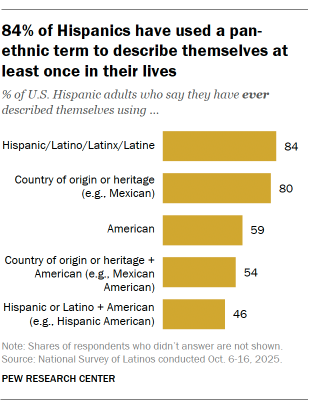
Some 84% of U.S. Hispanics say they have used a pan-ethnic term (such as Hispanic, Latino, Latinx or Latine) to describe themselves at least once in their lives. And 80% say they have ever used their family’s country of origin on its own (such as Mexican) to describe themselves.
Fewer have ever used other terms:
- 59% of U.S. Hispanics have used the standalone term American to describe themselves at least once in their lives.
- 54% have ever used their country of origin together with American (e.g., Mexican American).
- 46% have ever used a pan-ethnic label combined with American (e.g., Hispanic American).
Which label do Hispanics use most often to describe themselves?
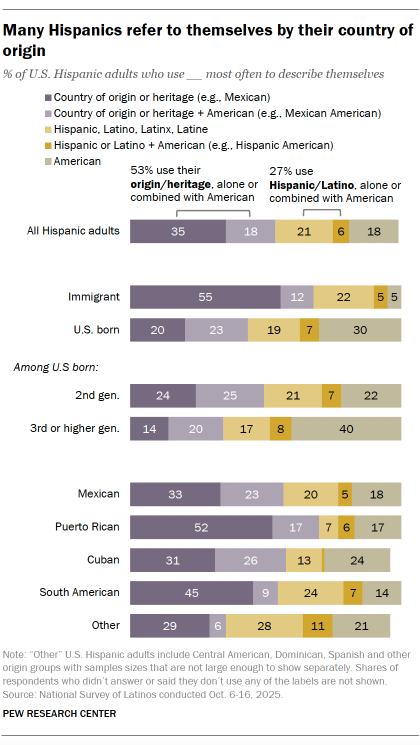
There is wide variation in the identity labels Hispanic adults use most often to describe their identity.
Some use standalone labels (such as Cuban, Hispanic or American), while others use combined labels (such as Mexican American or Hispanic American).
- 35% say they most often use a standalone label that references their country of origin or heritage (e.g., Cuban or Mexican).
- 21% say they most often use a standalone pan-ethnic term (e.g., Hispanic or Latino).
- 18% say they use the standalone label American.
- 18% use their country of origin combined with American.
- 6% use a pan-ethnic term combined with American.
Looking at it another way, 53% say their most-often-used label includes their origin country (either alone or combined with the term American), while 27% say their top label uses a pan-ethnic term (either alone or combined with the term American).
Place-of-origin labels have long been central for many Hispanics. In Center surveys of Hispanics since 2002, most have said they use labels that reference their or their family’s country or place of origin over other labels.5 In the October 2025 survey, Puerto Ricans are the origin group most likely to say they identify by their place of origin or heritage; 70% of U.S. Hispanics of Puerto Rican descent say they most often call themselves Puerto Rican, either alone or combined with American.
Label use also varies by immigrant generation. Among Hispanic adults born outside the U.S., around 67% use their country or place of origin – alone or combined with American – most often to describe themselves, a higher share than among second-generation (49%) or third- or higher-generation (34%) Hispanics. By contrast, third- or higher-generation Hispanics are more likely than other groups to say they most often use American by itself (40%). (Find our definitions of immigrant generations in the Key Terms section.)
Which pan-ethnic term do Hispanics prefer to describe people of Spanish descent?
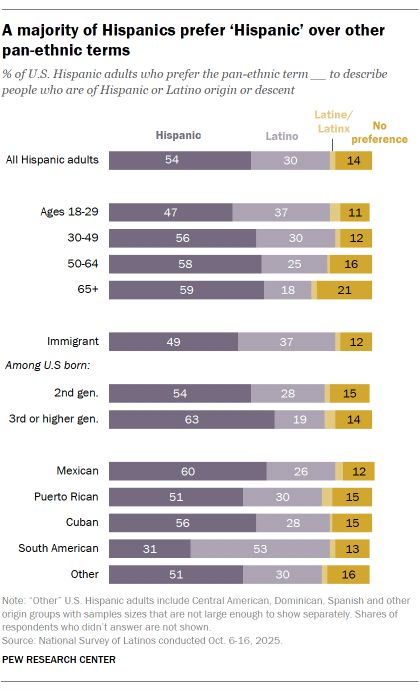
More than half of Hispanic adults say they prefer the pan-ethnic term Hispanic (54%) to describe the group of people who are of Hispanic or Latino origin or descent, while 30% prefer the term Latino. Few prefer the terms Latinx (1%) or Latine (1%). Meanwhile, 14% say they have no preference among these pan-ethnic terms.
There are differences by age, immigrant status and country of origin.
For example, Hispanic adults under 30 and Hispanic immigrants (those born outside the U.S.) are slightly less likely than their counterparts to say they prefer the term Hispanic.
But generally speaking, in almost every group we analyzed, larger shares prefer Hispanic than prefer Latino.
Respondents of South American origin are an exception, with a majority who prefer Latino (53%) over Hispanic (31%).
Historically, U.S. Hispanics overall have preferred the term Hispanic over the term Latino since the Center began studying this topic in the early 2000s. Percentages have fluctuated slightly depending on how surveys asked the question about pan-ethnic term preferences. They have changed little since the current question wording was introduced in 2023.
Hispanics are divided on whether they see themselves as a ‘typical American’
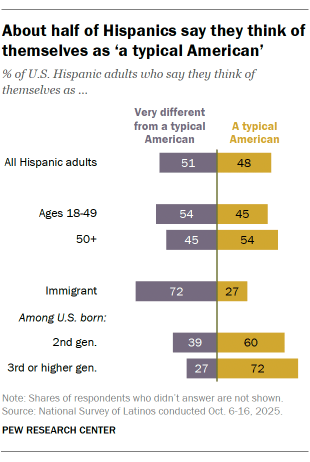
Since American is one of the labels Hispanics sometimes use to describe their identity, the survey also asked whether respondents consider themselves “a typical American.”
Hispanics are split on whether they see themselves as a typical American (48%) or very different from a typical American (51%).
- Hispanics who are third or higher generation (72%) are more likely than second-generation Hispanics (60%) and much more likely than Hispanic immigrants (27%) to consider themselves a typical American.
- Hispanics adults ages 50 and older (54%) are more likely to consider themselves a typical American than those under 50 (45%).
Even as a growing share of Hispanics are U.S.-born, Center telephone surveys of Hispanic adults since 2012 show that the share of Hispanics who see themselves as a typical American has changed little.6


