This is one of five detailed sections in a report on how Black Americans define and support their family networks. The report also includes an overview of key findings.
Traditionally, family has been defined by ties of birth, marriage or law. But for many Americans, it goes beyond those conventions.
To understand how Black Americans define family – that is, who is included in their family networks and why – Pew Research Center conducted a national survey of U.S. adults including 4,271 Black Americans in June 2025.
Black Americans are more likely than other Americans to:
- Have someone they consider family who is not related to them by birth, marriage or law – for example, a close friend, family friend or play cousin (77% among Black adults vs. 63% among non-Black adults)
- Have more than one non-relative in their family network (58% vs. 48%)
Among people with a non-relative family member, Black adults are more likely than other adults to say that person is someone they grew up with in the same neighborhood. Black adults are also more likely to say their non-relative family member shares an aspect of their identity (for example, race or gender) or shares their religious or spiritual beliefs.
Non-relatives who count as family
Overall, 77% of Black adults say they have someone not related to them by blood, marriage or law whom they consider family. This includes 19% who have one such person in their family and 58% who have more than one.
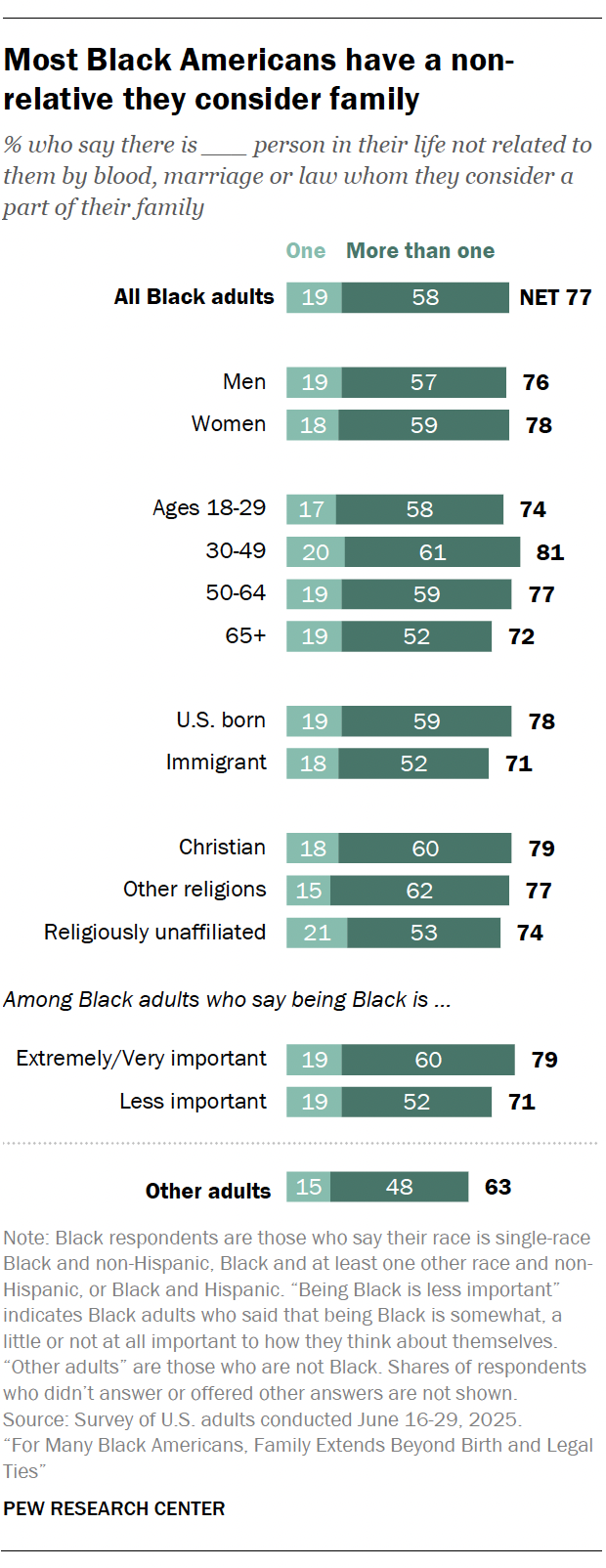
Across demographic groups of Black Americans, majorities say they have a non-relative they consider family. When slight differences do appear, they are mostly in the shares who say they have more than one such person.
- 61% of adults ages 30 to 49 say they have more than one non-relative family member, versus 52% of those ages 65 and older.
- 60% of Christians have more than one non-relative family member, versus 53% of religiously unaffiliated adults – those who identify as atheist, agnostic or “nothing in particular.”
- 59% of U.S.-born adults have more than one non-relative family member, versus 52% among immigrants.
Whether Black respondents say they have multiple non-relatives in their family network also varies by how they see their own racial identity. Among Black adults who say being Black is extremely or very important to them, 60% have more than one non-relative family member, compared with 52% of those who say being Black is less important.
Still, half of Black adults or more across these groups say they have more than one person they consider family who is not related to them.
A smaller majority of non-Black adults (63%) say they have at least one non-relative family member.
Who are the non-relatives that Black Americans consider family?
Many of the non-relatives that Black Americans consider family are people with whom they share friendships, experiences or other commonalities such as identity (like their race or gender) or community (like growing up in the same neighborhood).
Among Black Americans who have a non-relative family member, nearly all say these family members are people who:
- They have known a long time (95%)
- Are close friends (95%)
- Supported them through a difficult time (92%)
Significant majorities also say these non-relatives are people who:
- They have a lot in common with (88%)
- Share an aspect of their identity, such as their race, ethnicity, gender, sexuality or something else (85%)
- Are longtime family friends (83%)
- Share their religious or spiritual beliefs (72%)
And more than half (55%) say their non-relative family member is someone they grew up with in the same neighborhood.
Among demographic groups of Black Americans, there are some differences in what kind of non-relatives are included in their family networks. For example, whether Black peoples’ family networks include people who grew up in the same neighborhood as them varies. Among Black adults who have non-relative family members:
- 65% of Black Hispanic adults say these non-relatives grew up in their neighborhood, compared with 55% of Black single-race, non-Hispanic adults and 45% of Black multiracial, non-Hispanic adults.
- 59% of Black adults under 30 say their non-relative family member grew up in the same neighborhood as them, compared with 45% of those ages 65 and older.
- 58% of Black adults in the lower income tier say their non-relative family member grew up in their neighborhood, compared with 51% in the middle income tier and 47% in the upper income tier.
Age is a factor in whether Black Americans’ family networks include non-relatives who share their religious or spiritual beliefs. Though majorities across age groups say their family includes such people, respondents ages 65 and older are more likely to say so than adults under 30 (83% vs. 67%). Notably, older Black adults are more likely than younger Black adults to describe themselves as very religious.
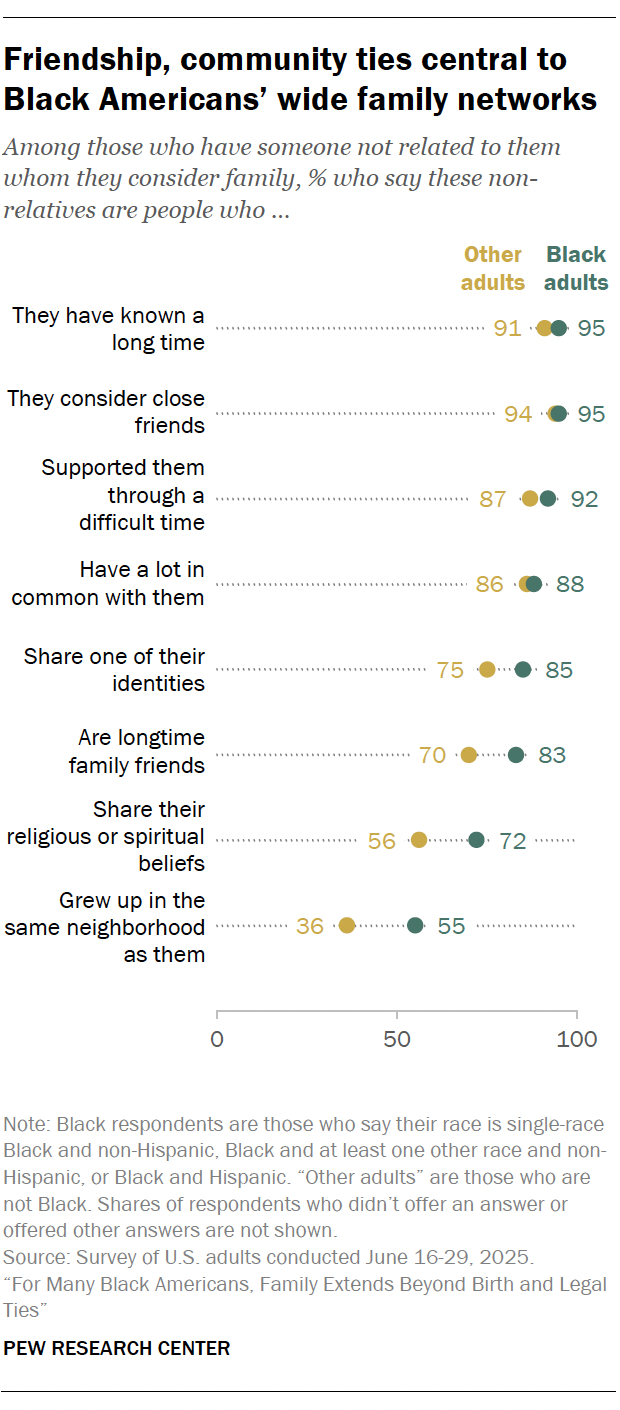
While most Americans know their non-relative family members through close friendships and shared experiences, Black Americans stand out in some ways.
Among those who have at least one non-relative family member, Black adults are more likely than other adults to say these family members are people who:
- Share one of their identities (85% vs. 75%)
- Are longtime family friends (83% vs. 70%)
- Share their religious or spiritual beliefs (72% vs. 56%)
- Grew up in the same neighborhood as them (55% vs. 36%)