This is a Pew Research Center report from the Pew-Knight Initiative, a research program funded jointly by The Pew Charitable Trusts and the John S. and James L. Knight Foundation.
The American Trends Panel survey methodology
Overview
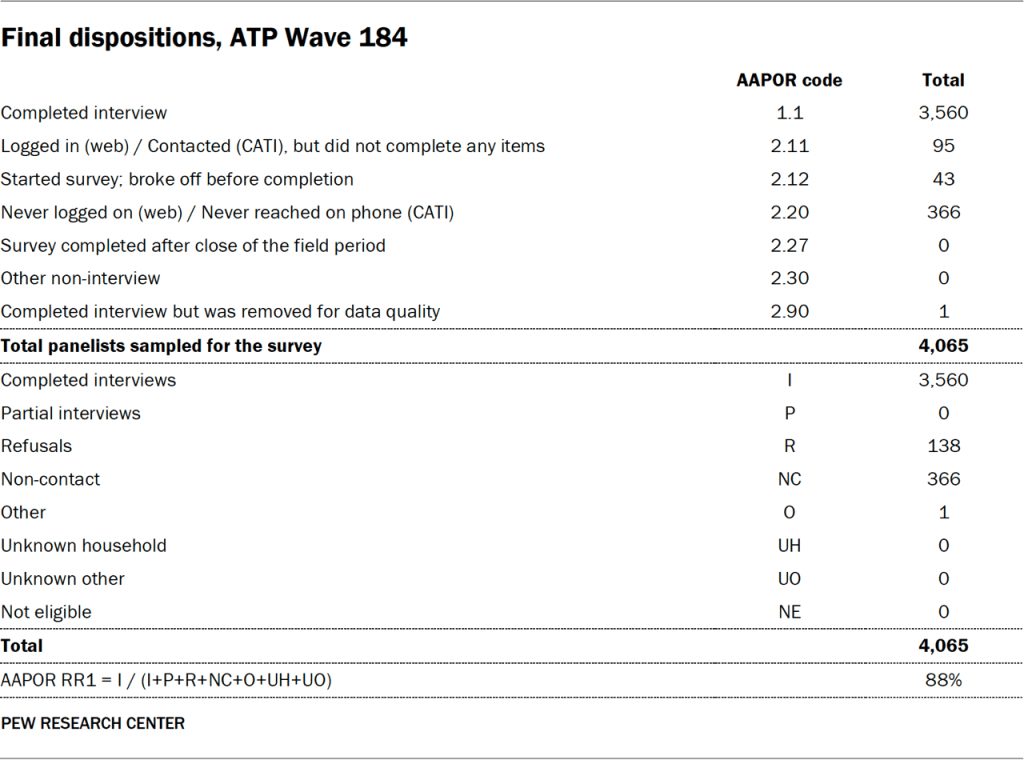
Data in this report comes from Wave 184 of the American Trends Panel (ATP), Pew Research Center’s nationally representative panel of randomly selected U.S. adults. The survey was conducted from Dec. 8 to Dec. 14, 2025. A total of 3,560 panelists responded out of 4,065 who were sampled, for a survey-level response rate of 88%.
The cumulative response rate accounting for nonresponse to the recruitment surveys and attrition is 3%. The break-off rate among panelists who logged on to the survey and completed at least one item is 1%. The margin of sampling error for the full sample of 3,560 respondents is plus or minus 1.8 percentage points.
The survey includes an oversample of non-Hispanic Asian adults in order to provide more precise estimates of the opinions and experiences of this smaller demographic subgroup. Oversampled groups are weighted back to reflect their correct proportions in the population.
SSRS conducted the survey for Pew Research Center via online (n=3,417) and live telephone (n=143) interviewing. Interviews were conducted in both English and Spanish.
To learn more about the ATP, read “About the American Trends Panel.”
Panel recruitment
Since 2018, the ATP has used address-based sampling (ABS) for recruitment. A study cover letter and a pre-incentive are mailed to a stratified, random sample of households selected from the U.S. Postal Service’s Computerized Delivery Sequence File. This Postal Service file has been estimated to cover 90% to 98% of the population.1 Within each sampled household, the adult with the next birthday is selected to participate. Other details of the ABS recruitment protocol have changed over time but are available upon request.2 Prior to 2018, the ATP was recruited using landline and cellphone random-digit-dial surveys administered in English and Spanish.
A national sample of U.S. adults has been recruited to the ATP approximately once per year since 2014. In some years, the recruitment has included additional efforts (known as an “oversample”) to improve the accuracy of data for underrepresented groups. For example, Hispanic adults, Black adults and Asian adults were oversampled in 2019, 2022 and 2023, respectively.
Sample design
The overall target population for this survey was noninstitutionalized persons ages 18 and older living in the United States. It featured a stratified random sample from the ATP in which non-Hispanic Asian adults were selected with certainty. The remaining panelists were sampled at rates designed to ensure that the share of respondents in each stratum is proportional to its share of the U.S. adult population to the greatest extent possible. Respondent weights are adjusted to account for differential probabilities of selection as described in the Weighting section below.
Questionnaire development and testing
The questionnaire was developed by Pew Research Center in consultation with SSRS. The web program used for online respondents was rigorously tested on both PC and mobile devices by the SSRS project team and Pew Research Center researchers. The SSRS project team also populated test data that was analyzed in SPSS to ensure the logic and randomizations were working as intended before launching the survey.
Incentives
All respondents were offered a post-paid incentive for their participation. Respondents could choose to receive the post-paid incentive in the form of a check or gift code to Amazon.com, Target.com or Walmart.com. Incentive amounts ranged from $5 to $20 depending on whether the respondent belongs to a part of the population that is harder or easier to reach. Differential incentive amounts were designed to increase panel survey participation among groups that traditionally have low survey response propensities.
Data collection protocol
The data collection field period for this survey was Dec. 8 to Dec. 14, 2024. Surveys were conducted via self-administered web survey or by live telephone interviewing.
For panelists who take surveys online:3 Postcard notifications were mailed to a subset on Dec. 8.4 Survey invitations were sent out in two separate launches: soft launch and full launch. Sixty panelists were included in the soft launch, which began with an initial invitation sent on Dec. 8. All remaining English- and Spanish-speaking sampled online panelists were included in the full launch and were sent an invitation on Dec. 9.
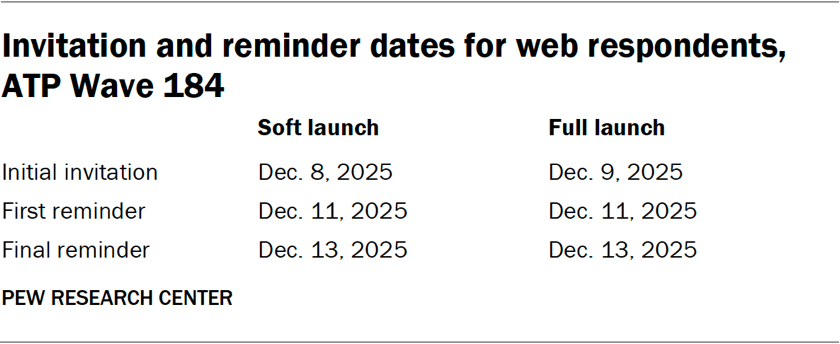
Panelists participating online were sent an email invitation and up to two email reminders if they did not respond to the survey. ATP panelists who consented to SMS messages were sent an SMS invitation with a link to the survey and up to two SMS reminders.
For panelists who take surveys over the phone with a live interviewer: Prenotification postcards were mailed on Dec. 5. Soft launch took place on Dec. 8 and involved dialing until a total of six interviews had been completed. All remaining English- and Spanish-speaking sampled phone panelists’ numbers were dialed throughout the remaining field period. Panelists who take surveys via phone can receive up to six calls from trained SSRS interviewers.
Data quality checks
To ensure high-quality data, Center researchers performed data quality checks to identify any respondents showing patterns of satisficing. This includes checking for whether respondents left questions blank at very high rates or always selected the first or last answer presented. As a result of this checking, one ATP respondent was removed from the survey dataset prior to weighting and analysis.
Weighting
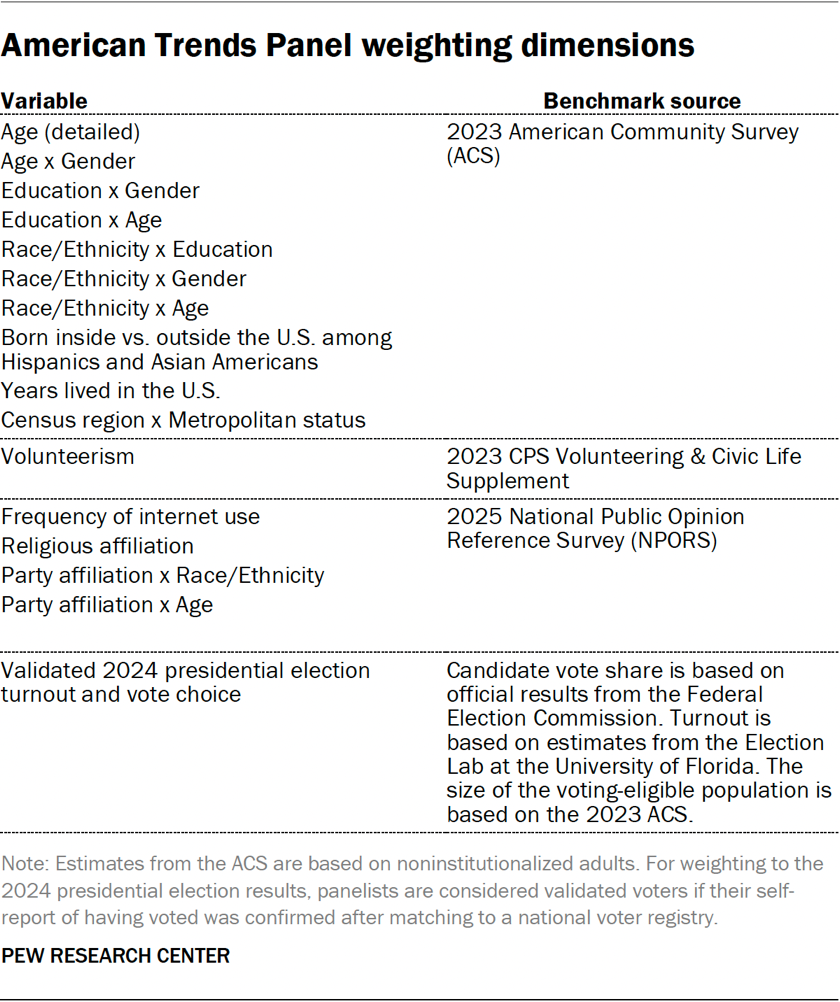
The ATP data is weighted in a process that accounts for multiple stages of sampling and nonresponse that occur at different points in the panel survey process. First, each panelist begins with a base weight that reflects their probability of recruitment into the panel. These weights are then calibrated to align with the population benchmarks in the accompanying table to correct for nonresponse to recruitment surveys and panel attrition. If only a subsample of panelists was invited to participate in the wave, this weight is adjusted to account for any differential probabilities of selection.
Among the panelists who completed the survey, this weight is then calibrated again to align with the population benchmarks identified in the accompanying table and trimmed at the 1st and 99th percentiles to reduce the loss in precision stemming from variance in the weights. Sampling errors and tests of statistical significance take into account the effect of weighting.
The following table shows the unweighted sample sizes and the error attributable to sampling that would be expected at the 95% level of confidence for different groups in the survey.
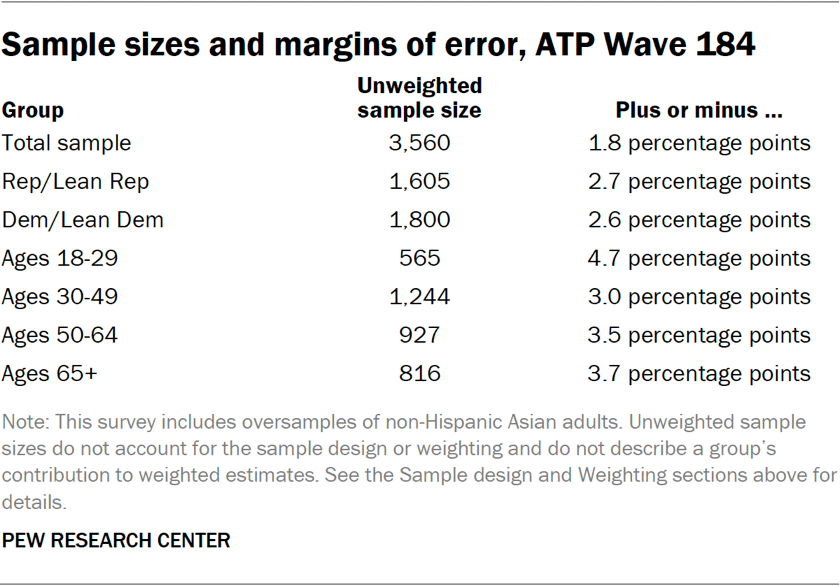
Sample sizes and sampling errors for other subgroups are available upon request. In addition to sampling error, one should bear in mind that question wording and practical difficulties in conducting surveys can introduce error or bias into the findings of opinion polls.
Dispositions and response rates

How family income tiers are calculated
Family income data reported in this study is adjusted for household size and cost-of-living differences by geography. Panelists then are assigned to income tiers that are based on the median adjusted family income of all American Trends Panel members. The process uses the following steps:
- First, panelists are assigned to the midpoint of the income range they selected in a family income question that was measured on either the most recent annual profile survey or, for newly recruited panelists, their recruitment survey. This provides an approximate income value that can be used in calculations for the adjustment.
- Next, these income values are adjusted for the cost of living in the geographic area where the panelist lives. This is calculated using price indexes published by the U.S. Bureau of Economic Analysis. These indexes, known as Regional Price Parities (RPP), compare the prices of goods and services across all U.S. metropolitan statistical areas as well as non-metro areas with the national average prices for the same goods and services. The most recent available data at the time of the annual profile survey is from 2023. Those who fall outside of metropolitan statistical areas are assigned the overall RPP for their state’s non-metropolitan area.
- Family incomes are further adjusted for the number of people in a household using the methodology from Pew Research Center’s previous work on the American middle class. This is done because a four-person household with an income of say, $50,000, faces a tighter budget constraint than a two-person household with the same income.
- Panelists are then assigned an income tier. “Middle-income” adults are in families with adjusted family incomes that are between two-thirds and double the median adjusted family income for the full ATP at the time of the most recent annual profile survey. The median adjusted family income for the panel is roughly $77,800. Using this median income, the middle-income range is about $51,900 to $155,600. Lower-income families have adjusted incomes less than $51,900 and upper-income families have adjusted incomes greater than $155,600 (all figures expressed in 2024 dollars and scaled to a household size of three). A panelist is assigned “no answer” in the income tier variable if they did not provide all three pieces of information needed to calculate their tier (family income, household size and residential address).
Two examples of how a given area’s cost-of-living adjustment was calculated are as follows: the Pine Bluff metropolitan area in Arkansas is a relatively inexpensive area, with a price level that is 19.7% less than the national average. The San Francisco-Oakland-Berkeley metropolitan area in California is one of the most expensive areas, with a price level that is 18.2% higher than the national average. Income in the sample is adjusted to make up for this difference. As a result, a family with an income of $40,200 in the Pine Bluff area is as well off financially as a family of the same size with an income of $59,100 in San Francisco.
Focus groups
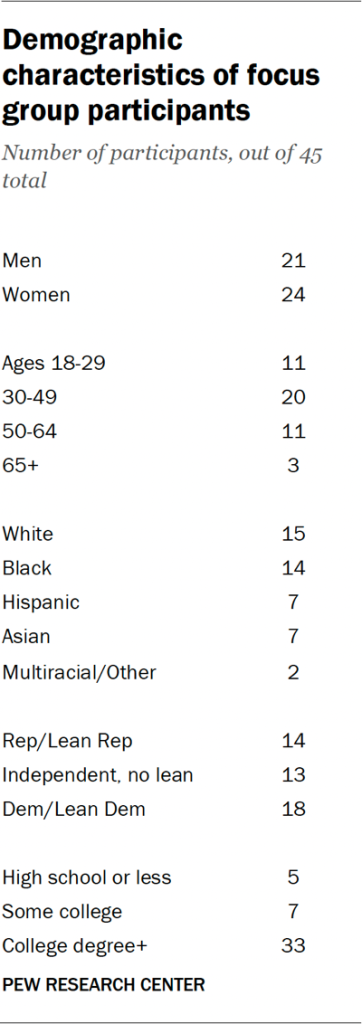
Pew Research Center worked with PSB Insights to conduct nine 90-minute online focus groups with 45 U.S. adults from June 10 to June 18, 2025. These discussions are not nationally representative. This report includes findings and quotes from the second half of these focus groups to help illustrate and add nuance to the survey findings.
Recruitment
PSB Insights recruited participants using quotas for gender, age, party affiliation, education, race and ethnicity, self-reported news engagement level and primary medium of news consumption. All participants had to be 18 years of age or older (19 or older if living in Alabama or Nebraska and 21 or older if living in Mississippi), live in the U.S., and have access to a computer or mobile device with high-speed internet access and a working webcam.
Eligible participants had to be willing and able to contribute to the research, complete an online pre-session activity, attend the focus group on the set date and time, and sign an informed consent form before they could participate. This included agreement that all responses could be used in research reports, though participants’ names and identifying information would remain private and not be used in any reports.
For each focus group, seven participants were recruited and five were selected to participate. The research team overrecruited participants to account for “no-shows,” as well as participants who may experience other issues preventing participation. Each participant was offered a $225 incentive.
The first six focus groups were organized by political affiliation (Republicans, Democrats and independents) and primary news source (traditional or nontraditional) to capture a range of perspectives. Traditional news sources included television, radio, print publications, and news websites or apps noted as a participant’s primary source of news. Nontraditional sources included social media, search engines, podcasts, online forums and email newsletters noted as a participant’s primary source of news.
Additional focus groups were conducted with adults ages 18 to 29, adults 50 and older, and those who reported low levels of news use.
Online pre-session activity
Before each focus group, participants completed an online pre-session activity with both written and video questions. This helped guide the group discussions and introduced participants to the general topic before the focus group began.
Discussion
The Pew Research Center and PSB Insights research teams developed the discussion guide through an iterative process. After the first focus group, the teams made minor changes, including cutting some questions and adjusting the wording of others to better explore key topics.
After the moderator set ground rules and participants introduced themselves, each focus group discussed a range of topics related to their experiences with news. This analysis focused on participants’ personal approaches to getting news, including why they follow it, how their news habits have changed over time, what they see as “good” news habits, barriers to following the news, how they verify and share news, the role of media literacy, and views about paying for news.
Analysis
All human-generated transcripts were analyzed and coded by the Pew Research Center research team using ATLAS.ti, a qualitative data analysis software program.
Two members of the research team wrote analytical memos while observing each focus group, noting similarities and differences across participants and linking individual experiences to broader themes. In addition, two coders separately analyzed each focus group transcript in ATLAS.ti using a codebook that was developed before analysis, based on the survey findings, and refined during analysis as new themes emerged from participants’ responses. After coding was completed, the research team brought together key findings and selected quotes.
This process allowed the team to identify major patterns in the data and to organize and categorize relevant quotes, including linking them to participants’ demographic characteristics. Multiple members of the research team observed and analyzed the focus groups to ensure that the findings accurately reflect the full range of participants’ views and experiences.
Reporting
This report includes selected quotes from participants. Quotes were lightly edited by Pew Research Center staff for spelling, punctuation and clarity.