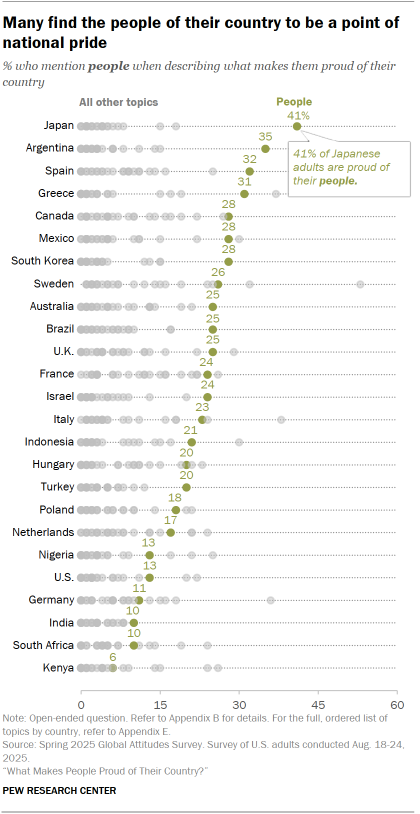
We asked more than 30,000 adults across 25 countries to share, in their own words, what makes them proud of their country. For many, the question is not just about what evokes national pride, but rather who. In nearly every country surveyed, people are one of the most common topics mentioned.
In the sections below we’ll explore pride in the following:
- The people in their country, whether it’s their characteristics or the unity that they feel.
- The diversity in their country, including variety in religion, ethnicity, race and more.
- Their personal identity as someone born in or otherwise tied to the country.
For more on other sources of pride, read “What Makes People Proud of Their Country?” or specific analyses about pride in culture, politics and the economy, and those who say they are not proud. For the full, ordered list of topics by country, refer to the detailed tables in Appendix E.
How people describe pride in their country’s diversity and people
Canadians and Indonesians are the most likely to point to their country’s multicultural society as a source of national pride, with roughly three-in-ten in each country saying this.
“Nigeria is incredibly diverse with hundreds of ethnic groups and language. This rich tapestry of cultures [creates] a vibrant and dynamic society.”
– Woman, 19, Nigeria
In Indonesia, respondents mention the diversity of their society more than any other topic, pointing to the variety of religions, cultures, languages and ethnicities living together in harmony. Some explicitly mention the official national motto, “Bhinneka Tunggal Ika,” meaning “Unity in Diversity.” One Indonesian man said, “Indonesia has many tribes, although they are different, but they are still one Indonesia.”
Canadians instead describe their society as a multicultural “mosaic.” One Canadian man said, “It’s a country that allows various cultures, they are allowed to exist and remain unassimilated, instead of being a melting pot.” In South Africa, many refer to the country as a “rainbow nation,” describing the diverse array of cultures, languages and races present as a point of pride. South Africans also commonly refer to the concept of ubuntu, a philosophy emphasizing the interconnectedness of individuals.
Many refer not only to the presence of different types of people in their country, but also to the tolerance exhibited by the people. One Swedish man said that “the people are peaceful and we have quite a few religious communities. People accept differences here. Everyone can be themselves here.”
Similarly, when describing why people in their country make them proud, many emphasize solidarity and unity, like one Argentine man who said his pride in Argentina comes from “the people, because in spite of all the difficulties the country is going through, the people continue to have hope.” Indeed, in Argentina, people are the top sources of pride in the country.
In Australia, respondents refer specifically to the concept of “mateship,” including one woman who said she is proud of “mateship and community spirit: Australians are known for their friendliness, resilience, and willingness to help each other, especially in tough times.”
Some mention persistence and resilience as reasons to be proud of the people in their country, such as one American woman who said she was proud of “the people trying to make things better, even though everything is against it.” And one Greek woman said, “I am proud of the young people who do not give up and want to change things, even though we are paying for many mistakes of the previous generation.”
“Everything. … How we are as people, our kindness, our empathy with others, our patriotism, all the diversity that exists in the country.”
– Woman, 43, Mexico
Many across countries are also proud of the patriotism exhibited by the people of their country. This sentiment is common in Turkey, such as one man who referenced “the presence of people who love their country” as a source of pride.
Not all mentions of diversity and people are favorable in nature, though. Some express negative attitudes toward the presence of various identities in their country. For example, although 16% in the United Kingdom point to diversity as a point of national pride, others are critical of the cultural and economic changes they see brought about by immigration. For more on what makes people not feel proud, jump to “Where, and why, people aren’t proud of their country.”
In a few places, others instead point to their country’s homogeneity or lack of diversity as a point of national pride. As one South Korean man noted, he is proud “because it is a nation comprised of a single ethnic group, we have a national character that allows us to unite and wisely overcome difficult problems that arise.”
In some of the countries where diversity is more frequently mentioned, it is those on the ideological left who are more likely to include the topic in their response. For example, over a third of Canadians on the left include diversity as a point of pride in their country, compared with about two-in-ten among those on the right who also mention diversity. A similar pattern exists in Australia, Brazil, the Netherlands, Sweden, the U.K. and the United States.
Ancestry, roots and heritage are another source of pride
“Because I am Polish, this is my nation, my homeland, here I was born and raised … here I have my roots, my grandparents, great-grandparents. Polish blood flows in my veins … wherever I am in the world, I am not ashamed of my Polishness.”
– Woman, 59, Poland
In some places, people point to their own identity as a source of pride: having been born in the country, having ancestors from that country or just generally “being” the nationality.
Many describe their country as their homeland or motherland ordiscuss familial or ancestral ties to the country, with one Mexican woman saying she is “proud that my parents are from here.”
In over half the countries surveyed, adults 50 and older were more likely than their youngest counterparts to mention their national identity when describing what makes them proud of their country. For example, in Poland, those 50 and older are 18 percentage points more likely than adults under 35 to mention their identity as a source of pride in their country.
What specific characteristics of people are a source of pride?
Among the many who point to the people of their country as a source of pride, some mention more particular values and skills of the citizenry. For example:
- In Japan, where 41% mention the Japanese people as a source of pride in their country, people mention traits such as respectfulness, modesty, honesty and diligence. One Japanese man said, “Japanese people are known worldwide for their honesty, integrity, resilience and perseverance.”
- Some Brazilians find pride in things like “the love of Brazilians … the empathy that we have for each other, the ability to put ourselves in other people’s shoes.” Brazilians also mention people as a source of pride more than any other topic.
- In Greece, where the country’s people are among the most frequently mentioned sources of pride, some describe their fellow Greeks as “open-hearted.” Others speak to their “hospitality and goodwill.”
- In South Korea – another country where the people are the most common source of pride – people are proud of their hardworking citizenry, with one South Korean man referencing a “diligent and sincere workforce.”
For more on how people across countries uniquely find pride in their own country, jump to “What Makes People Proud of Their Country?”