In a survey of more than 30,000 adults across 25 countries in 2025, we asked respondents to explain, in their own words, “What makes you feel proud of your country?”
However, plenty of people say they are not proud of their country. And many of them share specific reasons why. These range from “dishonest politicians” to “rising taxes” to the sense that “people are very unfriendly and rude.”
In the sections below, we’ll explore who is most likely to say they are not proud, and why. For more on what does make people feel proud in each country, read “What Makes People Proud of Their Country?” or specific analyses about pride in culture, politics and the economy, or people.
Where are people most likely to not feel proud of their country?
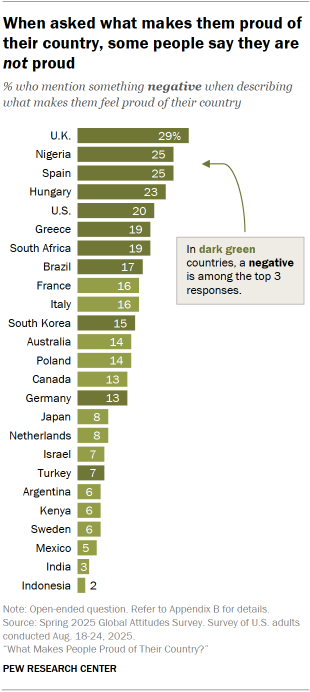
In the United Kingdom, Nigeria, Spain, Hungary and the United States, at least two-in-ten say they are not proud of their country when asked about national pride. And in 11 nations, this is among the most common responses given. For instance:
- In the U.K., people are about as likely to say they are not proud of the country (29%) as to say they are proud of the British people (25%).
- In the U.S., 22% say they are proud of the freedom in their country, while 20% say they are not proud of the country.
- Brazilians are most proud of their people (25%), but they are as likely to say they are not proud as they are to mention their country’s geography (17% each).
- For the full, ordered list of topics by country, refer to the detailed tables in Appendix E.
Related: 6 facts about national pride in the U.S.
Who is most likely to not feel proud of their country?
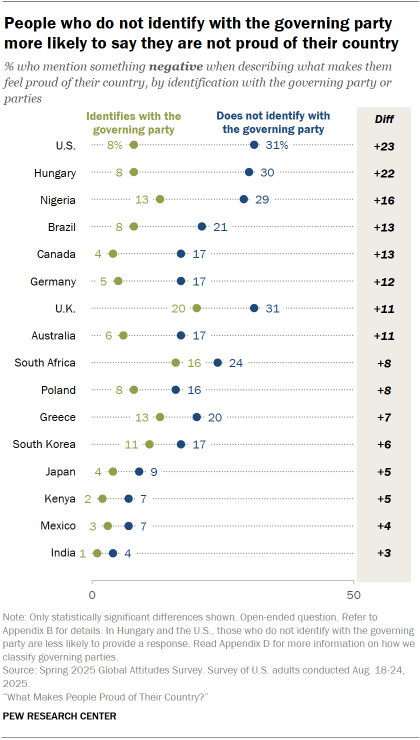
In many countries, the people who do not feel proud tend to be those who do not identify with the governing party or parties. This aligns with the political nature of many of the criticisms raised by people who say they aren’t proud. This is also consistent with our findings that governing party supporters are more satisfied with their democracies and pleased with their economies.
For example, Hungarians who do not feel close to Prime Minister Viktor Orban’s Fidesz party (or their coalition partner KDNP) are 22 percentage points more likely than those who do to say they are not proud.
In a handful of countries, older adults – those 50 and older – give negative responses more often than their younger counterparts (ages 18 to 34). This is the case in Canada, France, Hungary, Mexico, the Netherlands, Spain, Sweden and the U.K. (In Hungary, older adults are also more likely to offer any response.)
Why aren’t people proud of their country?
For many, there is simply “nothing” about their country to be proud of. But some people in each country surveyed detail specific reasons they are not proud. The following are common themes across countries:
Current leadership | Democratic backsliding | The economy and jobs | Immigration | International affairs
Current leadership
“I am not proud at all, especially of the current leaders of this country. I am thinking of the 130 ‘brave’ people who sit in the Hungarian parliament. They fatten their livers. They have the 3-4 million HUF [Hungarian forint] earnings and don’t give a damn about pensioners.”
– Man, 76, Hungary
For some who are not proud of their country, the current government leadership is the root of the problem. One American man said he is not proud of “a lot right now, with [Donald] Trump in office.” In France, one man asked for President Emmanuel Macron “to think before he speaks.” A young Nigerian man said he is not proud “because our leaders have messed the entire country up.”
People’s dissatisfaction with the people and parties in power is not a new finding in our research. In 2023, we asked another open-ended question – “What do you think would help improve the way democracy in your country is working?” – and the clear top answer across countries was better or different politicians.
Democratic backsliding
“We’ve got a democracy that’s not working well, a democracy that’s not respected, public services that are getting worse with time, a democracy that’s become a plutocracy.”
– Man, 60, France
Some people question or criticize their government system more than its leadership. This is especially common in high-income countries in Europe and North America. Said simply by one German man: “The democracy that exists is a disaster.” Another man in Canada said, “The only problem about Canada now is that it is not really a democracy. There is no freedom of speech, it’s either their way or no way. We can become a dictatorship.”
More specifically, people in several countries point to corruption in politics as the reason they are not proud. One American woman said the “government will always be corrupt.”
The economy and jobs
In many countries, people do not feel proud due to the state of their economy. This includes frustrations with wages, the price of goods, debt and other economic issues:
- “Inflation is high.” – Man, 22, India
- “It’s depressing knowing I won’t be able to afford my own house one day because prices will keep going up.” – Woman, 25, U.S.
- “The debt policy is disastrous.” – Man, 50, Germany
- “I don’t like the rise in taxes that will make poor people suffer.” – Woman, 52, South Africa
- “I see the forint [Hungary’s currency] losing its purchasing power.” – Man, 63, Hungary
- “The economy is in a bad place; renewal electricity policy is making it unaffordable.” – Man, 75, Australia
- “Nothing because the economy isn’t good. … Wages are low, things are very expensive.” – Man, 22, Brazil
“Everything is so bad, they left us in need of bread on charity shelves, the rents are so high, the economy is terrible, unemployment is very high.”
– Man, 51, Turkey
People in several countries also struggle to feel proud due to the lack of jobs and the associated economic hardships. Said one South African man: “I have lost all hope on the government of South Africa. We are parents, there are no jobs. The R350 grant [a social grant for the unemployed] is not enough, even the children can’t use school transport because the money is not enough.”
Immigration
“The Australian values we developed over generations have been eroded by poor immigration policies and weak politicians too scared to offend minority groups. It is now considered racist to advocate for old Australian values.”
– Man, 50, Australia
Some people say they are not proud because of immigration trends, policies and outcomes. One Swedish man said, “I am proud of everything in Sweden except immigration.” A young woman in Turkey said, “There is only one thing about my country that I’m not proud of, and that is accepting too many refugees from foreign countries.”
Others feel their country should be more welcoming to immigrants. Said one Briton, “Our commitment to immigration is really lacking at the moment.” Still, diversity and multiculturalism is a relatively common source of pride for people in the U.K., especially those on the ideological left (23% vs. 11% on the right). Some Americans share criticisms of the “persecution” of immigrants, citing “detention centers” and “people being disappeared.” Similarly, diversity is a more of a source of pride for Americans on the left than the right (11% vs. 4%).
International affairs
In several countries, people are not proud of their country’s international standing. For example, in Japan, some people are displeased with how easily their country can be “swept away” on the world stage.
“I am not happy about how the country is governed, [the] EU is prioritized over the nation state, and Sweden is giving up its sovereignty in favor of the EU federation.”
– Man, 32, Sweden
Some are displeased with their relationship with other countries, especially those in current conflicts. A German man said, “If we support Ukraine, then I will be proud.” Said one Swedish woman, “I was proud when [Sweden] was independent, but not now, when they have joined NATO.” An American man said, “We should be condemning Israel but we don’t.”
As for Israelis, there is a stark difference in pride between Jews and Arabs. Though they are significantly less likely to answer the question, Israeli Arabs are 18 points more likely to say they are not proud of their country than Israeli Jews. One Arab said she is not proud because Israel “occupies another people.”