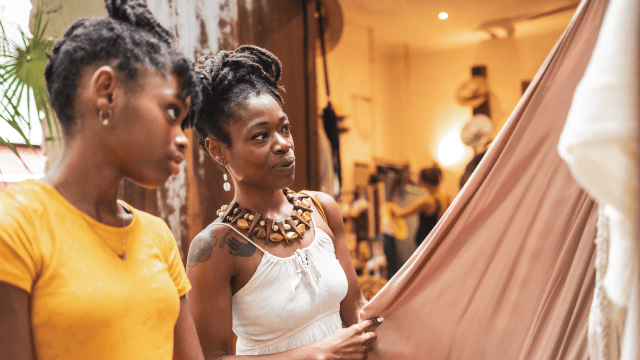
Black Americans say they learn what it means to be a Black man or Black woman mainly from the people closest to them. Mothers play the largest role, followed by other personal connections, according to a Pew Research Center survey from June 2025.
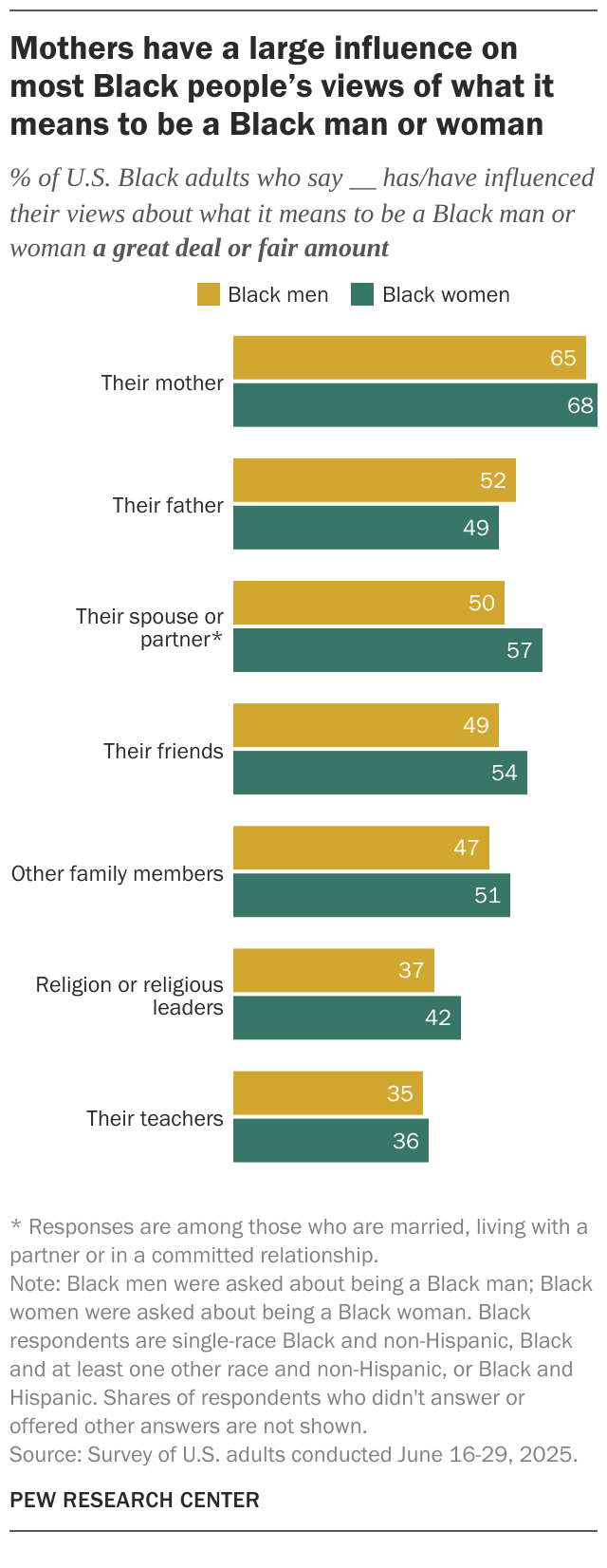
Note: Black men were asked about being a Black man; Black women were asked about being a Black woman. Black respondents are single-race Black and non-Hispanic, Black and at least one other race and non-Hispanic, or Black and Hispanic. Shares of respondents who didn’t answer or offered other answers are not shown.
| Black men | Black women | |
|---|---|---|
| Their mother | 65 | 68 |
| Their father | 52 | 49 |
| Their spouse or partner* | 50 | 57 |
| Their friends | 49 | 54 |
| Other family members | 47 | 51 |
| Religion or religious leaders | 37 | 42 |
| Their teachers | 35 | 36 |
Note: Black men were asked about being a Black man; Black women were asked about being a Black woman. Black respondents are single-race Black and non-Hispanic, Black and at least one other race and non-Hispanic, or Black and Hispanic. Shares of respondents who didn’t answer or offered other answers are not shown.
Roughly two-thirds of Black men (65%) say their mother has influenced their views about what it means to be a Black man a great deal or a fair amount. And 68% of Black women say the same about their views of being a Black woman.
About half or more of Black men and Black women say their father, spouse or partner, friends, and other family members have shaped their views.
Smaller shares say community members like religious leaders or teachers have influenced them.
In total, 79% of Black men and 83% of Black women say at least one of these connections has influenced them a great deal or a fair amount.
Do different media types shape views about being a Black man or a Black woman?
Black adults tend to be less likely to say different kinds of media have influenced their views about being a Black man or woman than to say this about the people in their lives.

| Black men | Black women | |
|---|---|---|
| Entertainment media (such as television, movies, music, etc.) | 36 | 39 |
| Social media (such as Facebook, Instagram, TikTok, YouTube, etc.) | 24 | 31 |
| Podcasts | 16 | 18 |
- 36% of Black men and 39% of Black women say entertainment media (like TV, movies or music) have influenced their views of what it means to be a Black man or woman a great deal or a fair amount.
- Smaller shares say the same about social media: 24% of Black men and 31% of Black women say platforms such as Facebook, Instagram, TikTok and YouTube have influenced how they view being a Black man or woman.
- Fewer still say this of podcasts: 16% of Black men and 18% of Black women cite podcasts as a large influence on their views.
Overall, 43% of Black men and 46% of Black women say at least one of these kinds of media have influenced them a great deal or a fair amount.
Younger Black adults are more likely than their older counterparts to say these forms of media have influenced their views, especially social media. This reflects younger adults’ greater use of social media in general.
- 29% of Black men under 50 say social media platforms have had a great deal or fair amount of influence for them on what it means to be a Black man. That compares with 17% of those ages 50 and older.
- The gap is even larger among Black women: 41% of those under 50 say social media platforms have had a large influence for them on what it means to be a Black woman, compared with 16% of those 50 and older.
What have Black adults learned about being a Black man or woman from their relationships?
In an open-ended question, we asked Black adults to describe the most important thing they learned about being a Black man or woman from the people who influenced them.
Respondents mentioned a wide range of topics. Some wrote about values, character, self-confidence, resilience, or pride in Black identity or culture. Others mentioned experiences of discrimination, stereotypes or unequal treatment.
Here’s what some Black men say are the most important things they learned about being a Black man from those who influenced their views:
Here are responses from Black women about the most important thing they learned about being a Black woman from those who influenced their views:
Note: Here are our survey questions, the detailed responses and the survey methodology.
Detailed tables
The tables below provide additional information about the people or media that have influenced Black adults’ views of their identities.
| Their mother | Their father | Their spouse or partner* | Their friends | Other family members | Religion or religious leaders | Their teachers | |
|---|---|---|---|---|---|---|---|
| Total | |||||||
| All Black men | 65 | 52 | 50 | 49 | 47 | 37 | 35 |
| Age | |||||||
| 18-49 | 63 | 52 | 46 | 47 | 44 | 34 | 32 |
| 50+ | 67 | 53 | 55 | 52 | 51 | 42 | 40 |
| Educational attainment | |||||||
| HS or less | 65 | 51 | 55 | 48 | 47 | 40 | 37 |
| Some college | 66 | 53 | 47 | 49 | 47 | 37 | 34 |
| Bachelor’s+ | 64 | 54 | 50 | 52 | 48 | 34 | 34 |
| Income | |||||||
| Lower income | 64 | 50 | 52 | 47 | 43 | 38 | 37 |
| Middle income | 64 | 54 | 49 | 51 | 50 | 36 | 31 |
| Upper income | 71 | 56 | ** | 56 | 52 | 36 | 37 |
| Partisanship | |||||||
| Rep/Lean Rep | 57 | 51 | ** | 42 | 44 | 32 | 28 |
| Dem/Lean Dem | 68 | 53 | 54 | 53 | 48 | 40 | 38 |
| Religion | |||||||
| Christian | 69 | 58 | 53 | 55 | 50 | 45 | 41 |
| Unaffiliated | 59 | 43 | 42 | 40 | 42 | 23 | 22 |
| Community type | |||||||
| Urban | 63 | 52 | 53 | 48 | 46 | 37 | 39 |
| Suburban | 65 | 51 | 49 | 53 | 48 | 36 | 31 |
| Rural | ** | ** | ** | ** | ** | ** | ** |
| Among Black men who say being Black is … | |||||||
| Extremely/Very important | 75 | 60 | 60 | 60 | 56 | 45 | 44 |
| Less important | 41 | 33 | 22 | 25 | 25 | 19 | 13 |
** Results are not shown due to small sample sizes.
Note: Results for other religious affiliations are not shown due to small sample size. Black respondents are single-race Black and non-Hispanic, Black and at least one other race and non-Hispanic, or Black and Hispanic. “Some college” includes those with an associate degree and those who attended college but did not obtain a degree. Family income tiers are based on adjusted 2024 earnings. Shares of respondents who didn’t answer are not shown.
| Their mother | Their father | Their spouse or partner* | Their friends | Other family members | Religion or religious leaders | Their teachers | |
|---|---|---|---|---|---|---|---|
| Total | |||||||
| All Black women | 68 | 49 | 57 | 54 | 51 | 42 | 36 |
| Age | |||||||
| 18-49 | 66 | 48 | 55 | 53 | 49 | 38 | 35 |
| 50+ | 70 | 52 | 62 | 55 | 55 | 48 | 37 |
| Educational attainment | |||||||
| HS or less | 67 | 49 | 61 | 52 | 49 | 45 | 39 |
| Some college | 70 | 52 | 57 | 55 | 55 | 42 | 36 |
| Bachelor’s+ | 66 | 47 | 53 | 53 | 49 | 37 | 32 |
| Income | |||||||
| Lower income | 70 | 51 | 61 | 54 | 52 | 45 | 38 |
| Middle income | 65 | 46 | 52 | 53 | 49 | 38 | 33 |
| Upper income | 74 | 56 | 59 | 59 | 54 | 34 | 36 |
| Partisanship | |||||||
| Rep/Lean Rep | 57 | 44 | 53 | 45 | 43 | 38 | 33 |
| Dem/Lean Dem | 71 | 51 | 60 | 57 | 54 | 43 | 37 |
| Religion | |||||||
| Christian | 71 | 51 | 59 | 56 | 53 | 47 | 36 |
| Unaffiliated | 60 | 46 | 52 | 47 | 48 | 27 | 32 |
| Community type | |||||||
| Urban | 70 | 51 | 58 | 58 | 57 | 43 | 37 |
| Suburban | 68 | 50 | 55 | 53 | 48 | 40 | 34 |
| Rural | 64 | 47 | 60 | 48 | 48 | 46 | 39 |
| Among Black women who say being Black is … | |||||||
| Extremely/Very important | 76 | 54 | 65 | 61 | 58 | 47 | 41 |
| Less important | 41 | 32 | 28 | 27 | 25 | 25 | 19 |
Note: Results for other religious affiliations are not shown due to small sample size. Black respondents are single-race Black and non-Hispanic, Black and at least one other race and non-Hispanic, or Black and Hispanic. “Some college” includes those with an associate degree and those who attended college but did not obtain a degree. Family income tiers are based on adjusted 2024 earnings. Shares of respondents who didn’t answer are not shown.
| Entertainment media such as television, movies, music, etc. | Social media such as Facebook, Instagram, TikTok, YouTube, etc. | Podcasts | |
|---|---|---|---|
| Total | |||
| All Black men | 36 | 24 | 16 |
| Age | |||
| 18-49 | 39 | 29 | 19 |
| 50+ | 32 | 17 | 12 |
| Educational attainment | |||
| HS or less | 40 | 27 | 21 |
| Some college | 33 | 23 | 14 |
| Bachelor’s+ | 34 | 22 | 13 |
| Income | |||
| Lower income | 39 | 27 | 19 |
| Middle income | 34 | 21 | 15 |
| Upper income | 32 | 20 | 12 |
| Partisanship | |||
| Rep/Lean Rep | 34 | 26 | 25 |
| Dem/Lean Dem | 38 | 24 | 14 |
| Religion | |||
| Christian | 38 | 26 | 17 |
| Unaffiliated | 32 | 20 | 13 |
| Community type | |||
| Urban | 37 | 26 | 18 |
| Suburban | 33 | 21 | 13 |
| Rural | * | * | * |
| Among Black men who say being Black is … | |||
| Extremely/Very important | 43 | 27 | 20 |
| Less important | 20 | 15 | 8 |
Note: Results for other religious affiliations are not shown due to small sample size. Black respondents are single-race Black and non-Hispanic, Black and at least one other race and non-Hispanic, or Black and Hispanic. “Some college” includes those with an associate degree and those who attended college but did not obtain a degree. Family income tiers are based on adjusted 2024 earnings. Shares of respondents who didn’t answer are not shown.
| Entertainment media such as television, movies, music, etc. | Social media such as Facebook, Instagram, TikTok, YouTube, etc. | Podcasts | |
|---|---|---|---|
| Total | |||
| All Black women | 39 | 31 | 18 |
| Age | |||
| 18-49 | 44 | 41 | 23 |
| 50+ | 31 | 16 | 9 |
| Educational attainment | |||
| HS or less | 49 | 39 | 22 |
| Some college | 35 | 32 | 17 |
| Bachelor’s+ | 31 | 20 | 12 |
| Income | |||
| Lower income | 46 | 39 | 22 |
| Middle income | 31 | 24 | 13 |
| Upper income | 25 | 18 | 8 |
| Partisanship | |||
| Rep/Lean Rep | 43 | 37 | 24 |
| Dem/Lean Dem | 39 | 31 | 17 |
| Religion | |||
| Christian | 38 | 27 | 16 |
| Unaffiliated | 41 | 42 | 22 |
| Community type | |||
| Urban | 42 | 32 | 19 |
| Suburban | 35 | 30 | 16 |
| Rural | 42 | 35 | 19 |
| Among Black women who say being Black is … | |||
| Extremely/Very important | 42 | 34 | 19 |
| Less important | 27 | 24 | 12 |