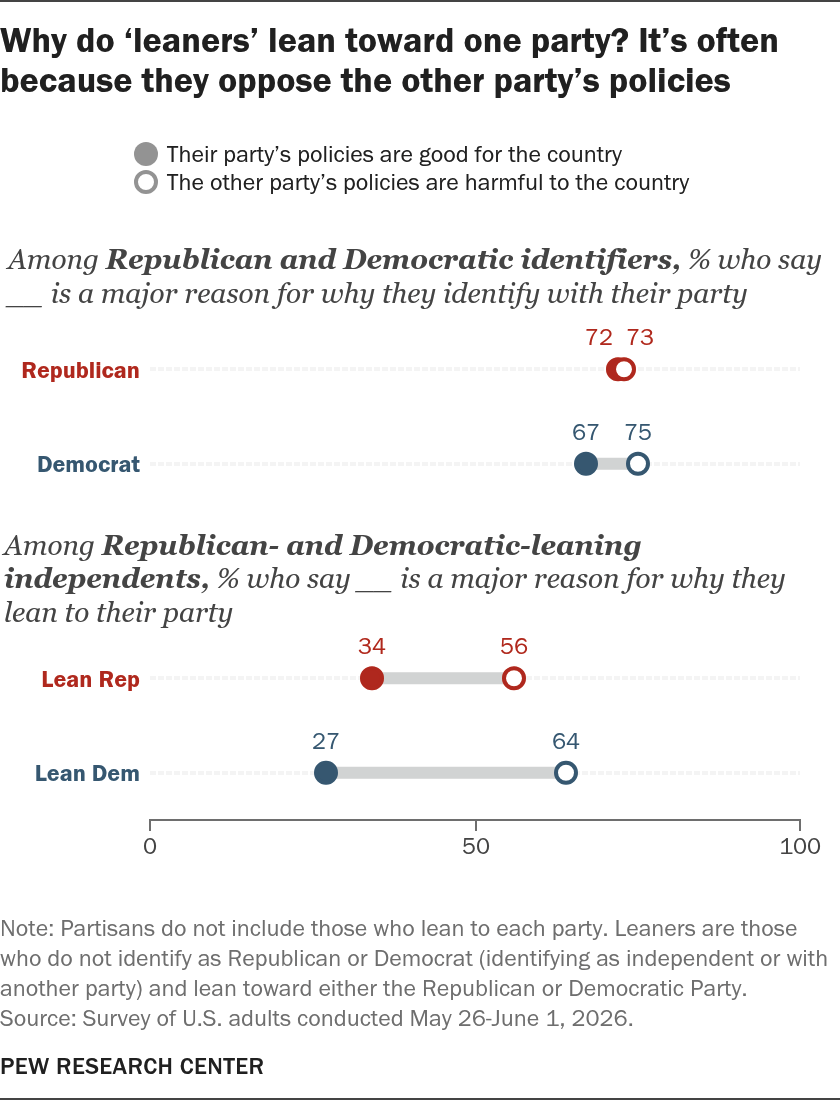
A majority of Americans consider themselves either Republicans or Democrats. Most say they identify this way because they view their own party’s policies as good for the country and the other party’s policies as harmful.
But many Americans don’t consider themselves Republicans or Democrats. Instead, these Americans identify as independents (or with some other party) and many “lean” toward one of the two major parties. For these Americans, opposition to the other party’s policies is more of a motivating factor than support for the policies of the party they lean toward.
A Pew Research Center survey of 9,750 U.S. adults, conducted from May 26 to June 1, finds:
| Group | Groupx | Group | Their party’s policies are good for the country | The other party’s policies are harmful to the country |
|---|---|---|---|---|
| Republican partisan | Partisan | Republican | 72 | 73 |
| Republican leaner | Leaner | Lean Rep | 34 | 56 |
| Democrat partisan | Partisan | Democrat | 67 | 75 |
| Democrat leaner | Leaner | Lean Dem | 27 | 64 |
- 72% of Republicans say a major reason they identify with the GOP is that its policies are good for the country. A nearly identical share (73%) say a major reason is that the Democratic Party’s policies are harmful for the country.
- Two-thirds of Democrats say a major reason they identify with the Democratic Party is that its policies are good for the country. A larger share (75%) say a major reason is that the Republican Party’s policies are bad for the country.
- Majorities of Republican leaners (56%) and Democratic leaners (64%) say a major reason they lean toward their preferred party is that the other party’s policies are harmful.
- Relatively few Republican leaners (34%) and Democratic leaners (27%) say a major reason they lean toward their preferred party is the perceived good of its policies.
The survey also highlights why leaners do not affiliate with their party. Roughly four-in-ten Republican leaners, and about the same share of Democratic leaners, point to frustration with the leadership of the party they lean toward – or disagreement on some issues – as reasons for rejecting the partisan label.
Why Republicans and Democrats identify with their party
For self-identified Republicans and Democrats, the policies of both their party and the opposite party are the leading reasons for their partisan identification. Fewer cite other factors as major reasons:
they identify with their party

they identify with their party
| Reason | Republicans | Democrats |
|---|---|---|
| The other party’s policies are bad for the country | 73 | 75 |
| My party’s policies are good for the country | 72 | 67 |
| I feel like my party sticks up for people like me | 53 | 56 |
| I have a lot in common with my party | 48 | 46 |
| Most of my friends and family are in my party | 16 | 18 |
- 53% of Republicans and 56% of Democrats say a major reason is that their party sticks up for people like them.
- 48% of Republicans and 46% of Democrats say a major factor is that they have a lot in common with other people who identify with their party.
- 16% of Republicans and 18% of Democrats say a major reason is that most of their friends and family are also party members.
Most of these figures are little changed since the last time we asked these questions in 2022. But there has been an increase in the share of Democrats who cite the harm of Republicans’ policies as a major factor – from 68% in 2022 to 75% this year.
Why independents lean to one party or the other
Majorities of leaners cite the harm of the other party’s policies as a major reason for why they choose the party they lean toward. Other reasons are far less common:
they lean toward each party

they lean toward each party
| Reason | Republican leaners | Democratic leaners |
|---|---|---|
| The other party’s policies are bad for the country | 56 | 64 |
| My party’s policies are good for the country | 34 | 27 |
| I feel like my party sticks up for people like me | 23 | 28 |
| I have a lot in common with my party | 22 | 21 |
- 34% of Republican-leaning independents and 27% of Democratic-leaning independents say a major reason is that their preferred party’s policies are good for the country.
- 23% of Republican leaners and 28% of Democratic leaners say a major reason is that the party sticks up for people like them.
- 22% of Republican leaners and 21% of Democratic leaners say a major factor is that they have a lot in common with people in that party.
Why leaners don’t join a party
As for reasons why leaners choose not to affiliate with a party fully, roughly four-in-ten leaners on each side of the partisan divide say a major reason is because they disagree with the party on some important issues. This share is up in both groups since 2022.

| Year | Lean Rep | Lean Dem | Panel |
|---|---|---|---|
| 2026 | 41 | 40 | I disagree with the party on some important issues |
| 2022 | 31 | 30 | I disagree with the party on some important issues |
| 2018 | 37 | 38 | I disagree with the party on some important issues |
| 2016 | 40 | 33 | I disagree with the party on some important issues |
| 2026 | 40 | 44 | I am frustrated with the party’s leaders |
| 2022 | 39 | 40 | I am frustrated with the party’s leaders |
| 2018 | 44 | 38 | I am frustrated with the party’s leaders |
| 2016 | 52 | 28 | I am frustrated with the party’s leaders |
| 2026 | 27 | 25 | I don’t care enough about politics to identify with a party |
| 2022 | 21 | 19 | I don’t care enough about politics to identify with a party |
| 2018 | 22 | 18 | I don’t care enough about politics to identify with a party |
| 2016 | 14 | 17 | I don’t care enough about politics to identify with a party |
About four-in-ten leaners in each partisan group also cite frustration with party leaders as a reason for not identifying fully with the party.
Among Democratic leaners, 44% now say frustration with leadership is a major reason why they don’t fully identify with the party. This is compared with 40% who said this in 2022, 38% in 2018 and 28% in the spring of 2016.
That is on par with how Republican leaners feel: 40% say their frustration with GOP leaders is a major reason they don’t consider themselves Republicans. This is little changed from 2022 and 2018, but down from 2016.
Note: Here are the questions used for this analysis, along with responses and the survey methodology.