Worries about the growth of artificial intelligence and its economic impact are more common in high-income countries than in middle-income nations, according to a recent Pew Research Center survey.
This analysis is part of a broader study on how people around the world view AI. It is based on a survey of 41,113 adults in 35 countries conducted Feb. 8-May 13, 2026. U.S. data comes from two surveys, the first of 5,119 adults conducted Feb. 17-23, and the second of 3,488 adults conducted June 22-28.
Impact on jobs
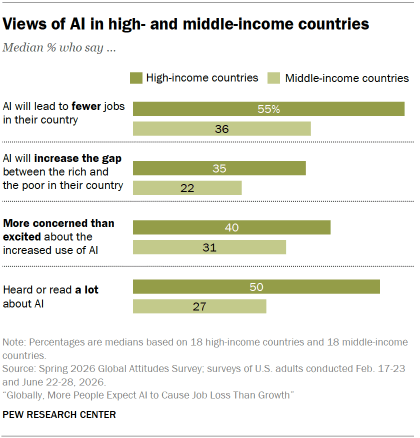
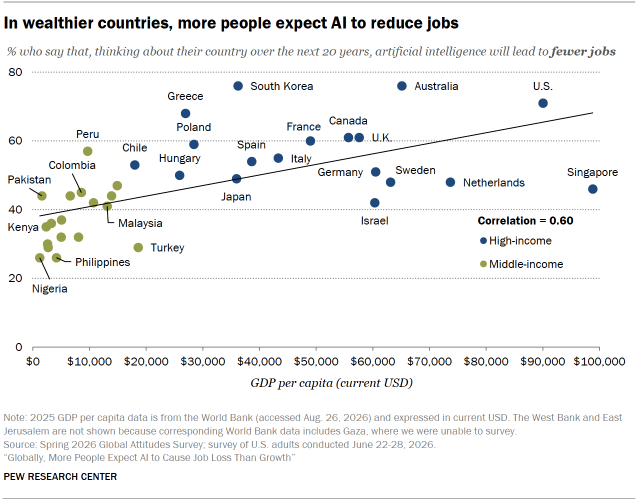
A median of 55% of adults across 18 high-income countries say AI will lead to fewer jobs in the next 20 years, compared with 36% across 18 middle-income countries (as classified by World Bank lending groups). More people in middle-income countries than high-income countries say they are not sure (34% vs. 22% medians).
This attitude and certain other views about AI – that it will increase the gap between the rich and the poor, as well as overall awareness – are generally correlated with gross domestic product per capita. The belief that AI will lead to job losses is less common in middle-income nations with the lowest GDP per capita, such as Kenya, Nigeria and the Philippines, and it’s more common in some high-income nations with relatively high GDP per capita, such as Australia and the United States (although Singapore is an outlier here).
AI and inequality
Views of AI’s role in inequality also vary between high- and middle-income countries. A median of 35% in high-income countries say AI will increase the gap between the rich and the poor, while 22% in middle-income countries say the same. For example, 46% of adults in the U.S., a high-income nation, say AI will increase the gap between the rich and poor, compared with 13% in middle-income Colombia.
Concern and excitement about AI
People in high-income and middle-income countries have somewhat different levels of concern about the increasing use of AI in daily life. A median of 40% in high-income countries say they are more concerned than excited about the technology. In middle-income countries, a median of 31% hold this view.
However, levels of excitement tend to be low worldwide: A median of 14% in high-income countries and 13% in middle-income countries are more excited than concerned about AI. Instead, many in both middle- and high-income nations say they are both concerned and excited about AI.
Rates of concern and excitement are much less closely related to GDP per capita than expectations about job loss or inequality.
Awareness of AI
People in high-income countries tend to have read or heard a lot about AI compared with people in middle-income countries (50% vs. 27% medians). For their part, people in middle-income countries are generally more likely to say they have heard nothing at all about AI relative to people in high-income countries (28% vs. 9%).
The share of adults saying they have read or heard a lot about AI has increased in seven high-income countries and four middle-income countries where trends from last year are available. People in countries with higher GDP per capita also tend to say they have heard a lot about AI relative to people in less wealthy nations.
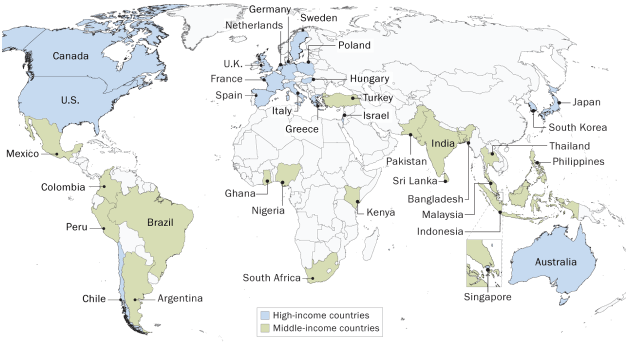
Which countries are high income and which are middle income?
For this section of the publication, we categorized 36 countries surveyed this spring as high- and middle-income countries based on World Bank classifications. The 18 high-income countries are Australia, Canada, Chile, France, Germany, Greece, Hungary, Israel, Italy, Japan, the Netherlands, Poland, Singapore, South Korea, Spain, Sweden, the U.K. and the U.S.
The 18 middle-income countries are Argentina, Bangladesh, Brazil, Colombia, Ghana, India, Indonesia, Kenya, Malaysia, Mexico, Nigeria, Pakistan, Peru, the Philippines, South Africa, Sri Lanka, Thailand and Turkey.
We also surveyed in the West Bank and East Jerusalem, which is not included in this section of the publication due to GDP data limitations.